The decomposition of a reducible representation of a group reduces it to the direct sum of irreducible representations of the group. We have shown in an earlier article that this involves decomposing a block diagonal matrix into the direct sum of its constituent square matrices. In this article, we shall derive some useful equations involving the characters of the representations of a group (see eq25, eq27a, eq29 and eq30 below).
Consider an element of a reducible representation \(\Gamma_R(1)\) that has undergone a similarity transformation to the following block diagonal matrix:
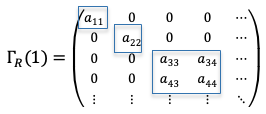
where \(a_{11}=tr[\Gamma_1(1)]\), \(a_{22}=tr[\Gamma_2(1)]\), \(a_{33}+a_{44}=tr[\Gamma_3(1)]\) and \(\Gamma_{R}(1)=\Gamma_1(1)\oplus\Gamma_2(1)\oplus\Gamma_3(1)\oplus\cdots\).
Clearly, \(tr[\Gamma_R(1)]=\sum_ktr[\Gamma_k(1)]\). Since the trace of a matrix belonging to the \(\alpha\)-th class of the \(k\)-th irreducible representation is called the character of a class \(\chi_k(\alpha)\), we have \(\chi_R(1)=\sum_ktr[\Gamma_k(1)]=\sum_k\chi_k(1)\). However, a particular constituent irreducible representation may appear more than once in the decomposition. Therefore,
$$\chi_R(\alpha)=\sum_kc_k\chi_k(\alpha)\;\;\;\;\;\;\;\;25$$
where \(c_k\) is the number of times \(\chi_k(\alpha)\) appear in the direct sum.
Multiplying eq25 by \(n_{\alpha}\chi_{k^{\prime}}^*(\alpha)\), where \(n_{\alpha}\) is the number of elements in the \(\alpha\)-th class, and sum over \(\alpha\),
$$\sum_{\alpha}n_{\alpha}\chi_{k^{\prime}}^*(\alpha)\chi_R(\alpha)=\sum_kc_k\sum_{\alpha}n_{\alpha}\chi_{k^{\prime}}^*(\alpha)\chi_k(\alpha)\;\;\;\;\;\;\;\;26$$
Substituting eq23 in eq26,
$$\sum_{\alpha}n_{\alpha}\chi_{k^{\prime}}^*(\alpha)\chi_R(\alpha)=\vert G\vert\sum_kc_k\delta_{kk^{\prime}}$$
Since \(\sum_kc_k\delta_{kk^{\prime}}=c_1\delta_{1k^{\prime}}+c_2\delta_{2k^{\prime}}+\cdots+c_{k^{\prime}}\delta_{k^{\prime}k^{\prime}}+\cdots=c_{k^{\prime}}\),
$$c_{k^{\prime}}=\frac{1}{\vert G\vert}\sum_{\alpha}n_{\alpha}\chi_{k^{\prime}}^*(\alpha)\chi_R(\alpha)\;\;\;\;\;\;\;\;27$$
Eq27 is sometimes written as a sum over the individual symmetry operations \(\beta\) rather than over the various classes:
$$c_{k^{\prime}}=\frac{1}{\vert G\vert}\sum_{\beta}\chi_{k^{\prime}}^*(\beta)\chi_R(\beta)\;\;\;\;\;\;\;\;27a$$

Question
Show that \(\sum_{\alpha}n_{\alpha}\vert\chi_R(\alpha)\vert^2=\vert G\vert\sum_kc_k^2\).
Answer
The complex conjugate of eq25, with a change of the dummy index from \(k\) to \(k^{\prime}\), is \(\chi_R^*(\alpha)=\sum_{k^{\prime}}c_{k^{\prime}}\chi_{k^{\prime}}^*(\alpha)\). Multiply this by eq25 and by \(n_{\alpha}\) and sum over \(\alpha\),
$$\sum_{\alpha}n_{\alpha}\chi_R^*(\alpha)\chi_R(\alpha)=\sum_k\sum_{k^{\prime}}c_{k^{\prime}}c_k\sum_{\alpha}n_{\alpha}\chi_{k^{\prime}}^*(\alpha)\chi_k(\alpha)$$
Swap the dummy indices of eq23 to \(\sum_{\alpha=1}^Cn_{\alpha}\chi_{k^{\prime}}^*(\alpha)\chi_k(\alpha)=\vert G\vert\delta_{k^{\prime}k}\), which when substituted in the above equation, gives
$$\sum_{\alpha}n_{\alpha}\vert\chi_R(\alpha)\vert^2=\vert G\vert\sum_k\sum_{k^{\prime}}c_{k^{\prime}}c_k\delta_{k^{\prime}k}$$
Since \(\sum_k\sum_{k^{\prime}}c_{k^{\prime}}c_k\delta_{k^{\prime}k}=\sum_k(c_1c_k\delta_{1k}+c_2c_k\delta_{2k}+\cdots+c_kc_k\delta_{kk}+\cdots )=\sum_kc_k^2\),
$$\sum_{\alpha}n_{\alpha}\vert\chi_R(\alpha)\vert^2=\vert G\vert\sum_kc_k^2\;\;\;\;\;\;\;\;28$$
With reference to eq25 and eq28, if one of the \(c_k\) is equal to 1, with the rest of the \(c_k\) equal to zero, then \(\chi_R(\alpha)\) is an irreducible representation. This implies that
$$\sum_{\alpha}n_{\alpha}\vert\chi_k(\alpha)\vert^2=\vert G\vert\;\;\;for\;an\;irreducible\;representation\;\;\;\;\;\;\;\;29$$
$$\sum_{\alpha}n_{\alpha}\vert\chi_k(\alpha)\vert^2>\vert G\vert\;\;\;for\;a\;reducible\;representation\;\;\;\;\;\;\;\;30$$
Question
Show that if two reducible representations \(\Gamma_R\) and \(\Gamma_R^{\prime}\) of a group \(G\) are equivalent, they decompose into the same direct sum of irreducible representations of \(G\).
Answer
Since \(\Gamma_R(\beta)\) and \(\Gamma_R^{\prime}(\beta)\) are related by a similarity transformation, \(tr[\Gamma_R(\beta)]=tr[\Gamma_R^{\prime}(\beta)]\) for every \(\beta\in G\). Using eq27a,
$$c_{k^{\prime}}=\frac{1}{\vert G\vert}\sum_{\beta}\chi_{k^{\prime}}^*(\beta)tr[\Gamma_R(\beta)]=\frac{1}{\vert G\vert}\sum_{\beta}\chi_{k^{\prime}}^*(\beta)tr[\Gamma_R^{\prime}(\beta)]$$