Parts per million (ppm) is a unit of concentration that expresses the amount of a specific substance present in one million parts of a total mixture.
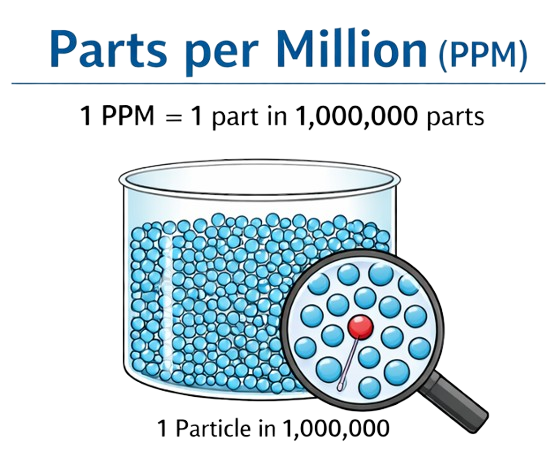
In other words, 1 ppm is 1 part of substance X in 1,000,000 parts of substance Y. The “part” most commonly refers to mass, but it can also represent volume, length or even frequency, depending on the context. This unit is often used to describe the concentration of a species in an aqueous solution.
Consider the measurement of a pollutant, such as Pb2+, in water. A concentration of 1 ppm Pb2+ by mass means 1 g of Pb2+ in 106 g of solution, or equivalently, 1 mg of Pb2+ in 1,000 g of solution. Because the density of water is 1.00 g/mL (or 1,000 g/L), 1 ppm is approximately equal to 1.00 mg/L in dilute aqueous solutions.

Question
What is the molar concentration of K+ in a solution containing 50.0 ppm of K3[Fe(CN)6] (Mr = 329.1)?
Answer
The molar concentration of K3[Fe(CN)6] is 50.0/329,100 mol/L. Therefore, [K+] = 3 x (50.0/329,100) = 4.56 x 10⁻⁴ mol/L.
Parts per million can also be used to describe the concentration of gases. In this case, the “part” refers to volume. For example, 1 ppm by volume of the toxic gas CO is equivalent to 1 μL of CO per litre of air.
In the chemistry of solids, the expansivity of an alloy may be expressed using parts per million. For instance, if bronze expands 18 μm per metre of the alloy for every degree Celsius, we say that it expands at 18 ppm/°C.
Parts per million can also be used with frequency as a reference. In nuclear magnetic resonance (NMR) spectroscopy, the chemical shift is defined as:
where is the resonance frequency of the specific nucleus being studied, and
is the resonance frequency of a reference compound, typically tetramethylsilane (TMS).
The ratio is dimensionless and less than 1. If we multiply it by 102, the result is expressed as a percentage (1 in 100). Therefore, multiplying it by 106 expresses the chemical shift in parts per million (1 in 1,000,000), giving
values that fall conveniently within the range of 0.0 to about 12.0 ppm for 1H NMR spectra.
Finally, trace analysis may involve units like parts per billion (ppb) and even parts per quadrillion (ppq). For example, because extremely small amounts of certain chemicals in water can have significant effects on the human body, the measurement of dioxins in drinking water is reported in ppq, where less than 30 ppq is recommended for safe drinking. To provide perspective, 1 ppq is equivalent to about 1 drop of liquid in a 5 x 10¹⁰-litre tank, roughly the volume of 20,000 Olympic-sized swimming pools.