The divergence theorem states that the total outward flux of a vector field through a closed surface equals the integral of the field’s divergence throughout the volume enclosed by that surface.
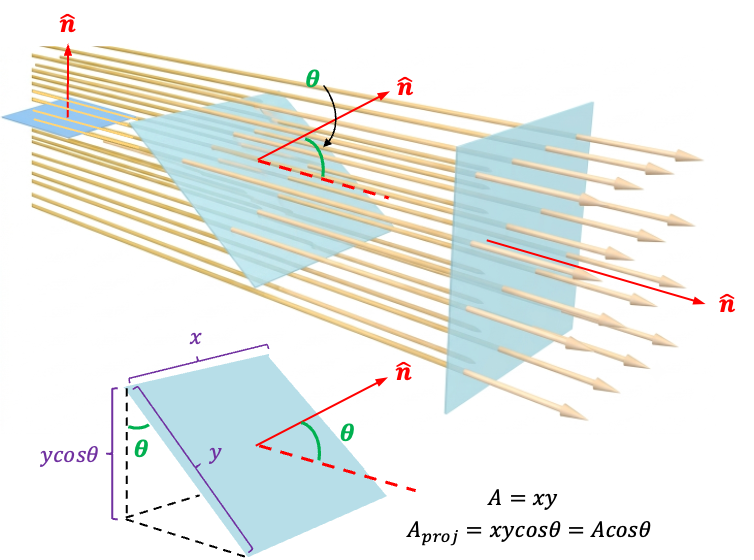
Flux measures how much of a vector field actually passes through a surface, and only the component of the field normal to the surface contributes to the flux. This can be visualised by comparing the number of uniform field lines passing through three surfaces, each of area (see diagram above). A surface perpendicular to the field presents its full area to the flow, so the maximum number of field lines passes through it.
To compare the field lines passing through a tilted surface meaningfully, we project the surface onto a plane perpendicular to the field, which gives a reduced effective area for the flux. If we let be the angle between the field and the surface’s normal, then the projected area is
. Consequently, the flux through the surface is
, where
is the flux density (also known as field strength), and
is the area vector, with
being the unit vector normal to the surface. Equivalently,
, where
is the component of the field normal to the surface. Therefore, only the component of the field normal to the surface contributes to the flux.
Comparatively, when the surface is parallel to the field, , resulting in a projected area of zero. No field lines pass through the surface, and the flux is zero.
To derive the mathematical expression of the divergence theorem, consider a tiny rectangular box with dimensions ,
and
in a vector field
, where the field lines can be passing through each face of the box in any direction (see diagram below).
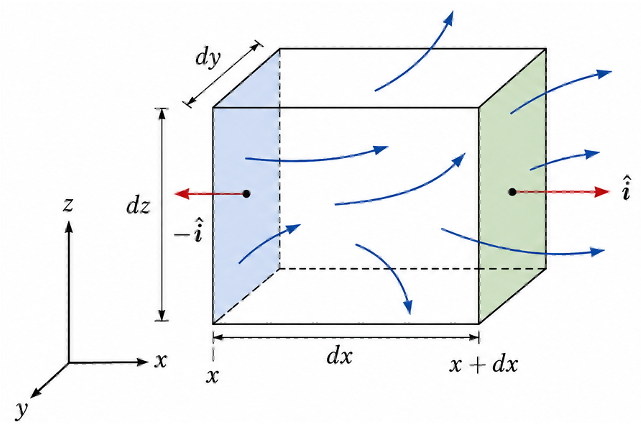
The flux perpendicularly through the right face of area at
is
while the flux perpendicularly through the left face at is
Therefore, the net flux through the box in the -direction is:
For a multivariable function , the first-order Taylor series about the point
is
Evaluating at the nearby point
, where
gives:
It follows that . Similarly,
and
. Therefore, the net total flux flowing through the box is:
where and
.
Summing over yields:
where the triple integral symbol corresponds to integration with respect to the three variables , and the subscript
is included for clarity to denote integration over the enclosed volume
.
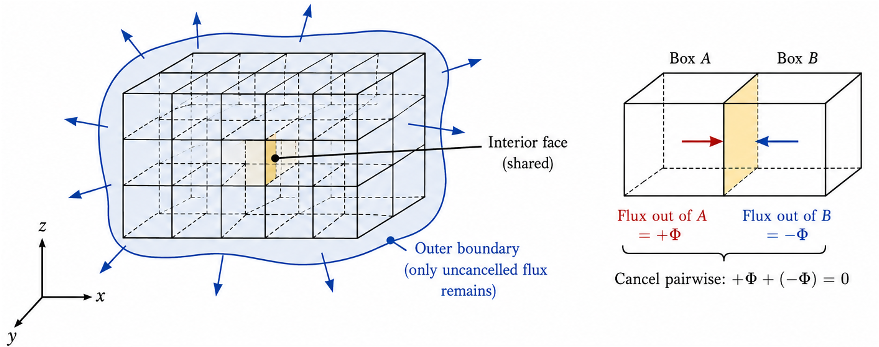
Now, consider a finite volume partitioned into many tiny rectangular boxes, with each interior face shared by two adjacent boxes (see diagram above). The outward flux through a shared face of one box is equal in magnitude and opposite in sign to the flux through the same face as part of the neighbouring box. As a result, all interior contributions cancel pairwise, leaving only the flux through the outer boundary surface. This converts the volume integral into a surface integral, giving the divergence theorem:
where the double integral symbol denotes integration with respect to the two variables defining a surface, and the circle on the integral symbol indicates that the integration is performed over the closed surface that bounds the volume
.

Question
What is the difference between a scalar field and a vector field?
Answer
A scalar field, expressed by a scalar function , associates a scalar with each point in some region of space, whereas a vector field, expressed by a vector function
, associates a vector with each point.
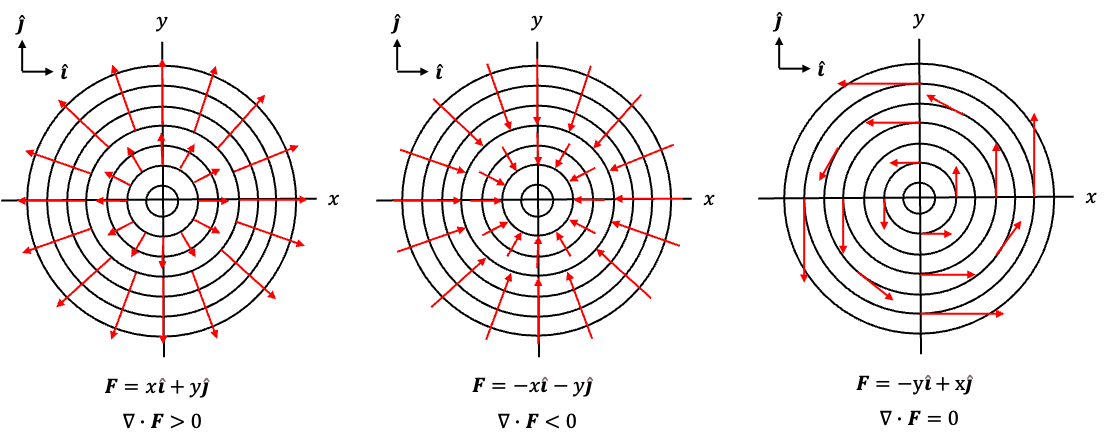
Finally, the theorem is called the divergence theorem because measures the net rate at which a vector field “spreads out” (diverges) from a point. This is best illustrated using a two-dimensional diagrammatic representation of the vector field function
(see diagram above), in which each point
in the two-dimensional space is associated with a vector
. In the first quadrant where
and
, the vector points up and to the right. As
increases, the horizontal component increases, and as
increases, the vertical component increases. Consequently, the vectors become larger and the field spreads outwards from the origin. A similar outward-spreading behaviour occurs in the other three quadrants, where the vectors also increase in magnitude as we move away from the origin. The divergence of this field is
, which is constant throughout the plane. In general,
-
- If
, the field behaves locally like a source, with a net outward flow (positive divergence).
- If
, the point behaves locally like a sink, with a net inward flow (negative divergence). An example of such a vector field function is
.
- If
, there is no net outward or inward flow (zero divergence). An example of such a vector field function is
.
- If