A pair of commuting operators that are Hermitian can have a common complete set of eigenfunctions.
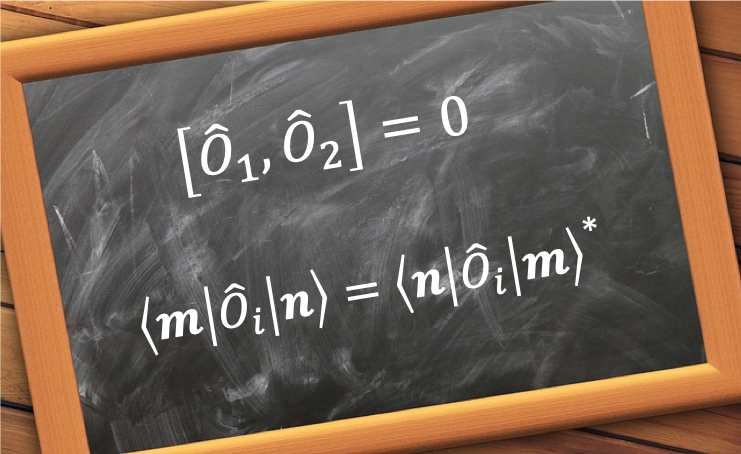
Let \(\hat{O}_1\) and \(\hat{O}_2\) be two different operators, with observables \(\Omega_1\) and \(\Omega_2\) respectively.
$$\hat{O}_1(\hat{O}_2\psi)=\hat{O}_1(\Omega_2\psi)=\Omega_2\hat{O}_1\psi=\Omega_2\Omega_1\psi$$
$$\hat{O}_2(\hat{O}_1\psi)=\hat{O}_2(\Omega_1\psi)=\Omega_1\hat{O}_2\psi=\Omega_1\Omega_2\psi$$
So, \(\hat{O}_1(\hat{O}_2\psi)=\hat{O}_2(\hat{O}_1\psi)\; \; \; or\; \; \;\hat{O}_1(\hat{O}_2\psi)-\hat{O}_2(\hat{O}_1\psi)=0\). If this is so, we say that the two operators commute. The short notation for \(\hat{O}_1(\hat{O}_2\psi)-\hat{O}_2(\hat{O}_1\psi)\) is \(\left [\hat{O}_1,\hat{O}_2\right ]\), where in the case of two commuting operators, \(\left [\hat{O}_1,\hat{O}_2\right ]=0\).
When the effect of two operators depends on their order, we say that they do not commute, i.e. \(\left [\hat{O}_1,\hat{O}_2\right ]\neq 0\). If this is the case, we say that the observables \(\Omega_1\) and \(\Omega_2\) are complementary.
One important concept in quantum mechanics is that we can select a common complete set of eigenfunctions for a pair of commuting Hermitian operators. The proof is as follows:
Let \(\left \{ \vert a_n\rangle \right \}\) and \(\left \{ \vert b_n\rangle \right \}\) be the complete sets of eigenfunctions of \(\hat{A}\) and \(\hat{B}\) respectively, such that \(\hat{A}\vert a_n\rangle=a_n\vert a_n\rangle\) and \(\hat{B}\vert b_m\rangle=b_m\vert b_m\rangle\). If the two operators have a common complete set of eigenfunctions, we can express \(\vert a_n\rangle\) as a linear combination of \(\vert b_m\rangle\):
$$\vert a_n\rangle=\sum_{m=1}^{k}c_{nm}\vert b_m\rangle\; \; \; \; \; \; \; \; 5$$
For example, the eigenfunction is:
$$\vert a_1\rangle=c_{11}\vert b_1\rangle+c_{12}\vert b_2\rangle+\cdots+c_{1k}\vert b_k\rangle\; \; \; \; \; \; \; \; 6$$
Since some of the eigenfunctions \(\vert b_m\rangle\) may describe degenerate states (i.e. some \(\vert b_m\rangle\) are associated with the same eigenvalue \(b_i\)), we can rewrite \(\vert a_n\rangle\) as:
$$\vert a_n\rangle=\sum_{i=1}^{j}\vert(a_n) b_i\rangle\; \; \; \; \; \; \; \; 7$$
where \(\vert(a_n) b_i\rangle=\sum_{m=1}^{k}d_{nm}\vert b_m\rangle\delta_{b_i,b_m}\) and \(b_i\) represents distinct eigenvalues of the complete set of eigenfunctions of \(\hat{B}\).
For example, if the linear combination of \(\vert a_1 \rangle\) in eq6 has \(\vert b_1\rangle\) and \(\vert b_2\rangle\) describing the same eigenstate with eigenvalue \(b_1\), and \(\vert b_4\rangle\) and \(\vert b_5\rangle\) describing another common eigenstate with eigenvalue \(b_3\),
$$\vert a_1\rangle=\vert(a_1) b_1\rangle+\vert(a_1) b_2\rangle+\vert(a_1) b_3\rangle+\cdots+\vert(a_1) b_j\rangle$$
where \(\vert(a_1) b_1\rangle=d_{11}\vert b_1\rangle+d_{12}\vert b_2\rangle\), \(\vert(a_1) b_2\rangle=d_{13}\vert b_3\rangle\), \(\vert(a_1) b_3\rangle=d_{14}\vert b_4\rangle+d_{15}\vert b_5\rangle\) and so on.
In other words, eq7 is a sum of eigenfunctions with distinct eigenvalues of \(\hat{B}\). Since a linear combination of eigenfunctions describing a degenerate eigenstate is an eigenfunction of \(\hat{B}\), we have
$$\hat{B}\vert(a_n)b_i\rangle=b_i\vert(a_n)b_i\rangle\; \; \; \; \; \; \; \; 8$$
i.e. \(\vert(a_n)b_i\rangle\) is an eigenfunction of \(\hat{B}\). Furthermore, the set \(\left \{ \vert(a_n)b_i\rangle \right \}\) is complete, which is deduced from eq7, where the set \(\left \{ \vert a_n\rangle \right \}\) is complete.
From \(\hat{A}\vert a_n\rangle=a_n\vert a_n\rangle\), we have:
$$(\hat{A}-a_n)\vert a_n\rangle=0$$
Substituting eq7 in the above equation, we have
$$(\hat{A}-a_n)\vert a_n\rangle=\sum_{i=1}^{j}(\hat{A}-a_n) \vert (a_n)b_i\rangle=0\; \; \; \; \; \; \; \; 9$$
By operating on the 1st term of the summation in the above equation with \(\hat{B}\), and using the fact that \(\hat{A}\) commute with \(\hat{B}\),
$$\hat{B}(\hat{A}-a_n)\vert (a_n)b_1\rangle=(\hat{A}-a_n)\hat{B} \vert (a_n)b_1\rangle\; \; \; \; \; \; \; \; 10$$
Substituting eq8, where \(i=1\) in the above equation,
$$\hat{B}(\hat{A}-a_n)\vert (a_n)b_1\rangle=b_1(\hat{A}-a_n) \vert (a_n)b_1\rangle\; \; \; \; \; \; \; \; 11$$
Repeating the operation of \(\hat{B}\) on the remaining terms of the summation in eq9, we obtain equations similar to eq11 and we can write:
$$\hat{B}(\hat{A}-a_n)\vert (a_n)b_i\rangle=b_i(\hat{A}-a_n) \vert (a_n)b_i\rangle$$
i.e. \((\hat{A}-a_n)\vert (a_n)b_i\rangle\) is an eigenfunction of \(\hat{B}\) with distinct eigenvalues \(b_i\). Since \(\hat{B}\) is Hermitian and \((\hat{A}-a_n)\vert (a_n)b_i\rangle\) are associated with distinct eigenvalues, the eigenfunctions \((\hat{A}-a_n)\vert (a_n)b_i\rangle\) are orthogonal and therefore linearly independent. Consequently, each term in the summation in eq9 must be equal to zero:
$$(\hat{A}-a_n)\vert (a_n)b_i\rangle=0\; \; \; \Rightarrow \; \; \;\hat{A}\vert (a_n)b_i\rangle=a_n\vert (a_n)b_i\rangle$$
This implies that \(\vert (a_n)b_i\rangle\), which is a complete set as mentioned earlier, is also an eigenfunction of \(\hat{A}\). Therefore, we can select a common complete set of eigenfunctions \(\left \{ \vert (a_n)b_i\rangle\right \}\) for a pair of commuting Hermitian operators. Conversely, if two Hermitian operators do not commute, eq10 is no longer valid and we cannot select a common complete set of eigenfunctions for them.