Koopmans’ theorem states that the energy to remove an electron from an orbital of an atom, whose state is described by a single Slater determinant, is approximately the negative value of the corresponding Hartree-Fock orbital energy. In other words, the theorem states that the negative value of the orbital energy \(E_k\) of an atom is approximately equal to the ionisation energy IE for the k-th electron in the atom.
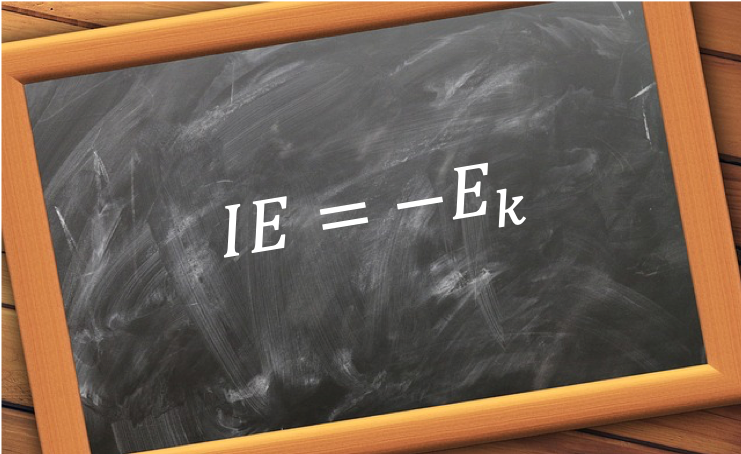
To prove the theorem, we begin with the ionisation process, which is generally expressed as
$$X(g)+h\nu\rightarrow X^+(g)+e^-$$
where \(X\) is an atom, which is irradiated with a photon of energy \(h\nu\), and \(X^+\) is the corresponding ion with an electron \(e^-\) removed.
In terms of energies,
$$h\nu=E_{X^+}-E_X+E_{e^-}$$
where \(E_{X^+}\) is the state of the ion, \(E_X\) is the state of the atom and \(E_{e^-}\) is the kinetic energy of the expelled electron.
As \(E_{e^-}\rightarrow 0\),
$$h\nu=IE=E_{X^+}-E_X\;\;\;\;\;\;\;\;(143)$$
Substituting eq95 in eq143 gives
$$IE=\sum_{i\neq k}^nH_i+\frac{1}{2}\sum_{j,i\neq k}^n(J_{ij}-K_{ij})-\sum_{i=1}^nH_i-\frac{1}{2}\sum_{j,i=1}^n(J_{ij}-K_{ij})$$
$$IE=-H_k+\frac{1}{2}\left[\sum_{j,i\neq k}^n(J_{ij}-K_{ij})-\sum_{j,i=1}^n(J_{ij}-K_{ij})\right]\;\;\;\;\;\;\;\;(144)$$

Question
Show that \(\sum_{j,i\neq k}^n(J_{ij}-K_{ij})-\sum_{j,i=1}^n(J_{ij}-K_{ij})=-2\sum_{j=1}^n(J_{kj}-K_{kj})\).
Answer
Let \(C=\sum_{j,i\neq k}^n(J_{ij}-K_{ij})-\sum_{j,i=1}^n(J_{ij}-K_{ij})\). Expanding the equation and eliminating common terms,
$$C=-\left[\sum_{i=1}^n(J_{ik}-K_{ik})+\sum_{j\neq k}^n(J_{kj}-K_{kj})\right]$$
Since \(J_{kk}-K_{kk}=0\), we can add it to \(\sum_{j\neq k}^n(J_{kj}-K_{kj})\), giving
$$C=-\left[\sum_{i=1}^n(J_{ik}-K_{ik})+\sum_{j=1}^n(J_{kj}-K_{kj})\right]$$
Furthermore, \(J_{ik}=J_{ki}\) and \(K_{ik}=K_{ki}\). So,
$$C=-\left[\sum_{i=1}^n(J_{ki}-K_{ki})+\sum_{j=1}^n(J_{kj}-K_{kj})\right]$$
Relabelling i to j for \(\sum_{i=1}^n(J_{ki}-K_{ki})\)
$$C=-2\sum_{j=1}^n(J_{kj}-K_{kj})\;\;\;\;\;\;\;\;(145)$$
Substituting eq145 in eq144 yields
$$IE=-\left[H_k+\sum_{j=1}^n(J_{kj}-K_{kj})\right]\;\;\;\;\;\;\;\;(146)$$
Relabelling t with j and \(\lambda_r^{\prime}\) with \(E_r\) in eq109, we have
$$\left[\left(-\frac{1}{2}\nabla^2-\frac{Z}{r}\right)+\sum_{j\neq r}\int\phi_j^{^{\prime}*}(x^{\prime}) \frac{(1-P_{rj})\phi_j^{\prime}(x^{\prime})}{\vert\boldsymbol{r}-\boldsymbol{r}^{\prime}\vert}dx^{\prime}\right]\phi_r^{\prime}(x)=E_r\phi_r^{\prime}(x)\;\;\;\;(147)$$
Multiplying the k-th equation in eq147 by \(\phi_k^{^{\prime}*}(x)\) and integrating over \(dx\), we have
$$E_k=H_k+\sum_{j\neq k}^n(J_{kj}-K_{kj})$$
Since \(J_{kk}-K_{kk}=0\)
$$E_k=H_k+\sum_{j=1}^n(J_{kj}-K_{kj})\;\;\;\;\;\;\;\;(148)$$
Substituting eq148 in eq146 results in
$$IE=-E_k\;\;\;\;\;\;\;\;(149)$$
Eq149 is known as Koopmans’ theorem.
Lastly, let’s study the relation between the relation between the orbital energy \(E_k\) of an atom and the total energy E of the atom. From eq148,
$$\sum_{k=1}^nE_k=\sum_{k=1}^nH_k+\sum_{k,j=1}^n(J_{kj}-K_{kj})$$
$$\sum_{k=1}^nE_k=\sum_{k=1}^nH_k+\sum_{j\neq k}\sum_{k=1}^n(J_{kj}-K_{kj})$$
Substituting eq94 in the above equation gives
$$E=\sum_{k=1}^nE_k-\frac{1}{2}\sum_{j\neq k}\sum_{k=1}^n(J_{kj}-K_{kj})\;\;\;\;\;\;\;\;(150)$$
Question
Show that the alternative to eq150 is \(E=\frac{1}{2}\sum_{k=1}^n(E_k+H_k)\) .
Answer
Adding \(H_k\) to both sides of eq148 and summing throughout from \(k=1,\cdots,n\),
$$\sum_{k=1}^n(E_k+H_k)=2\sum_{k=1}^nH_k+\sum_{k,j=1}^n(J_{kj}-K_{kj})$$ $$=2\sum_{k=1}^nH_k+\sum_{j\neq k}\sum_{k=1}^n(J_{kj}-K_{kj})=2\left[\sum_{k=1}^nH_k+\sum_{k >j}\sum_{j=1}^n(J_{kj}-K_{kj})\right]$$
Since \(E=\sum_{k=1}^nH_k+\sum_{k >j}\sum_{k=1}^n(J_{kj}-K_{kj})\),
$$E=\frac{1}{2}\sum_{k=1}^n(E_k+H_k)\;\;\;\;\;\;\;\;(151)$$
