An isotropic Cartesian tensor is one where its components are identical in any orthogonal Cartesian system.
An isotropic property is one that is independent of direction, e.g. thermal expansion of a solid, and therefore has a quantity that is independent of the reference frame. An isotropic property can therefore be described by a Cartesian tensor like \(T^{\prime}_{j_1j_2...j_n}\) in eq15.
To evaluate the properties of an isotropic tensor, we begin by considering a generic fourth-order tensor \(T_{jlnp}\), whose transformation is expressed by eq14:
$$T^{\prime}_{ikmo}=a_{ij}a_{kl}a_{mn}a_{op}T_{jlnp}\; \; \; \; \; \; \; (16)$$
Since j, l, n and p, each of which ranges from 1 to 3, the 81 components of \(T^{\prime}_{ikmo}\) are classified in four groups as follows:
-
- Components with four equal subscripts, i.e. \(T^{\prime}_{1111}\), \(T^{\prime}_{2222}\) and \(T^{\prime}_{3333}\).
- Components with three equal subscripts, e.g. \(T^{\prime}_{1211}\), \(T^{\prime}_{2223}\), etc.
- Components with two different pairs of equal subscripts, e.g. \(T^{\prime}_{1212}\), \(T^{\prime}_{3322}\), \(T^{\prime}_{1331}\), etc.
- Components with one pair of equal subscripts, e.g. \(T^{\prime}_{1213}\), \(T^{\prime}_{2213}\), etc.
Next, consider the transformation of \(T_{jlnp}\) to \(T^{\prime}_{ikmo}\) as a rotation about the x3-axis of \(\theta=180^o\) where x3 coincides with x’3 (x’3 is equal to x3 and is perpendicular to the plane of the page). From eq12, the transformation matrix is:
$$a_{ij}\: or\: a_{kl}\: or\: a_{mn}\: or\: a_{op}=\begin{pmatrix} cos\theta &sin\theta &0 \\ -sin\theta &cos\theta &0 \\ 0 &0 &1 \end{pmatrix}=\begin{pmatrix} -1 &0 &0 \\ 0 &-1 &0 \\ 0 &0 &1 \end{pmatrix}$$
Therefore, \(a_{11}=a_{22}=-1\) and \(a_{33}=1\), with the rest of the components of the transformation matrix equal to zero. From eq16, a component of group 2 of the above classification is:
$$T^{\prime}_{1113}=a_{1j}a_{1l}a_{1n}a_{3p}T_{jlnp}=a_{11}a_{11}a_{11}a_{31}T_{1111}+a_{11}a_{11}a_{11}a_{32}T_{1112}$$
$$+a_{11}a_{11}a_{11}a_{33}T_{1113}+...\; \; \; \; \; \; \; (17)$$
Substituting \(a_{11}=a_{22}=-1\), \(a_{33}=1\) and \(a_{i\neq j}=0\) in eq17, we have:
$$T^{\prime}_{1113}=-T_{1113}\; \; \; \; \; \; \; (18)$$
If \(T_{jlnp}\) is an isotropic tensor, \(T^{\prime}_{1113}=T_{1113}\) (since an isotropic Cartesian tensor is one where its components are identical in any orthogonal Cartesian system). Hence, the only way to satisfy eq18 is for \(T^{\prime}_{1113}=T_{1113}=0\). Otherwise, the value of \(T^{\prime}_{1113}\) varies with the value of \(T_{1113}\), e.g. when \(T_{1113}=-7\), \(T^{\prime}_{1113}=7\).
Another component of group 2 of the above classification is \(T^{\prime}_{1211}\) where after expanding and substituting with \(a_{11}=a_{22}=-1\), \(a_{33}=1\) and \(a_{i\neq j}=0\),
$$T^{\prime}_{1211}=T_{1211}\; \; \; \; \; \; \; (20)$$
Eq20 shows that \(T^{\prime}_{1211}=T_{1211}\) but does not indicate the value of either component. If the rotation is instead made about the x2-axis at \(\theta=180^o\), the transformation matrix is:
$$\begin{pmatrix} cos\theta & 0 &sin\theta \\ 0 & 1 &0 \\ -sin\theta &0 &cos\theta \end{pmatrix}=\begin{pmatrix} -1 &0 &0 \\ 0 &1 &0 \\ 0 &0 &-1 \end{pmatrix}$$
We have \(a_{11}=a_{33}=-1,a_{22}=1\), and \(a_{i\neq j}=0\), giving \(T^{\prime}_{1211}=-T_{1211}\). If \(T_{jlnp}\) is an isotropic tensor,
$$T^{\prime}_{1211}=T_{1211}=0\; \; \; \; \; \; \; (22)$$
Repeating the above steps and assuming that \(T_{jlnp}\) is an isotropic tensor, we find that all the components of \(T^{\prime}_{ikmo}\) in group 2 and group 4 are zero, which means that all the components of \(T_{jlnp}\) in group 2 and group 4 are zero.
We shall now analyse the components of group 1 by a rotation about the x3-axis at \(\theta=90^o\) with the transformation matrix:
$$\begin{pmatrix} cos\theta &sin\theta &0 \\ -sin\theta &cos\theta &0 \\ 0 &0 &1 \end{pmatrix}=\begin{pmatrix} 0 &1 &0 \\ -1 &0 &0 \\ 0 &0 &1 \end{pmatrix}$$
We have \(T^{\prime}_{1111}=T_{2222},T^{\prime}_{2222}=T_{1111},T^{\prime}_{3333}=T_{3333}\).
A rotation about the x2-axis at \(\theta=90^o\) involves the transformation matrix:
$$\begin{pmatrix} cos\theta & 0&sin\theta \\ 0 &1 &0 \\ -sin\theta &0 & cos\theta\end{pmatrix}=\begin{pmatrix} 0 &0 &1 \\ 0 &1 &0 \\ -1 &0 &0 \end{pmatrix}$$
and gives \(T^{\prime}_{1111}=T_{3333},T^{\prime}_{2222}=T_{2222},T^{\prime}_{3333}=T_{1111}\).
Comparing the six equations \(T^{\prime}_{1111}=T_{2222},T^{\prime}_{2222}=T_{1111},T^{\prime}_{3333}=T_{3333}\) and \(T^{\prime}_{1111}=T_{3333},T^{\prime}_{2222}=T_{2222},T^{\prime}_{3333}=T_{1111}\), all the components of \(T^{\prime}_{ikmo}\) in group 1 are equal to one another, which means that all the components of \(T_{jlnp}\) in group 1 are equal to one another.
Finally, let’s look at the components in group 3. Under a rotation about the x3-axis at \(\theta=90^o\), we have \(T^{\prime}_{1122}=T_{2211},T^{\prime}_{2233}=T_{1133},T^{\prime}_{3311}=T_{3322}\).
A rotation about the x2-axis at \(\theta=90^o\) gives \(T^{\prime}_{1122}=T_{3322},T^{\prime}_{2233}=T_{2211},T^{\prime}_{3311}=T_{1133}\).
Comparing the six equations \(T^{\prime}_{1122}=T_{2211},T^{\prime}_{2233}=T_{1133},T^{\prime}_{3311}=T_{3322}\) and \(T^{\prime}_{1122}=T_{3322},T^{\prime}_{2233}=T_{2211},T^{\prime}_{3311}=T_{1133}\) , components in group 3 of \(T^{\prime}_{ikmo}\) (which is equal to the components in group 3 of \(T_{jlnp}\)) with i = k and m = o are equal to one another. Repeating the above steps, we can show that components in group 3 with i = m and k = o are equal to one another and those with i = o and k = m are equal to one another.
Therefore, if \(T_{jlnp}\) is an isotropic tensor:
i) components of \(T^{\prime}_{ikmo}\) with i = k = m = o are equal and therefore \(T_{jlnp}\) with j = l = n = p are equal
ii) components of \(T^{\prime}_{ikmo}\) with i = k ≠ m = o are equal and therefore \(T_{jlnp}\) with j = l ≠ n = p are equal
iii) components of \(T^{\prime}_{ikmo}\) with i = m ≠ k = o are equal and therefore \(T_{jlnp}\) with j = n ≠ l = p are equal
iv) components of \(T^{\prime}_{ikmo}\) with i = o ≠ k = m are equal and therefore \(T_{jlnp}\) with j = p ≠ l = n are equal
v) all other components not mentioned are equal to zero
Note that components of parts ii, iii and iv belong to group3 of the isotropic tensor. Now, consider a case of \(T_{jlnp}\) where components of \(T_{jlnp}\) in iii and iv are set to zero (\(T_{jlnp}\) is still an isotropic tensor but with more components equal to zero). A rotation about the x3-axis at \(\theta=45^o\) gives the transformation matrix:
$$\begin{pmatrix} cos\theta &sin\theta &0 \\ -sin\theta &cos\theta &0 \\ 0 & 0 &1 \end{pmatrix}=\begin{pmatrix} \frac{\sqrt{2}}{2} & \frac{\sqrt{2}}{2} & 0\\ -\frac{\sqrt{2}}{2} & \frac{\sqrt{2}}{2} &0 \\ 0 &0 &1 \end{pmatrix}$$
Since components in part iii and part iv are set to zero and the conditions of part v applies, we have \(T^{\prime}_{1111}=\frac{1}{4}T_{1111}+\frac{1}{4}T_{1122}+\frac{1}{4}T_{2211}+\frac{1}{4}T_{2222}\) . Furthermore, part i states that \(T_{1111}=T_{2222}\) and part ii states that \(T_{1122}=T_{2211}\) . So,
$$T^{\prime}_{1111}=\frac{1}{2}\left ( T_{1111}+T_{1122}\right )\; \; \; \; \; \; \; (23)$$
If \(T_{jlnp}\) is an isotropic tensor, \(T^{\prime}_{1111}=T_{1111}\) and therefore, \(T_{1111}=T_{1122}\) . This means that all non-zero components of this particular \(T_{jlnp}\) have the same value, say, λ, where:
$$T_{jlnp}=\lambda\delta_{jl}\delta_{np}\; \; \; \; \; \; \; (24)$$
where \(\delta_{jl}\) and \(\delta_{np}\) are Kronecker deltas.
Using the same logic by considering the cases of \(T_{jlnp}\) where components of \(T_{jlnp}\) in part ii and part iv are set to zero and where components of \(T_{jlnp}\) in part ii and part iii are set to zero, we have:
$$T_{jlnp}=\mu\delta_{jn}\delta_{lp}\; \; \; \; \; \; \; (25)$$
and
$$T_{jlnp}=\nu\delta_{jp}\delta_{ln}\; \; \; \; \; \; \; (26)$$
respectively.
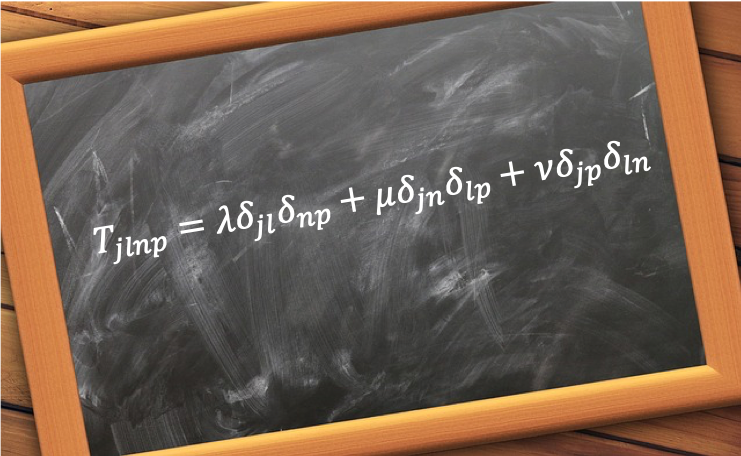
Therefore, we can write the general form of the fourth-order isotropic tensor as:
$$T_{jlnp}=\lambda\delta_{jl}\delta_{np}+\mu\delta_{jn}\delta_{lp}+\nu\delta_{jp}\delta_{ln}\; \; \; \; \; \; \; (27)$$

Question
Show that \(T_{jlnp}\) in eq27 continues to satisfy parts i to v, all of which are needed to define a fourth-order isotropic tensor.
Answer
In eq27,
i) the components of \(T_{jlnp}\) with j = l = n = p have values of \(\lambda+\mu+\nu\) and are therefore still equal to one another;
ii) the components of \(T_{jlnp}\) with j = l ≠ n = p have values of \(\lambda\) and are therefore still equal to one another;
iii) the components of \(T_{jlnp}\) with j = n ≠ l = p have values of \(\mu\) and are therefore still equal to one another;
iv) the components of \(T_{jlnp}\) with j = p ≠ l = n have values of \(\nu\) and are therefore still equal to one another;
v) all other components not mentioned are equal to zero.
Therefore, the general form of the fourth-order isotropic tensor is valid.