Leibniz’s theorem extends the product rule to determine higher-order derivatives of the product of two or more functions.
Consider the function \(f(x)=u(x)v(x)\), where \(u\) and \(v\) are \(n\) times differentiable. Using the product rule, the first few derivatives are:
$$(uv)^{\prime}=uv^{\prime}+u^{\prime}v$$
$$(uv)^{\prime}^{\prime}=uv^{\prime}^{\prime}+2u^{\prime}v^{\prime}+u^{\prime}^{\prime}v$$
$$(uv)^{(3)}=uv^{(3)}+3u^{\prime}v^{\prime}^{\prime}+3u^{\prime}^{\prime}v^{\prime}+u^{(3)}v$$
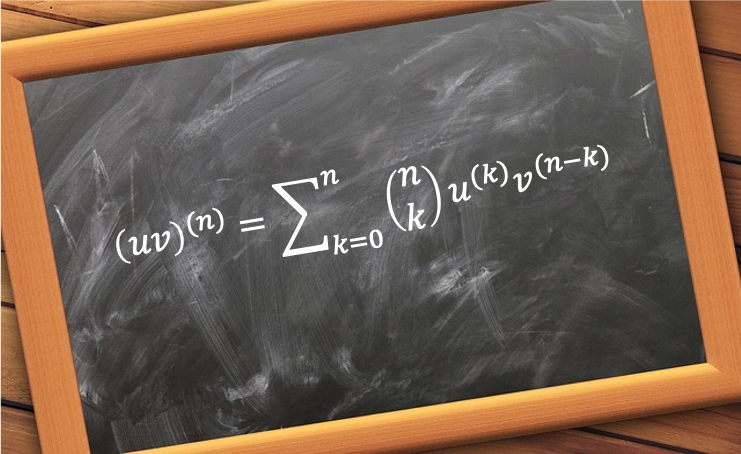
which suggests that the \(n\)-th order derivative of \(f\) can be expressed as the binomial expansion
$$(uv)^{(n)}=\sum_{k=0}^n\begin{pmatrix}n\\k\end{pmatrix}u^{(k)}v^{(n-k)}\;\;\;\;\;\;\;\;319a$$
where \(n\) and \(k\) are non-negative integers, \(u^{(j)}\) and \(v^{(j)}\) are the \(j\)-th order derivatives of \(u\) and \(v\), respectively, and \(\begin{pmatrix}n\\k\end{pmatrix}=\frac{n!}{k!(n-k)!}\) are the binomial coefficients.
Eq319a is known as Leibniz’s theorem, which can be proven by induction as follows:
For \(n=1\),
$$(uv)^{(1)}=\begin{pmatrix}1\\0\end{pmatrix}u^{(0)}v^{(1)}+\begin{pmatrix}1\\1\end{pmatrix}u^{(1)}v^{(0)}=uv^{\prime}+u^{\prime}v$$
If eq319a holds for all \(k\) when \(n=m\), then for \(n=m+1\),
$$\begin{align*}(uv)^{m+1}&=\frac{d}{dx}\sum_{k=0}^m\begin{pmatrix}m\\k\end{pmatrix}u^{(k)}v^{(m-k)}\\&=\sum_{k=0}^m\begin{pmatrix}m\\k\end{pmatrix}u^{(k+1)}v^{(m-k)}+\sum_{k=0}^m\begin{pmatrix}m\\k\end{pmatrix}u^{(k)}v^{(m-k+1)}\\&=\sum_{k=1}^{m+1}\begin{pmatrix}m\\k-1\end{pmatrix}u^{(k)}v^{(m-k+1)}+\sum_{k=0}^{m}\begin{pmatrix}m\\k\end{pmatrix}u^{(k)}v^{(m-k+1)}\\&=\sum_{k=1}^{m}\begin{pmatrix}m\\k-1\end{pmatrix}u^{(k)}v^{(m-k+1)}+\begin{pmatrix}m\\m\end{pmatrix}u^{(m+1)}v^{(0)}+\begin{pmatrix}m\\0\end{pmatrix}u^{(0)}v^{(m+1)}\\&\;\;\;+\sum_{k=1}^{m}\begin{pmatrix}m\\k\end{pmatrix}u^{(k)}v^{(m-k+1)}\\&=\begin{pmatrix}m+1\\0\end{pmatrix}u^{(0)}v^{(m+1)}+\sum_{k=1}^{m}\biggr[\begin{pmatrix}m\\k-1\end{pmatrix}+\begin{pmatrix}m\\k\end{pmatrix}\biggr]u^{(k)}v^{(m-k+1)}\\&\;\;\;+\begin{pmatrix}m+1\\m+1\end{pmatrix}u^{(m+1)}v^{(0)}\end{align*}$$
Since \(\begin{pmatrix}m\\k-1\end{pmatrix}+\begin{pmatrix}m\\k\end{pmatrix}=\begin{pmatrix}m+1\\k\end{pmatrix}\) (see this article for proof),
$$\begin{align*}(uv)^{m+1}&=\begin{pmatrix}m+1\\0\end{pmatrix}u^{(0)}v^{(m+1)}+\sum_{k=1}^{m}\begin{pmatrix}m+1\\k\end{pmatrix}u^{(k)}v^{(m-k+1)}+\begin{pmatrix}m+1\\m+1\end{pmatrix}u^{(m+1)}v^{(0)}\\&=\sum_{k=0}^{m+1}\begin{pmatrix}m+1\\k\end{pmatrix}u^{(k)}v^{(m-k+1)}\end{align*}$$
and the theorem holds for all \(n\) and \(k\).