Centrifugal distortion

Centrifugal distortion refers to the deformation of a molecule’s structure that occurs due to the rotational motion of the molecule.

As a molecule rotates, the centrifugal force, which acts outward from the axis of rotation, causes the molecule’s bond lengths and bond angles to stretch and distort, particularly at higher rotational speeds. This effect is most pronounced in larger, heavier molecules, where the rotational energy is sufficient to cause a noticeable shift in the geometry. Centrifugal distortion is an important factor in molecular spectroscopy, as it can influence the rotational energy levels of a molecule, leading to shifts in the observed spectral lines, and must be accounted for when interpreting high-resolution rotational spectra.

What is centrifugal force, and how is it different from centripetal force?

Centripetal force and centrifugal force are both associated with circular motion, but they are described in different frames of reference. Centripetal force is described in an inertial frame of reference or in a frame where the object is experiencing actual physical forces that are measurable and observable. In the inertial frame, the force that keeps the object in circular motion is real and necessary to counteract the object’s tendency to move in a straight line (due to inertia).

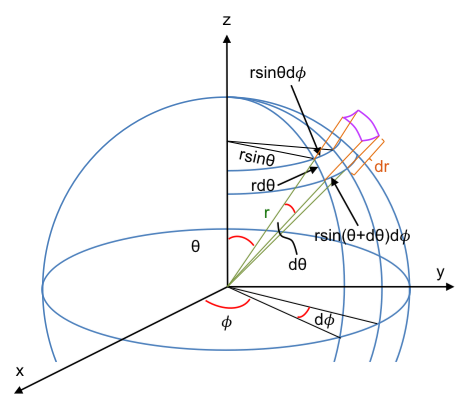
Consider a particle moving around a circle (see diagram above) of radius with an instantaneous velocity at and at , where . If is small, the arc length is approximately equal to and hence to . Since the ratio of corresponding sides of two similar triangles is always equal, . Dividing both sides of this equation by and rearranging (noting that and ) gives:

Substituting (see this article for details) into eq85 yields:

Therefore the centripetal force acting on the rotating particle of reduced mass is

Centrifugal force, on the other hand, is experienced in a non-inertia frame of reference (rotating frame). It appears to act outward on the rotating particle. However, it does not correspond to any real physical force but is instead a fictitious force introduced to account for the observed effects of acceleration in the rotating frame. Since the magnitude of centrifugal force is the same as that of the centripetal force, the magnitude of the centrifugal force experienced by a diatomic molecule of reduced mass and bond length rotating at angular velocity is .


Question

Explain how the fictitious centrifugal force accounts for the observed effects of acceleration in the rotating frame?

Answer

Consider a ball tied to a string, rotating in a horizontal plane. In the inertia frame of reference, the only force acting on the ball is the centripetal force, directed towards the axis of rotation. In the rotating frame of reference, the centripetal force still acts on the ball, even though the ball appears stationary. This would imply that the ball should accelerate towards the centre, contradicting the observation that it remains at rest in the rotating frame. Therefore, a fictitious force, equal in magnitude to the centripetal force but acting in the opposite direction, must be introduced to restore consistency with Newton’s second law.


At equilibrium, the centrifugal force (or the centripetal force) equals the restoring force given by Hooke’s law:

where is the force constant and is the equilibrium bond length.

For small displacements, the motion expressed by eq88 is simple harmonic, with the following classical Hamiltonian for the system:

where the kinetic energy term is given by the classical form of eq4a and the potential energy term is derived from this article.

Rearranging eq88 results in , and therefore

For small displacements, , which implies from that , and hence . So, we can ignore the last term in eq90 as a first approximation, giving:

Substituting (see this article for details) into RHS of eq91 gives:

Substituting eq92 and eq88 into eq89 yields:

Since for small displacements, eq93 becomes:

Using the quantum mechanics postulate that “to every observable quantity in classical mechanics there corresponds a linear, Hermitian operator in quantum mechanics”, and replacing the classical angular momentum with the quantum mechanical operator gives

The corresponding eigenvalues of eq94 (derived using orbital angular momentum ladder operators) are:

or

where is the rotational constant and is the centrifugal distortion constant.

However, rotational energies are typically reported as wavenumbers in molecular spectroscopy. Substituting and into eq95 yields , which is a function of . Therefore,


Question

Can centrifugal distortion be observed from an inertia frame?

Answer

Yes, centrifugal distortion can indeed be observed from an inertial frame, though it’s important to clarify that there are no “fictitious forces” like centrifugal force in an inertial frame. However, centrifugal distortion is not a fictitious effect. It is a real, physical phenomenon that arises due to the rotation of the molecule, and this can be observed in an inertial reference frame.

In a non-rotating molecule, the bonds between atoms are at their equilibrium lengths, representing the most stable configuration where the bond is neither stretched nor compressed. When the molecule begins to rotate, each atom wants to move in a straight line (due to its inertia) tangentially away from the center of rotation. To keep the atoms moving in a circular path, the chemical bond must provide an inward pulling force (the centripetal force).

Just like a spring, a chemical bond can only exert a restoring force when it is displaced from its equilibrium position. To generate a small centripetal force (restoring force) during low-speed rotation, the bond needs to stretch only a little. For faster rotation, the bond must stretch more to provide a larger centripetal force. This stretching of the bond beyond its equilibrium length is the physical phenomenon of centrifugal distortion, which can be observed and measured in an inertia frame.

Next article: Rotation operator
Previous article: Microwave spectra
Content page of rotational spectroscopy
Content page of advanced chemistry
Main content page

Microwave spectra

Microwave spectra represent the electromagnetic radiation absorbed or emitted by molecules when they undergo transitions between discrete rotational energy levels. These spectra are a key component in the study of molecular structure and dynamics. They provide valuable insights about molecular properties, such as bond lengths and moments of inertia.

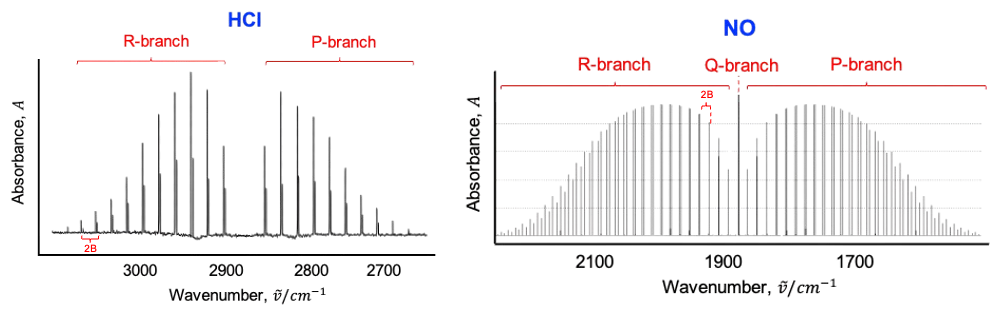
An ideal, pure absorption rotational spectrum of a rigid linear molecule, generated in the microwave frequency range of 3 to 600 GHz (1 to 200 cm-1), typically exhibits a series of absorption lines that correspond to the rotational transitions between discrete rotational energy levels (see diagram below). In the absence of fine or hyperfine splitting, these transitions follow the selection rule , meaning that a molecule can only transition from one rotational level to the next higher level.

Question

What is the difference between an absorption spectrum and an emission spectrum?

Answer

An external radiation is required to produce an absorption spectrum. The detector measures the amount of energy absorbed by the sample at each frequency, corresponding to transitions with .

In an emission spectrum, the sample itself acts as the source. It must first be excited to higher-energy rotational states, for example by heating or applying an electrical discharge. The detector then measures the amount of energy emitted by the sample, corresponding to transitions with .

Both types of spectra can be obtained using the same spectrometer, with different settings. Suppose the spectrometer is configured to record the absorption spectrum of a sample. If two rotational states are populated under the experimental conditions, the sample can both absorb and emit radiation at the same frequency, since both processes involve transitions with between the same pair of quantised energy levels. However, the conditions for measuring an absorption spectrum are typically set to ensure that net absorption occurs.


The rotational energy levels are given by eq44 or eq45 and the frequencies of the transitions are directly related to the rotational constant , and as such, the spacing between the spectral lines provides information about the moment of inertia and the molecular structure. Using the definition , we have

Therefore, the first peak, obtained by substituting into eq80, lies at the point along the horizontal axis. Similarly, the second and third peaks are at and respectively. In other words, the peaks in an ideal rotational spectrum (without centrifugal distortion) of a rigid linear rotor are equally spaced at .


Question

Calculate the moment of inertia and bond length of HCl if the line spacing in the rotational spectrum is 21.2 cm-1?

Answer

Since the spacing is , we have cm-1. Using the formula gives kg m2. Furthermore, . Therefore, the bond length is m.


The intensity of each transition depends on the population of the initial level , which is governed by the Boltzmann distribution, with higher- states being less populated at lower temperatures:

where

is the Boltzmann constant.
is the number of particles in the energy state .
is the total number of particles in the system.

Since represents the fraction of particles in the state ,  the intensity of a spectral line is proportional to , where the value corresponds to a specific energy level. However, there are degenerate states associated with each value of  in a rigid linear molecule. This degeneracy increases the statistical weight of higher levels, redistributing the population towards more degenerate states, which become thermally accessible at typical laboratory temperatures. In other words, at a given temperature, more particles will occupy a higher state with greater degeneracy at equilibrium than they would if the state were non-degenerate. Therefore, when a sample is exposed to an external microwave field, the intensity of each allowed transition in the pure rotational spectrum is proportional to the population of the initial state, which is the product of  and . This gives:

where is a proportionality constant and is given by eq45.

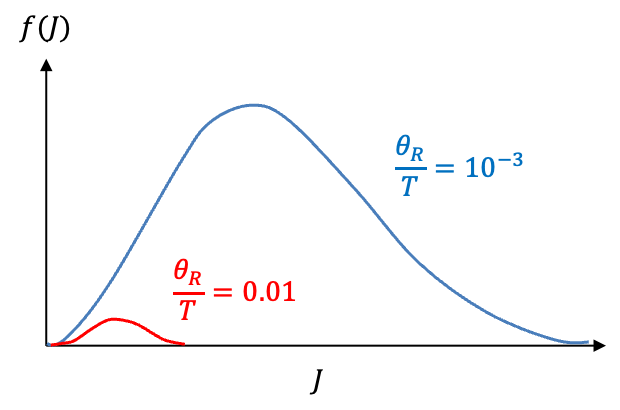
The factor in eq81 increases linearly with , while the exponential term decreases exponentially. As a result, the graph of versus forms a skewed bell curve (see diagram above), with a maximum found by treating as a continuous variable and taking the derivative of with respect to :

Setting , and noting that for any finite , gives

Since must be an integer, the maximum intensity occurs at the value of closest to the result of eq82.


Question

Is the intensity of each transition dependent on the electric dipole moment?

Answer

Although the transition probability between adjacent rotational states is proportional to , which depends on the magnitude of the electric dipole moment, the sample molecules in the waveguide of a typical microwave spectrometer are randomly oriented. As a result, the effect transition dipole moment does not vary significantly from one transition to the next for a given molecule. Therefore, while the absolute intensity depends on the dipole moment, it is often treated as a constant factor when comparing transitions within the same molecule.


For a symmetric rotor, and is also given by eq80. However, unlike a linear rotor, each allowed transition receives contributions from multiple states. These overlapping contributions increase the intensity of the lines but do not change their positions for an ideal spectrum. Consequently, the overall intensity envelope of the spectrum still resembles a skewed bell curve, with a maximum at the value of corresponding to the highest population.

In practice, the peaks in a real rotational spectrum are not discrete vertical lines but have finite width and shape, appearing as broadened curves. This broadening arises, under typical laboratory conditions, from several effects:

    • Doppler broadening, due to the thermal motion of molecules, causes a spread in observed frequencies as molecules move towards or away from the detector.
    • Instrumental broadening, resulting from the finite resolution of the spectrometer itself.
    • Lifetime broadening, which is based on the energy-time uncertainty relation.

Beyond broadening, other phenomena affect the detailed structure and spacing of the spectral lines:

    • Centrifugal distortion causes deviations from the ideal rigid rotor model. As rotational speed increases at higher levels, the molecular bond stretches slightly, increasing the moment of inertia and decreasing the rotational constant . This leads to uneven spacing between lines, especially at higher , and is accounted for using a correction term.
    • Isotopic substitution alters the moment of inertia due to changes in atomic mass, thereby changing the rotational constant . Different isotopologues of the same molecule produce distinct sets of rotational lines, each with slightly different spacings. If multiple isotopes are present in the sample, the resulting spectrum may show clusters or duplications of lines, corresponding to each isotopologue.

Together, these effects lead to a rotational spectrum that is richer and more complex than the idealised, evenly spaced series of lines predicted by the rigid rotor model.


Question

Do large molecules, such as polymers, enzymes and DNA, undergo rotational transitions when radiated by microwaves?

Answer

Yes, large molecules can undergo rotational transitions when exposed to microwave radiation. However, such molecules are flexible and do not behave like rigid rotors, which invalidates some of the assumptions used in microwave rotational spectroscopy. If we assume that still applies, the rotational energy levels will be very closely spaced because the moment of inertia is large, and becomes very small. As a result, individual rotational transitions for large molecules often overlap, leading to broad, unresolved bands or a complete loss of identifiable peaks.

Furthermore, instead of undergoing uniform rotation, different parts of these complex molecules can move independently in response to the microwave field, including side-chain rotations and wobbling. These movements cause the molecules to collide with neighbouring molecules, converting the absorbed microwave energy into kinetic energy and heat. This general heating effect may denature the large molecules, leading to further changes in their structure and, consequently, variations in the observed spectra.


Next article: Centrifugal distortion
Previous article: Microwave spectroscopy (instrumentation)
Content page of rotational spectroscopy
Content page of advanced chemistry
Main content page

Microwave spectroscopy (Instrumentation)

Microwave spectroscopy is a powerful analytical technique that analyses the rotational transitions of molecules. Operating in the microwave region of the electromagnetic spectrum, this method provides highly precise information about molecular structure, bond lengths, bond angles, and even the distribution of electrons within a molecule.

The diagram above outlines a conventional microwave spectrometer. A stable and tunable microwave source is essential for probing molecular energy transitions. This is fulfilled by a device known as a Klystron amplifier, which is a vacuum tube engineered to generate and amplify narrow-band microwave signals that can be precisely tuned to the desired frequency. It was invented in 1937 by American electrical engineers Russell and Sigurd Varian.

A Klystron amplifier includes an electron gun, two resonant cavities (buncher and catcher), a drift tube and a collector (see diagram above). The electron gun operates on the principle of thermionic emission, where electrons are emitted from a heated coil (cathode) and accelerated towards an anode. The buncher cavity is connected to a weak external AC supply (with frequency in the microwave range), which creates an oscillating flow of free electrons within the cavity walls. This, in turn, generates an alternating electric field across the perforated section (grid) of the cavity.

As electrons pass through the grid, they are either accelerated or decelerated depending on the polarity of the electric field. When the entrance grid is negative and the exit grid is positive, electrons are accelerated. When the polarity reverses, they are decelerated. This periodic acceleration and deceleration causes the electrons to bunch together as they travel through the drift tube, forming dense clusters that correspond to the frequency of the external AC source.

When these bunched electrons enter the catcher cavity, they induce a stronger alternating current (due to their higher density) at the same frequency as the AC input. Through an inductor, this energy is converted into strong monochromatic microwave radiation, which is then propagated along a waveguide.


Question

Is the frequency of the generated microwave radiation tunable? How does induction occur in the catcher cavity?

Answer

The resonant cavities are precisely engineered in both shape and size to resonate at a narrow band of microwave frequencies. Each Klystron amplifier module has a narrow operational bandwidth that can be tuned by mechanically adjusting the cavity dimensions using tuning screws. To cover a wider frequency range, multiple modules with different cavity dimensions must be employed.

Electromagnetic theory states that a flowing current generates a magnetic field, and that a changing magnetic field induces an alternating current in a conductor. The varying density of electrons flowing through the catcher cavity constitutes a varying current, which in turn creates a time-varying magnetic field. This results in the induction of an alternating current within the cavity walls.


The waveguide, constructed using copper of stainless steel, is a hollow evacuated tube designed to confine and direct the microwaves to the sample cell, which is often a section of the waveguide. Gases to be analysed are introduced via a gas inlet system, and the cell is often equipped with pumps and valves to control pressure and flush previous samples.

If the monochromatic microwave radiation matches the energy of a specific rotational transition of the molecules, a portion of it will be absorbed by the sample. The remaining (transmitted) microwave signal then reaches the detector, which typically consists of an inductive pickup (antenna), a diode rectifier, capacitors, and an amplifier. The inductor acts as an antenna that couples the microwave radiation into an alternating current (AC), which is then rectified by the diode to produce a pulsating direct current (DC) signal. A low-pass filter, often just a capacitor, smooths the rectified signal into a more stable DC voltage. This process is repeated as the microwave frequency is swept or incremented across a range. At each frequency step, the resulting DC voltage, which is proportional to the transmitted microwave intensity, is amplified and sent to a computer for data acquisition and analysis. Finally, the amplitudes of the DC voltages are plotted as a function of frequency, producing a microwave absorption spectrum that reveals the rotational transitions of the sample.


Next article: Microwave spectra
Previous article: rotational selection rules
Content page of rotational spectroscopy
Content page of advanced chemistry
Main content page

Rotational selection rules

Rotational selection rules for molecules determine the probabilities of rotational state transitions observed in spectroscopy.

According to the time-dependent perturbation theory, the transition probability between the orthogonal rotational states and within a given vibrational state of a molecule, as observed by microwave spectroscopy, is proportional to , where is the operator for the molecule’s electric dipole moment. In other words, a molecule must possess a permanent electric dipole moment () to exhibit a rotational spectrum. Homonuclear diatomic molecules and spherical rotors with no net permanent dipole moment (such as H2 and CH4 in their ground states) are generally rotationally inactive.

Since , the components of the dipole moment in polar coordinates are:

Suppose the perturbation on the molecule is caused by a plane-polarised electromagnetic wave with an electric component oscillating in the -direction. We have , with

Substituting the explicit expression of the spherical harmonics wavefunction into eq63 gives:

where , and and are functions of .

When , the integral with respect to is . When , it evaluates to . Since eq63 must be non-zero for a transition to be probable in the -direction, or

Substituting back into eq64 and noting that yields:

where .

Substituting the polar coordinate form into eq370 (a recurrence relation of the associated Legendre polynomials) results in:

Substituting eq67 into eq66 gives:

For , either integral in eq68 must be non-zero. Each integral is non-zero when the corresponding pair of spherical harmonics is not orthogonal. This occurs if and for the first integral and and  for the second integral. In other words, if

or using rotational spectroscopy notations:

For an electric component oscillating in the -direction, eq63 becomes

Substituting the explicit expression of the spherical harmonics wavefunction and into eq70 gives:

When , the integral with respect to equals zero. When , it evaluates to . Since eq71 must be non-zero for a transition to be probable in the -direction, it must satisfy:

Substituting back into eq71, and noting that , yields:

Substituting the polar coordinate form and  into eq371 (another recurrence relation of the associated Legendre polynomials) results in:

Substituting eq74 into eq73 gives:

For , either integral in eq75 must be non-zero. Each integral is non-zero when the corresponding pair of spherical harmonics is not orthogonal. This occurs if

Integrals Condition 1 Cases Condition 2 Results
1st if
if
if
if
2nd if
if
if
if

Combining the results, when and , or in rotational spectroscopy notations:

Repeating the derivation for , we arrive at the same selection rules expressed by eq76. Therefore, the rotational selection rules for polar molecules (linear rotors and spherical rotors) subjected to isotropic radiation are:


Question

Is eq77 applicable both to transitions between rotational levels within a single vibrational state (e.g. ) and to transitions between rotational levels of two different vibrational states (e.g. and )?

Answer

Yes, the selection rule applies to both pure rotational transitions within a vibrational state and to rotational transitions accompanying vibrational transitions (rovibrational transitions).


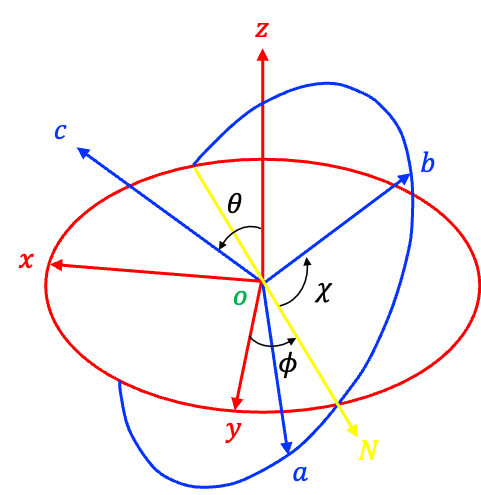
For symmetric rotors, the electric dipole moment lies along the principal molecular axis (-axis). However, there is a third quantum number to consider.  If  also lies along the principal axis, the wavefunction can be approximated as the product of three functions (known as the Wigner D-functions), where depends solely on the quantum number and  is one of three Euler angles (see diagram above). The matrix element can then be expressed as a product of three integrals over the Euler angles, with one of the integrals being . Since is independent of ,

For this integral to be non-zero, we must have . In other words, the rotational transition selection rules for symmetric rotors are:


Question

Is the effect of nuclear statistics on rotational states different from rotational selection rules?

Answer

The effect of nuclear statistics on rotational states is a separate, yet related, concept from the general rotational selection rules. While both influence which rotational states are observed in a spectrum, they operate based on different fundamental principles. The key distinction is that rotational selection rules dictate the possible transitions, while nuclear statistics determine the relative populations of the initial states. A transition must be both “allowed” by the selection rules and originate from a “populated” state to be observed. Therefore, nuclear statistics modify the intensity of the allowed transitions without changing the fundamental rule of which transitions are allowed.


Next article: Microwave spectroscopy (Instrumentation)
Previous article: Effect of nuclear statistics on rotational states
Content page of rotational spectroscopy
Content page of advanced chemistry
Main content page

Molecular rotational energies

Molecular rotational energies are quantised states arising from rotation about principal axes, determined by the moments of inertia. These levels are fundamental in molecular spectroscopy.


Diatomic rigid rotor

For a diatomic rigid rotor, the rotational Hamiltonian is given by eq4a, . Here, is the square of the total angular momentum operator, with the eigenvalues (derived using orbital angular momentum ladder operators), where is the rotational quantum number and . Therefore, the rotational energy levels of a diatomic molecule are given by:

Eq44 can also be expressed in terms of the rotational constant :

where is the Planck constant and is the speed of light.

However, rotational energies are typically reported as wavenumbers in molecular spectroscopy. Substituting and into eq45 yields , which is a function of . Therefore,

This indicates that the separation between adjacent rotational levels increases linearly with (see above diagram), as given by:

Furthermore, each energy level (i.e. eq44 for a particular value of ) is -fold degenerate due to the allowed eigenvalues of the component of angular momentum, which are , where . In the absence of an external magnetic field, these sublevels are degenerate.


Other linear rotors

A rigid linear triatomic molecule (e.g. HCN) behaves similarly as a diatomic rigid rotor when rotating about an axis perpendicular to its bond axis. The moment of inertia about the molecular axis is essentially zero due to the absence of perpendicular mass displacement. Therefore, the rotational energy levels are, per eq44:

where is given by eq15.

Similar to diatomic molecules, each is -fold degenerate in the absence of an external magnetic field.


Question

Is C2H2 also a linear rotor?

Answer

Yes. Its rotational energy levels are also given by eq44 and eq46.


Symmetric rotors

Symmetric rotors have two equal moments of inertia about mutually orthogonal axes. Each of these is perpendicular to a third rotational axis associated with a distinct, non-zero moment of inertia . If , the molecule is known as a prolate symmetric rotor (shaped like a cigar) and rotates more easily around the principal axis. Examples include NH3 and CHCl3. If , the molecule is called an oblate symmetric rotor (flattened like a disc), and it rotates more easily around an axis perpendicular to the disc. Examples include C6H6 and BF3.

The rotational Hamiltonian of a rigid symmetric rotor in the molecule-fixed frame is given by eq4d (by replacing the orthogonal lab-frame axes  with orthogonal molecular axes ):

Conventionally, and . Furthermore, from eq75, . Therefore,

With reference to eq132, and replacing the notations , and with , and , where , we have . It follows that the rotational energy levels of a rigid symmetric rotor are given by:


Question

Is a quantum number? Is it the same as (or )?

Answer

In eq48, refers to the component of the angular momentum operator along the symmetry axis (or -axis) in the molecule-fixed frame, not the -axis in the laboratory frame. Although its eigenvalues have the same form as those of in the laboratory frame, it is a different quantum number from  (or ). An analogy can be made with the projections of the spin vector of a spinning top: its projection along its own axis differs in general from the projection along an arbitrary laboratory axis, unless the axes are aligned. While both projections can take similar ranges of values (assuming these values are quantised), they are not equal in general. Likewise,  and are related to projections in different frames and are different quantum numbers.


Substituting and into eq49 yields:

Substituting and into eq50 gives , which is a function of two rotational quantum numbers and . Therefore,

When , there is only one distinct moment of inertia, with eq51 reducing to eq46, where . In this case, each is -fold degenerate in the absence of an external magnetic field. If , is determined by the magnitudes of and . Since is the same for and for each in eq49, the energy levels for and are degenerate. Additionally, there are possible  substates for each value of . Therefore, the total degeneracy when is in the absence of an external magnetic field.


Spherical rotors

A spherical rotor has three equal moments of inertia about three mutually orthogonal axes. It belongs to a point group that is a parent group of that of a symmetric rotor. Therefore, the rotational energy levels of a spherical rotor can be described by eq49 with , which is equivalent the condition in eq50. This implies that remains a function of both and , and that for a given energy level, is not restricted to just two values (as in the case of a symmetric rotor), but can take on different values. It follows that each energy level is -fold degenerate in the absence of an external magnetic field.


Next article: Effect of nuclear statistics on rotational states
Previous article: Moments of inertia of spherical rotors
Content page of rotational spectroscopy
Content page of advanced chemistry
Main content page

Moments of inertia of spherical rotors

A spherical rotor is a molecule in which the moments of inertia about all three principal axes are equal. This high degree of symmetry, typically found in molecules with tetrahedral (e.g. methane, CH₄), octahedral (e.g. sulfur hexafluoride, SF₆), or icosahedral geometries, leads to simplified rotational behaviour. Unlike asymmetric or symmetric rotors, spherical rotors exhibit degenerate energy levels due to their identical rotational constants along each axis. As a result, they serve as important models in quantum mechanics and spectroscopy, particularly for interpreting rotational spectra and understanding molecular symmetry.

The left diagram above shows an octahedral molecule of the type BA6 ( symmetry), where B is the central atom. The moment of inertia along the -axis, which is equal to those along the -axis and -axis, is or


Question

Why do the three atoms that lie along the -axis not contribute to ?

Answer

In general, . Since the three atoms along the rotational axis, the moment of inertia about this axis is effectively zero due to the absence of perpendicular mass displacement ().


To determine the moment of inertia of the tetrahedral molecule around the -axis, let atom B be at the centre of a cube (see diagram above), which is designated as the origin . The four A atoms (, , and ) are located at alternating vertices, with coordinates: , , and , where  is the half the length of an edge of the cube.

Since the B-A bond length is , we have , which when substituted back into the coordinates yields: , , and . Therefore, the moment of inertia of the tetrahedral molecule around the -axis is:


Next article: Molecular rotational energies
Previous article: Moments of inertia of a trigonal planar oblate symmetric rotor with D3h symmetry
Content page of rotational spectroscopy
Content page of advanced chemistry
Main content page

Moments of inertia of a trigonal planar oblate symmetric rotor with \(D_{3h}\) symmetry

The moments of inertia of a trigonal planar oblate rotor with symmetry (e.g. BF3) are characterised by a unique moment of inertia around the principal axis and two equal moments of inertia perpendicular to the principal axis, where . They are derived using simple geometric considerations.

The diagram above shows a trigonal planar oblate rotor with its centre of mass located at atom B (of mass ), which is positioned at the origin . The three A atoms (1,2 and 3), each with mass , are equally spaced at 120° apart on an imaginary circle of radius .

The moment of inertia along the -axis, which is perpendicular to the plane of the diagram, is . Since the three B-A bonds have equal lengths of , we have


Question

Why do  not contribute to ?

Answer

In general, . Since atom B lie along the rotational axis, the moment of inertia about this axis is effectively zero due to the absence of perpendicular mass displacement ().


To derive , we can make use of the coordinates of the atoms that form the base of a trigonal pyramidal molecule mentioned in an earlier article, where and :

Atom Coordinates
Trigonal pyramidal Trigonal planar
A1
A2
A3

Therefore,  or

Similarly, .


Next article: Moments of inertia of spherical rotors
Previous article: Moments of inertia of octahedral prolate symmetric rotor with D4h symmetry
Content page of rotational spectroscopy
Content page of advanced chemistry
Main content page

Moments of inertia of octahedral prolate symmetric rotor with \(D_{4h}\) symmetry

The moments of inertia of an octahedral prolate rotor with symmetry (e.g. Pt(NH3) 2Cl4) are characterised by a unique moment of inertia around the principal axis and two equal moments of inertia perpendicular to the principal axis, where . They are derived using simple geometric considerations.

The diagram above shows an octahedral molecule of the type BA4C2, where B is the central atom. The moment of inertia along the -axis is . Since the four B-A bonds have equal lengths of , we have


Question

Why do and  not contribute to ?

Answer

In general, . Since atoms B and C lie along the rotational axis, the moment of inertia about this axis is effectively zero due to the absence of perpendicular mass displacement ().


Similarly, the moment of inertia of the molecule about the -axis, which is equal to that about the -axis, is . Since the two B-C bonds have equal lengths of , we have

You’ll find that the expression for the moment of inertia about the -axis is the same as eq36.


Next article: Moments of inertia of a trigonal planar oblate symmetric rotor with D3h symmetry
Previous article: Moments of inertia of tetrahedral prolate symmetric rotor with C3v symmetry
Content page of rotational spectroscopy
Content page of advanced chemistry
Main content page

Moments of inertia of tetrahedral prolate symmetric rotor with \(C_{3v}\) symmetry

The moments of inertia of a tetrahedral prolate rotor with symmetry (e.g. CHCl3) are characterised by a unique moment of inertia around the principal axis and two equal moments of inertia perpendicular to the principal axis, where . They are derived using simple geometric considerations.

Since the rotation about the axis (-axis) of the molecule has the same symmetry as a trigonal pyramidal molecule, the moment of inertia for symmetric rotors like CHCl3 along the -axis is given by eq22:

To derive the expression for , place the origin at the centre of mass of the molecule. The -coordinates of atom C, atom B and each of the A atoms are , and respectively. Then, the centre of mass of the molecule satisfies or

with

Using the and  coordinates of the three A atoms defined in the previous article, the positions of the atoms are:

Atom Coordinates
C
B
A (point F)
A (point I)
A (point E)

Since , the moment of inertia of the molecule about the -axis is . Substituting the data from the above table and eq23 into this equation gives:

You’ll find that substituting the data from the above table into the expression for the moment of inertia of the molecule about the -axis , and then substituting eq23 into the resultant equation, yields the same expression as eq33. Therefore, eq22 and eq33 represent two distinct moments of inertia of a tetrahedral prolate rotor with symmetry.


Question

Does eq33 apply to CH3Cl, where the centre of mass of the molecule is between C and Cl?

Answer

Yes it does. Eq33 applies to any tetrahedral prolate rotor with symmetry. You can convince yourself by deriving the expression using the geometry of CH3Cl.


Next article: Moments of inertia of octahedral prolate symmetric rotor with D4h symmetry
Previous article: Moments of inertia of trigonal pyramidal prolate symmetric rotor with C3v symmetry
Content page of rotational spectroscopy
Content page of advanced chemistry
Main content page

Moments of inertia of trigonal pyramidal prolate symmetric rotor with \(C_{3v}\) symmetry

The moments of inertia of a trigonal pyramidal prolate rotor with symmetry (e.g. NH3) are characterised by a unique moment of inertia around the rotational axis (-axis) and two equal moments of inertia perpendicular to the axis, where . They are derived using simple geometric considerations.

The structure on the right of the above diagram illustrates the geometry of the central atom B (with mass ) and two of the three A atoms, each with mass . Let be the angle between an A-B-A bond (between FG and GI), be the angle between a B-A bond and the -axis (GH) and be the length of each B-A bond. According to the VSEPR theory, .

Applying the cosine rule on gives . Since , we have

Using the cosine rule again on and noting that yields . Substituting eq20 into this equation results in

Hence, the moment of inertia for symmetric rotors like NH3 along the -axis is:

To derive , we begin by noting that the centre of mass of the molecule (green sphere) lies along the -axis (one of three principal axes of rotation), between atom B and the plane formed by the three A atoms (see diagram below). The -axis and -axis are orthogonal to the -axis and to each other. They intersect at the centre of mass but do not intersect any of the B-A bonds.

The relationship between the angles and is established by letting atom B be the origin and the three A atoms at angles 0°, 120°, 240° around the -axis. Furthermore, let be the unit vector pointing from atom B to atom A at F, and be the unit vector pointing from atom B to atom A at I (see diagram below).

The dot product of the two vectors is given by or , which is equivalent to

Importantly, eq23 is independent of the choice of origin or reference frame even though it was derived with atom B as the origin.

Now, let’s place the origin at the centre of mass of the molecule. The -coordinates of atom B and each of the A atoms are and respectively. Then, the centre of mass of the molecule satisfies or

with  or

Since the position of the centre of mass relative to that of atom B only involves a shift in the -direction, the and coordinates of the three A atoms are those defined by the unit vectors above multiplied by the factor . Therefore, the positions of the atoms are:

Atom

Coordinates

B

A (point F)

A (point I)

A (point E)


Question

Derive the and  coordinates of atom A at point E.

Answer

With reference to the diagram below, we have .


Since , the moment of inertia of the molecule about the -axis is:

Substituting the data from the above table into eq26 and simplifying gives:

Substituting eq23 into eq27 and simplifying yields:

You’ll find that substituting the data in the above table into the moment of inertia of the molecule about the -axis results in the same expression as eq28. Therefore, eq22 and eq28 are the two distinct moments of inertia of a trigonal pyramidal prolate rotor with symmetry.


Next article: Moments of inertia of tetrahedral prolate symmetric rotor with C3v symmetry
Previous article: Moments of symmetric rotors
Content page of rotational spectroscopy
Content page of advanced chemistry
Main content page
Mono Quiz