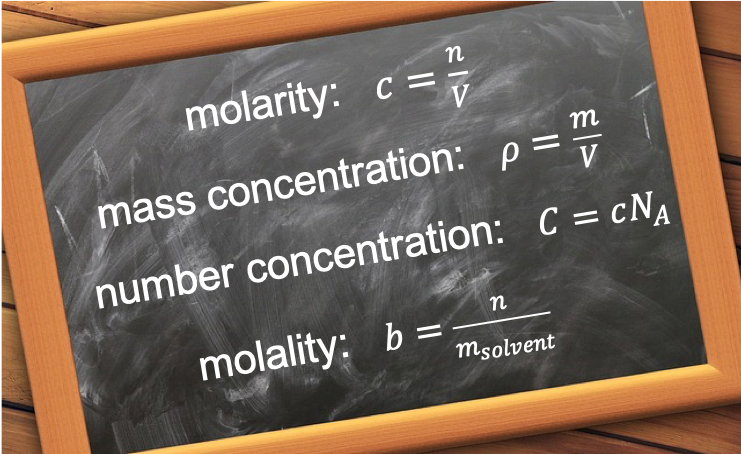
The concentration of a chemical species in a solution can be expressed in several ways, namely,
i) Molar concentration or molarity
The molar concentration, c, of a solute (i.e. a chemical species in a solvent) is defined as
where n is the number of moles of the solute and V is the volume of the solvent.
V is usually expressed in units of L, dm3 or cm3, which means that the molar concentration, c, has units of mol L-1, mol dm-3 or mol cm-3 respectively, even though the SI unit for c is mol m-3. As the units mol L-1 and mol dm-3 are equivalent and most commonly used, they are given the symbol M, which is called molar (not to be confused with molar mass, M). For example,
Q: How many moles of NaCl are there in 250.0 mL of a 0.100 M sodium chloride solution?
A:
ii) Mass concentration
The mass concentration, ρ, of a solute is defined as
where m is the mass of the solute in grams and V is the volume of the solvent, usually in dm3 or cm3.
For a pure chemical, e.g. water or molten iron, the mass concentration equals its density. A chemical species’ mass concentration can be converted to its molarity by dividing it with its molar mass, M:
iii) Number concentration
The number concentration (or number density), C, of a solute is defined as
where NA is the Avogadro constant.
Number concentration is used when the number of particles in a particular volume is countable, e.g., macromolecules.
iv) Molality
The molality, b, of a solute is defined as
where msolvent is the mass of the solvent and the units for b is mol kg-1.
Molality is sometimes preferred over molarity in measuring the concentration of a chemical species, as the latter varies according to temperature due to thermal expansion.
v) Percentage concentration
Percent concentration is the amount of solute present in a solution expressed as a percentage of the total solution, based on mass, volume, or both.
The concentration of a commercial aqueous reagent, such as 37% (w/w) HCl (about 12 M), is usually expressed as weight percent. Although HCl is a liquid at room temperature, it is actually a gas dissolved in water. Therefore, measuring its concentration in weight percent, which is independent of temperature, is more precise.
The concentrations of aqueous laboratory reagents, prepared by laboratory technicians diluting commercial reagents, are described by volume percent. For example, 70% (v/v) ethanol is prepared by adding enough water to 700 ml of absolute ethanol to form a 1 L solution. Finally, weight/volume percent is often expressed as g/mL. It is used to denote the concentration of a dissolved solid reagent, such as 5% (w/v) aqueous potassium iodide, which contains 5 g of KI in 100 mL of solution.

Question
What is 50% (w/w) NaOH in (w/v), given g/mL?
Answer
50% (w/w) NaOH contains 50 g of NaOH in a 100 g solution. Since the volume of 100 g of NaOH solution is 100/1.525 mL, the corresponding (w/v) is [(50 x 1.525)/100] x 100% = 76.3%.
vi) Parts per million (ppm)
See the next article for details.