jj-coupling is an atomic coupling scheme used to determine the total angular momentum of heavy multi-electron atoms from the angular momenta of individual electrons.
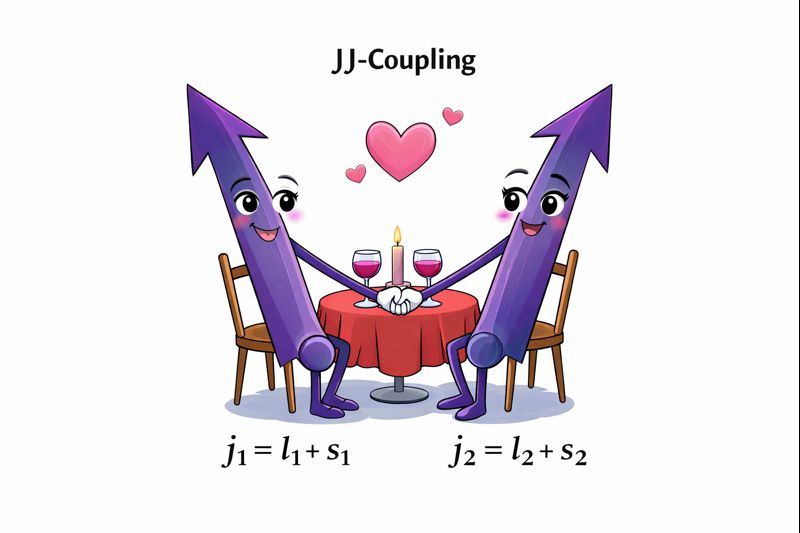
As mentioned in the previous article, Russell-Saunders (LS) coupling applies to light atoms, where spin-orbit interactions are weak compared to electron–electron Coulomb interactions (). In this regime, the total orbital angular momentum
and total spin angular momentum
are good quantum numbers because the spin-orbit Hamiltonian
satisfies the commutation relation
. The good quantum atomic states are therefore described by
.
jj-coupling becomes appropriate when spin–orbit interactions are strong compared to the residual electrostatic interactions between electrons, as is typical in heavy atoms. In this regime, each electron’s orbital and spin angular momenta couple to form an individual total angular momentum , and the total angular momentum of the atom is obtained by vectorially adding these:
. The corresponding spin-orbit Hamiltonian is
.
Although , the total operators
and
do not commute with
, due to the cross terms such as
. Consequently,
and
are no longer good quantum numbers, and the atomic states are best described by
.