The root mean square speed of a gas provides a measure of the average molecular speed in the gas.
Consider a gas particle of mass \(m\) moving in a container to the right with velocity \(v\) (see diagram below). The change in momentum of the particle \(\Delta p\) in the \(x\)-coordinate before and after colliding elastically with a surface of the container is
$$\Delta p=-mv_x-mv_x=-2mv_x\;\;\;\;\;\;\;\;(1)$$
with the particle colliding the same surface every
$$\Delta t=\frac{dist}{speed}=\frac{2L}{\vert v_x\vert}\;\;\;\;\;\;\;\;(2)$$
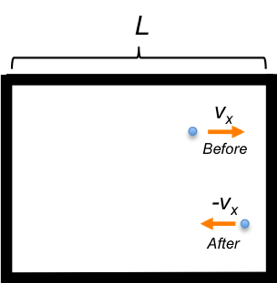
The force \(F\) acting on the particle at collision is
$$F=m\frac{\Delta v}{\Delta t}=\frac{\Delta p}{\Delta t}=-\frac{mv_x^2}{L}\;\;\;\;\;\;\;\;(3)$$
By Newton’s third law, the force acting on the surface of the container by the particle is
$$F=\frac{mv_x^2}{L}\;\;\;\;\;\;\;\;(4)$$
The total force \(F_T\) exerted on the surface by \(N\) particles is
$$F_T=\frac{mv_{x,1}^2}{L}+\frac{mv_{x,2}^2}{L}+\cdots+\frac{mv_{x,N}^2}{L}=\frac{Nm\overline{v_x^2}}{L}\;\;\;\;\;\;\;\;(5)$$
where \(\overline{v_x^2}=\frac{v_{x,1}^2+v_{x,2}^2+\cdots+v_{x,N}^2}{N}\) .
Comparing \(\overline{v_x^2}\) and the definition of root mean square speed, we have \(\overline{v_x^2}=v_{x,rms}^2\), i.e. the square of the root mean square speed of the gas in the \(x\)-direction.
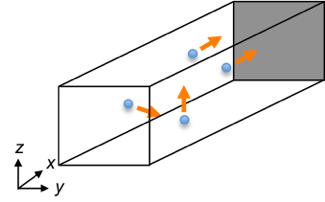
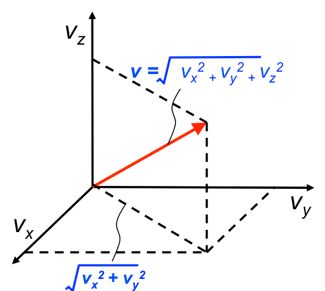
If the container is three-dimensional (see above diagram), the velocity vector for a particle in Cartesian coordinates in three dimensions is:
$$v^2=v_x^2+v_y^2+v_z^2\;\;\;\;\;\;\;\;(6)$$
Even though a particle has three velocity components in space, the force exerted on the shaded wall is dependent only on the \(x\)-component velocity of the particle.
To express the root mean square speed for \(N\) particles, let’s begin by summing the squares of the velocity vectors of all particles:
$$v_1^2+v_2^2+\cdots+v_N^2=(v_{x,1}^2+v_{y,1}^2+\cdots+v_{z,1}^2)+(v_{x,2}^2+v_{y,2}^2+\cdots+v_{z,2}^2)+\cdots+(v_{x,N}^2+v_{y,N}^2+\cdots+v_{z,N}^2)$$
Next, group the velocity components and divide the equation throughout by \(N\),
$$\frac{v_1^2+v_2^2+\cdots+v_N^2}{N}=\frac{(v_{x,1}^2+v_{x,2}^2+\cdots+v_{x,N}^2)}{N}+\frac{(v_{y,1}^2+v_{y,2}^2+\cdots+v_{y,N}^2)}{N}+\cdots+\frac{(v_{z,1}^2+v_{z,2}^2+\cdots+v_{z,N}^2)}{N}$$
$$\overline{v^2}=\overline{v_x^2}+\overline{v_y^2}+\overline{v_z^2}\;\;\;\;\;\;\;\;(7)$$
The velocity components of the particles in the container are assumed to be random, with the particles evenly distributed in the container at any time. \(v_x\), like \(v_y\) and \(v_z\), can be positive or negative, but their squares,\(v_x^2\), \(v_y^2\) and \(v_z^2\), are always positive. If the velocity components of the particles in the container are random, and the number of particles is very large,
$$\overline{v_x^2}=\overline{v_y^2}=\overline{v_z^2}\;\;\;\;\;\;\;\;(8)$$
Otherwise, there is a preference of direction in a particular axis and the particles’ movement is no longer random (you can convince yourself the validity of eq8 by summing the squares of three sets of randomly generated numbers in a spreadsheet and finding their averages; the larger the number of elements in each set, the closer the average values are to each other). Hence, we can rewrite eq7 as:
$$\overline{v^2}=3\overline{v_x^2}\;\;\;\;\;\;\;\;(9)$$
Substituting eq9 in eq5 gives
$$F_T=\frac{Nm\overline{v^2}}{3L}\;\;\;\;\;\;\;\;(10)$$
The pressure \(p\) (not to be confused with momentum) exerted by \(N\) particles on the shaded wall is
$$p=\frac{F_T}{A}=\frac{Nm\overline{v^2}}{3V}$$
where \(V\) is the volume of the container.
Hence,
$$pV=\frac{1}{3}Nm\overline{v^2}=\frac{2}{3}N\left(\frac{1}{2}m\overline{v^2}\right)\;\;\;\;\;\;\;\;(11)$$
Substituting the ideal gas law in eq11 yields
$$nRT=\frac{1}{3}Nm\overline{v^2}=\frac{2}{3}N\left(\frac{1}{2}m\overline{v^2}\right)\;\;\;\;\;\;\;\;(11)$$
Since \(R=N_Ak\) (see this article for derivation ) and \(N=nN_A\),
$$nkT=\frac{2}{3}n\left(\frac{1}{2}m\overline{v^2}\right)$$
$$\frac{3}{2}kT=\frac{1}{2}m\overline{v^2}=\langle KE\rangle\;\;\;\;\;\;\;\;(12)$$
Since \(\overline{v^2}=\frac{v_1^2+v_2^2+\cdots+v_N^2}{N}\) and the root mean square speed is \(v_{rms}=\sqrt{\frac{v_1^2+v_2^2+\cdots+v_N^2}{N}}\), we have \(\overline{v^2}=v_{rms}^2\). Therefore,
$$v_{rms}=\sqrt{\frac{3kT}{m}}\;\;\;\;or\;\;\;\;v_{rms}=\sqrt{\frac{3RT}{M}}\;\;\;\;\;\;\;\;(13)$$
where \(M\) is the molar mass of the gas.
