Functional variation refers to the change in a functional’s output as a result of a small change in the functional’s input on a specified domain.

Question
What is a functional?
Answer
A functional is a function \(F[\phi]\) whose value depends on a function \(\phi\) instead of an independent variable. For example, the expectation value of the Hamiltonian is a functional, where \(F[\phi]=\left\langle\phi\vert\hat{H}\vert\phi\right\rangle\).
For a small variation in \(\phi\),
\(F[\phi+\delta\phi]=\left\langle\phi+\delta\phi\vert\hat{H}\vert\phi+\delta\phi\right\rangle=\left\langle\phi\vert\hat{H}\vert\phi\right\rangle+\left\langle\delta\phi\vert\hat{H}\vert\phi\right\rangle\)\(+\left\langle\phi\vert\hat{H}\vert\delta\phi\right\rangle+\left\langle\delta\phi\vert\hat{H}\vert\delta\phi\right\rangle\)
where \(\delta\phi\) is a small arbitrary change in \(\phi\).
Since \(\delta\phi\) is small, \(\left<\delta\phi\vert\widehat{H}\vert\delta\phi\right>=c(\delta\phi)^2\approx 0\), and
$$F[\phi+\delta\phi]=\left<\phi\vert\widehat{H}\vert\phi\right>+\delta E=F[\phi]+\delta E$$
where \(\delta E=\left<\delta\phi\vert\widehat{H}\vert\phi\right>+\left<\phi\vert\widehat{H}\vert\delta\phi\right>\).
If \(\delta E=0\), we have \(F[\phi+\delta\phi]=F[\phi]\) or
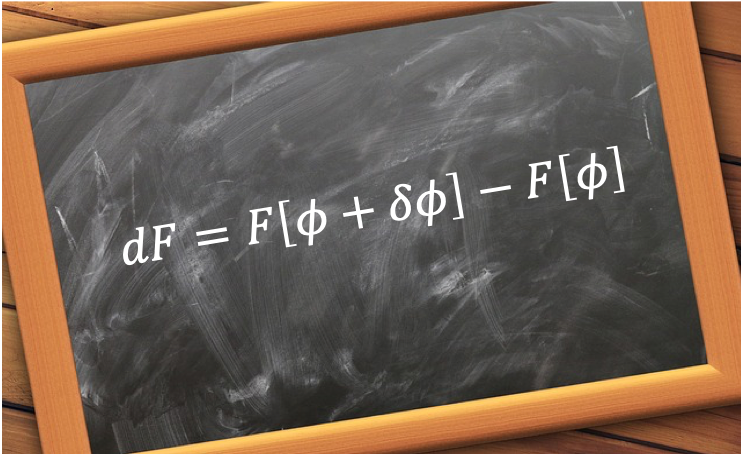
$$dF=F[\phi+\delta\phi]-F[\phi]=0\;\;\;\;\;\;\;\;(14a)$$
which means that a small change in the functional’s input yields no change in the functional’s output. This implies a minimum energy according to the variational principle.