A set is collection of different mathematical objects called elements, which can be numbers, people, colours, matrices, etc. Examples of sets are {4, 20, 83, 1059, …} and {red, blue, cyan, grey}, where the former is an infinite set and the latter is a finite set. Two sets \(A\) and \(B\) are equal if they have the same elements, e.g. \(A=\{3,10,17\}\) and \(B=\{17,3,10\}\). A set with no element, denoted by \(\varnothing\), is called an empty set. An element \(k\) in a set \(A\) is denoted by \(k\in A\).
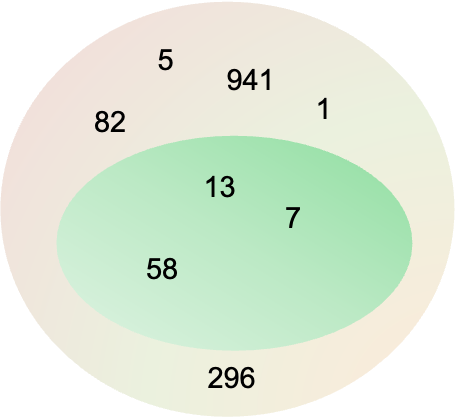
A subset is an equal or smaller collection of elements of a particular set. With reference to the above diagram, the set \(A=\{7,13,58\}\) is a subset of the set \(B=\{1,5,7,13,58,82,296,941\}\), which is mathematically denoted by \(A\subseteq B\). Similarly, \(\varnothing\subseteq B\) and \(B\subseteq B\).

Question
Is \(\{3,10,17,3\}\) a set.
Answer
No, because a set is defined as a collection of different elements.