An operator in a vector space
maps a set of vectors
to another set of vectors
(or transforms one function into another function), where
. For example, the operator
transforms the function
into
:
Linear operators have the following properties:
For property 1, the input state is a linear combination of two basis states. Suppose
,
and
, then the output state is
. This has implications for quantum mechanics (see diagram below for an illustration).
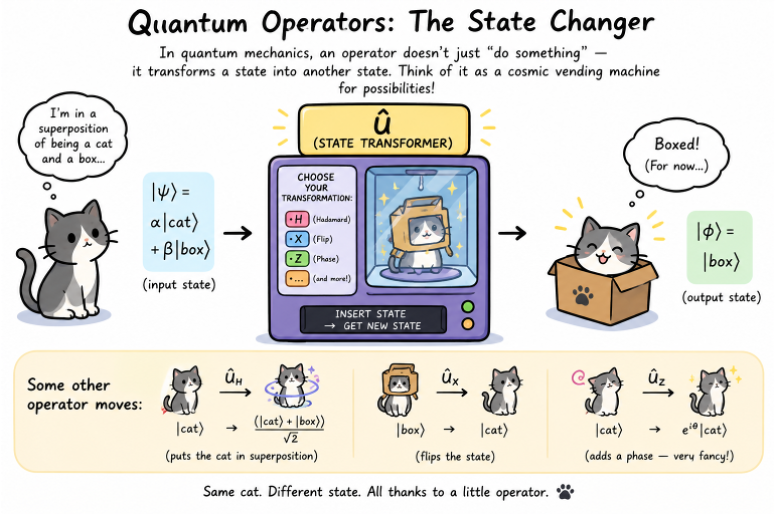
Conversely, the operator can transform
into a linear combination of
and
:
where the resulting state can be normalised to .
can also be transformed (or flipped) into
using
, while a phase can be added to
using
, where
is the phase angle.
Two operators commonly encountered in quantum mechanics are the position and linear momentum operators. To construct these operators, we refer to probability theory, where the expectation value of the position of a particle in a 1-D box of length
is
where is the probability of observing the particle at a particular position between
and
, and
is the particle’s wavefunction, which is assumed to be real.
Comparing the above equation with the expression of the expectation value of a quantum-mechanical operator, .
One may infer that the linear momentum operator is . However, we must find a form of
that is a function of
so that we can compute
. If we compare the time-independent Schrodinger equation
with the total energy equation
, we have
.
To test the validity of and
, we compute
and
using the 1-D box wavefunction of
and check if the results are reasonable with respect to classical mechanics.
Integrating by parts, we have
. In classical mechanics, the particle can be anywhere in the 1-D box with equal probability. Therefore, the average position of
is reasonable.
For the linear momentum operator, we have . Since
, we expect
. Therefore,
and
are reasonable assignments of the position and linear momentum operators respectively. In 3-D, the position and linear momentum operators are:
To see the proof that the position and linear momentum operators are Hermitian, read this article.