A vector space is a set of objects that follows specific rules of addition and multiplication.
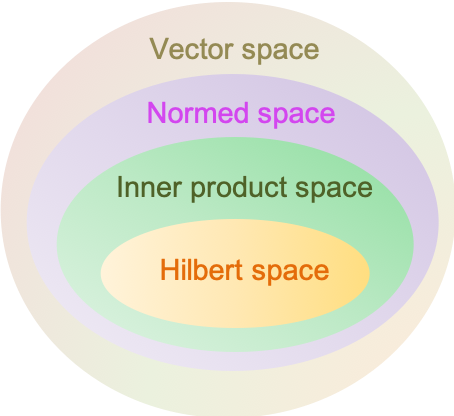
These objects are called vectors and the rules are:
1) Commutative and associative addition for all elements of the closed set.
$$\boldsymbol{v_{1}}+\boldsymbol{v_{2}}=\boldsymbol{v_{2}}+\boldsymbol{v_{1}}$$
$$(\boldsymbol{v_{1}}+\boldsymbol{v_{2}})+\boldsymbol{v_{3}}=\boldsymbol{v_{1}}+(\boldsymbol{v_{2}}+\boldsymbol{v_{3}})$$
2) Associativity and distributivity of scalar multiplication for all elements of the closed set
$$c_1(c_2\boldsymbol{v_{1}})=(c_1c_2)\boldsymbol{v_{1}}$$
$$c_1(\boldsymbol{v_{1}}+\boldsymbol{v_{2}})=c_1\boldsymbol{v_{1}}+c_1\boldsymbol{v_{2}}$$
$$(c_1+c_2)\boldsymbol{v_{1}}=c_1\boldsymbol{v_{1}}+c_2\boldsymbol{v_{1}}$$
where \(c_1\) and \(c_2\) are scalars.
3) Scalar multiplication identity.
$$\boldsymbol{1}\boldsymbol{v_{1}}=\boldsymbol{v_{1}}$$
4) Additive inverse.
$$\boldsymbol{v_{1}}+(-\boldsymbol{v_{1}})=0$$
5) Existence of null vector \(\boldsymbol{0}\), such that
$$\boldsymbol{0}+\boldsymbol{v_{1}}=\boldsymbol{v_{1}}$$
In a vector space \(V=\left \{\boldsymbol{v_{1}},\boldsymbol{v_{2}},\cdots ,\boldsymbol{v_k}\right \}\), one vector can be expressed as a linear combination of other vectors in the set, e.g.:
$$\boldsymbol{z}=c_1\boldsymbol{v_{1}}+c_2\boldsymbol{v_{2}}+\cdots+c_k\boldsymbol{v_k}$$
The span of a set of vectors \(V\) is the set of vectors that can be written as a linear combination of vectors in the set . For example, the span of the set of unit vectors \(\boldsymbol{\hat{i}}\) and \(\boldsymbol{\hat{j}}\) in the \(\mathbb{R}^{2}\) space is the set of all vectors (including the null vector) in the \(\mathbb{R}^{2}\) space. Alternative, we say that \(\boldsymbol{\hat{i}}\) and \(\boldsymbol{\hat{j}}\) span \(\mathbb{R}^{2}\).
If we vary \(c_1,c_2,\cdots c_k\) (but not the trivial case where all scalars are zero) such that \(\boldsymbol{z}\) is equal to \(\boldsymbol{0}\),
$$c_1\boldsymbol{v_1}+c_2\boldsymbol{v_2}+\cdots+c_k\boldsymbol{v_k}=\boldsymbol{0}\; \; \; \; \; \; \;\; 1$$
the set of vectors \(\boldsymbol{v_1},\boldsymbol{v_2},\cdots\boldsymbol{v_k}\) is said to be linearly dependent because any vector can be written as a linear combination of the others:
$$\boldsymbol{v_1}=\frac{-c_2}{c_1}\boldsymbol{v_2}+\cdots+\frac{-c_k}{c_1}\boldsymbol{v_k}\; \; \; \; \; \; \; \; 2$$
If the only way to satisfy eq1 is when \(c_k=0\) for all \(k\), the set of vectors is said to be linearly independent. In this case, we can no longer express any vector as a linear combination of the other vectors (as \(c_1=0\), resulting in RHS of eq2 being undefined). An example of a set of linearly independent vectors is the set of unit vectors \(\boldsymbol{\hat{i}}\), \(\boldsymbol{\hat{j}}\) in the \(\mathbb{R}^{2}\) space.

Question
Can a set of linearly independent vectors include the zero vector?
Answer
No, because if \(\boldsymbol{v_{1}}=0\) and \(c_2,\cdots ,c_k=0\) in eq1, then \(c_1\) can be any number. Since \(c_1\) is not necessarily 0, it contradicts the definition of linear independence.
A set of \(\textit{N}\) linearly independent vectors in an \(\textit{N}\)-dimensional vector space \(\textit{V}\) forms a set of basis vectors, \(\boldsymbol{e_1},\boldsymbol{e_2},\cdots,\boldsymbol{e_N}\). A complete basis set is formed by a set of basis vectors of \(\textit{V}\) if any vector \(\boldsymbol{x}\) in the span of \(\textit{V}\) can be written as a linear combination of those basis vectors, i.e.
$$\boldsymbol{x}=\sum_{i=1}^{N}x_i\boldsymbol{e_i}$$
