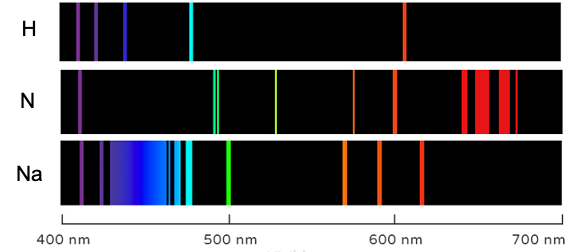
Atomic Absorption Spectroscopy (AAS) and Atomic Emission Spectroscopy (AES) are analytical techniques used to determine the concentration of elements by measuring the interaction of free atoms in the gaseous state with electromagnetic radiation.
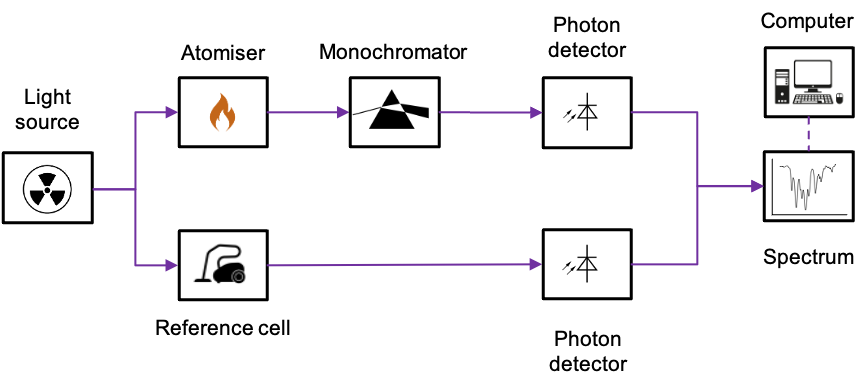
A typical atomic absorption spectrometer consists of a light source, such as a hollow cathode lamp (HCL), which emits light characteristic of the element being analysed (see diagram above). The light is split into two beams by mirrors, with one beam passing through an atomiser, where the sample atoms are introduced using a nebuliser and then vaporised by an air-acetylene flame. The other beam is directed through a vacuum reference cell.

Question
Explain how the HCL works.
Answer
A HCL emits narrow wavelengths of light because its operation is based on the specific electronic energy levels of a single element. Inside the lamp, the cathode is made of the element to be analysed (for example, copper or sodium), and the tube is filled with an inert gas such as neon or argon. When a high voltage is applied, the inert gas becomes ionised, producing positively charged gas ions. These ions accelerate towards the cathode and strike its surface, knocking out atoms of the cathode material in a process called sputtering. Some of these sputtered atoms are excited by collisions within the lamp. When their electrons return from higher energy levels to lower ones, they emit light. Because the energy differences between electronic levels in atoms are fixed and discrete, the emitted photons have very specific energies (wavelengths). As a result, the lamp produces a spectrum consisting of sharp emission lines rather than a broad range of wavelengths. Since the cathode is made of only one element, the emitted lines correspond almost exclusively to that element, giving the hollow cathode lamp its narrow, characteristic output. For example, if the cathode is made of sodium, the emitted light involves the 3p → 3s energy levels, corresponding to:
2P3/2 → 2S1/2 ( ≈ 589.0 nm: D2 line)
2P1/2 → 2S1/2 ( ≈ 589.6 nm: D1 line)
N.B: Click this link to understand how the above atomic term symbols are derived.
As the light passes through the cloud of gaseous atoms in the atomiser, it is absorbed at specific wavelengths corresponding to electronic energy level transitions. The transmitted light then passes into a monochromator, which isolates the specific wavelength absorbed by the element of interest, removing any unwanted radiation.
The two beams, emerging from the monochromator and the reference cell respectively, are subsequently directed to separate detectors, typically photomultiplier tubes. Here, the intensities of the transmitted and reference light are measured. The signals are then compared by a signal processor, which compensates for fluctuations in the light source and instrumental noise. Finally, the processed signal is converted into an electrical output and displayed, typically as absorbance, allowing the concentration of the element in the sample to be determined.
To analyse the concentrations of multiple elements in a sample (see above diagram), the light source may adopt one of the following designs:
-
- Lamp turret: Several HCLs, each with a cathode made of a different element, are automatically rotated to emit different wavelengths of light. Measurements are then taken sequentially.
- Multi-element lamps: A single HCL, in which the cathode is made from an alloy or a mixture of metal powders (e.g. a combination of cobalt, chromium, copper, iron, manganeses and nickel), is used. Sensitivity is usually lower than that of single-element lamps.
- Continuum source: More modern instruments use a broadband light source, such as a xenon lamp. This provides a broad spectrum of light, allowing the detector to measure multiple elements at different wavelengths without changing lamps.
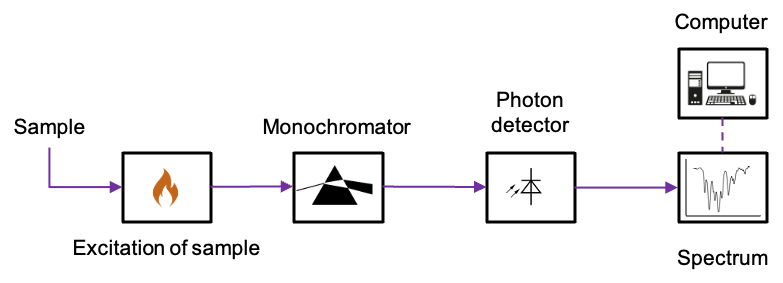
Atomic Emission Spectroscopy (AES) differs from AAS in that it does not use an external light source (see diagram above); instead, the sample itself is energetically excited using a high-energy source such as a flame, electric arc, spark or inductively coupled plasma (ICP). As the excited atoms spontaneously return to lower energy levels, they emit light at characteristic wavelengths, and this emitted radiation is measured directly. In AES, there is no need for a reference beam or a hollow cathode lamp, and the signal is based on emission intensity rather than absorption.
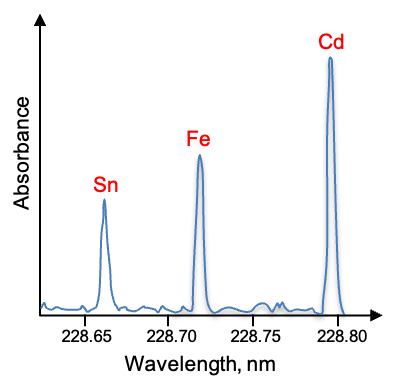
Modern AES instruments use monochromators with high resolving power, which can separate wavelengths that are extremely close together, enabling multi-element analysis. The computer records a composite spectrum but presents the results as individual element concentrations by filtering the data using its wavelength database. The emission spectra of individual elements can also be derived from the composite spectrum by the software (see diagram below).