Electronic spectroscopy is the study of how atoms or molecules absorb or emit light due to transitions of electrons between different energy levels.
When atoms or molecules absorb energy, typically in the ultraviolet or visible regions of the spectrum, electrons can be promoted from lower-energy (ground) states to higher-energy (excited) states. Conversely, when these excited electrons return to lower energy levels, energy is released, often in the form of light. These absorption and emission processes form the basis of electronic spectra.
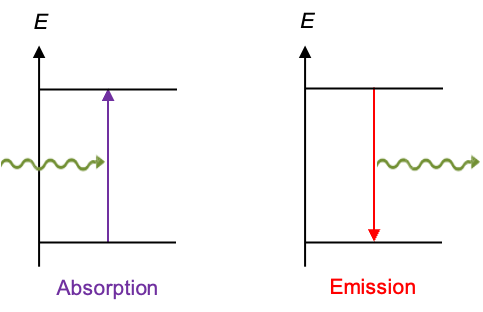
The resulting spectra are highly characteristic of the substance being studied. Because each element or compound has a unique arrangement of electrons and energy levels, the wavelengths of light they absorb or emit act like a fingerprint. This makes electronic spectroscopy a powerful analytical tool in chemistry, physics, and materials science for identifying substances and studying their structure.
An important branch of electronic spectroscopy is atomic spectroscopy, which focuses specifically on isolated atoms, usually in the gas phase. Unlike molecules, atoms have simpler electronic structures, so their spectra consist of sharp, well-defined lines rather than broad bands. Techniques such as atomic absorption spectroscopy (AAS) and atomic emission spectroscopy (AES) measure the specific wavelengths of light absorbed or emitted by atoms as their electrons transition between discrete energy levels. Because each element produces a unique line spectrum, atomic spectroscopy is widely used for precise elemental analysis in fields such as environmental testing, metallurgy and forensic science.
There are several other types of electronic spectroscopy, with ultraviolet-visible (UV-Vis) spectroscopy being one of the most common. In UV-Vis spectroscopy, a sample absorbs light in the ultraviolet or visible region, causing electronic transitions, particularly in molecules with conjugated systems or transition metal complexes. The intensity and position of absorption bands can provide information about concentration (via Beer–Lambert law), molecular structure and the nature of chemical bonds.
Another important form is fluorescence spectroscopy, where a substance absorbs light at one wavelength and then emits light at a longer wavelength. This technique is especially useful in biological and environmental studies due to its high sensitivity.
Overall, electronic spectroscopy serves as a bridge between light and matter, revealing the electronic structure and properties of substances through their interaction with radiation.