Stokes’ theorem states that the surface integral of the curl of a vector field over an oriented surface equals the line integral of the vector field around the boundary curve of that surface.
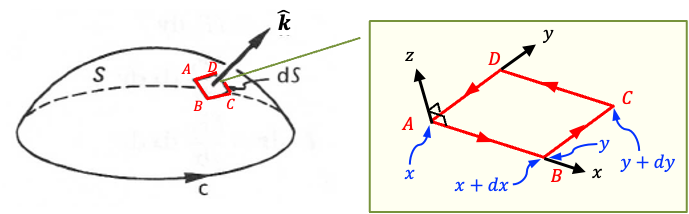
Consider a vector field defined on an open surface
bounded by a curve
(see diagram above).
Let the Cartesian axes and
coincide with the edges AB and AD of an infinitesimal rectangular patch ABCD on the surface such that
in the
-direction,
in the
-direction, and
. The line integral of
around the boundary of ABCD is given by:
where denotes the ABCD boundary curve, the circle on the integral symbol indicates that the integration is taken over a closed curve, and
.
For the edge AB, in
is constant, and so,
. For the edge BC,
in
is a constant at
, and so,
. For a multivariable function
, the first-order Taylor series about the point
is
Evaluating at the nearby point
, where
gives:
Therefore,
For the edge CD, in
is a constant at
, and so,
. Using Taylor expansion gives
. Finally, for the edge DA,
in
is a constant at
, and so,
.
Summing all line integrals of the four edges yields:
Notably,
where is called the curl of
.
So,
Substituting eq11 back into eq10 gives:
where .
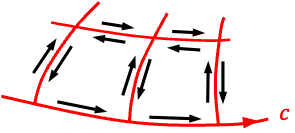
Summing over all infinitesimal rectangle patches that partition the surface results in
where the interior edges cancel pairwise, leaving only the contribution from the outer boundary (see diagram above).
Thus, the LHS of eq13 is equivalent to the line integral of around the boundary
, while the RHS becomes the surface integral of
over
:
which is the mathematical expression of the Stokes’ theorem.