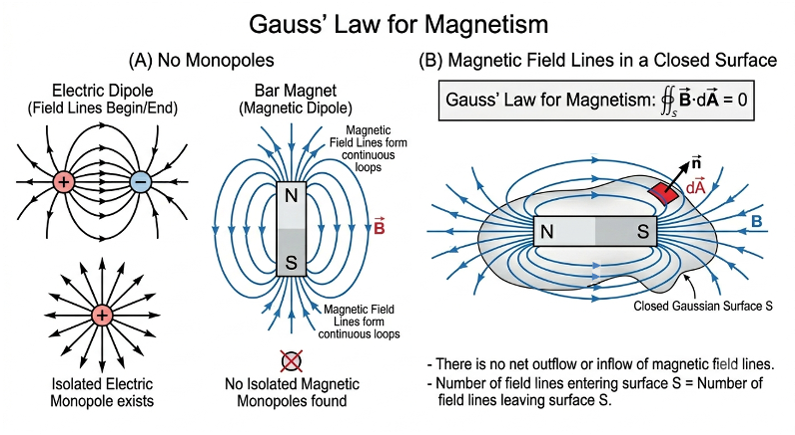
Maxwell’s second equation (Gauss’s law for magnetism) states that the net magnetic flux through any closed surface is zero.
Just like the electric flux through a surface in the derivation of Maxwell’s first equation is given by
, the magnetic flux
through a surface is given by:
where Gauss’s law for magnetism states that:
This law is empirical, meaning it is based on experimental observation rather than being derived from more fundamental principles. It arises from the fact that, in all experiments to date, magnetic fields have never been observed to have isolated sources or sinks (no magnetic monopoles). Instead, every magnet behaves as a dipole, with magnetic field lines forming closed loops that exit one pole and re-enter the other. This is what justifies Gauss’s law for magnetism as a fundamental postulate of classical electromagnetism.
Eq6 is the integral form of Maxwell’s second equation. Its differential form can be derived using Gauss’ theorem (also known as the divergence theorem), where . Applying the theorem to the magnetic field gives,
, and hence,
For this equation to hold for any arbitrary volume , the integrand itself must be zero everywhere:
Eq7 is the differential form of Gauss’ law for magnetism.