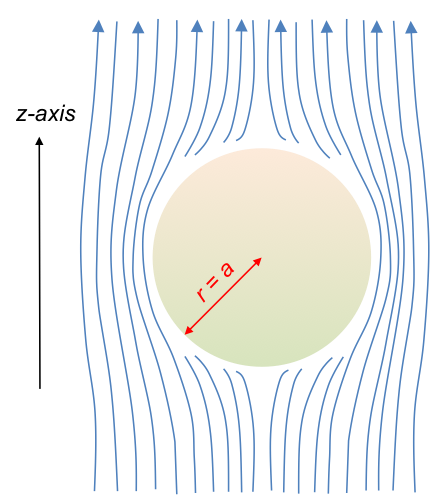
The derivation of the differential equation \(E^2(E^2\psi)=0\) is part of the steps in deriving Stoke’s law.
We have, in the previous section, derived the Navier-Stokes equation:
$$\rho\frac{D\textbf{u}}{Dt}=-\nabla p+\rho g+\mu \nabla^2\textbf{u}\; \; \; \; \; \; \; (32)$$
The terms \(\rho \frac{D\textbf{u}}{Dt}\) and \(\rho g\) are attributed to inertia forces, while the terms \(\nabla p\) and \(\mu \nabla^2\textbf{u}\) are due to hydrostatic forces and viscous forces respectively. For a very viscous fluid, the viscosity of the fluid is very high but fluid velocities are very low. Therefore, the non-inertia forces dominate the inertia forces and eq37 is reduced to:
$$\mu \nabla^2\textbf{u}=\nabla p\; \; \; \; \; \; \; (33)$$

Taking the curl on both sides of eq33,
$$\nabla \times \mu \nabla^2\textbf{u}=\nabla \times \nabla p$$
Since the curl of the gradient of a function is zero and the viscosity of an incompressible fluid is constant,
$$\nabla\times\mu \nabla^2\textbf{u}=0\; \; \; \; \Rightarrow \; \; \; \; \nabla\times\nabla^2\textbf{u}=0\; \; \; \; \; \; \; (33a)$$
Substituting eq14 where \(\nabla\cdot\textbf{u}=0\) in the vector identity \(\nabla^2\textbf{u}=\nabla\left ( \nabla\cdot \textbf{u}\right )-\nabla \times \left ( \nabla \times \textbf{u}\right )\), we get:
$$\nabla^2\textbf{u}=-\nabla\times\left ( \nabla\times \textbf{u}\right )\; \; \; \; \ (33b)$$
Substitute eq33b in eq33a
$$\nabla \times \nabla \times \left ( \nabla \times \textbf{u}\right )=0\; \; \; \; \; \; \; (34)$$
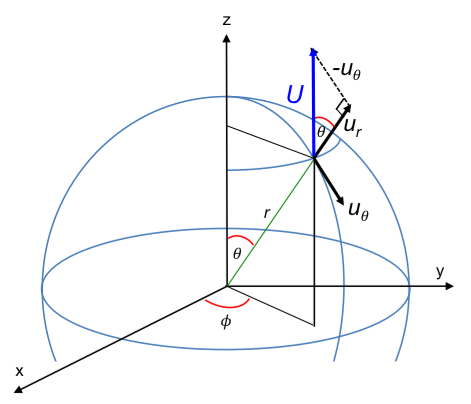
Assuming that the fluid is flowing in the \(e_\phi\) direction, eq3 becomes \(\textbf{u}=u_r\hat{r}+u_\theta \hat{\theta}\). Noting that the curl of a function in spherical coordinates is:
$$\nabla\times\textbf{u}=\frac{1}{rsin\theta}\left [ \frac{\partial }{\partial \theta}\left ( u_\phi sin\theta \right )-\frac{\partial }{\partial \phi}u_\theta \right ]\hat{r}$$
$$+\frac{1}{r}\left [\frac{1}{sin\theta} \frac{\partial }{\partial \phi} u_r-\frac{\partial }{\partial r}\left (ru_\phi \right ) \right ]\hat{\theta}+\frac{1}{r}\left [ \frac{\partial }{\partial r}\left (r u_\theta \right )-\frac{\partial }{\partial \theta}u_r \right ]\hat{\phi}$$
and substituting eq15 and eq16 in \(\textbf{u}=u_r\hat{r}+u_\theta \hat{\theta}\), we get:
$$\textbf{u}=\frac{1}{r^2sin\theta}\frac{\partial \psi}{\partial \theta}\hat{r}-\frac{1}{rsin\theta}\frac{\partial \psi}{\partial r}\hat{\theta}=\nabla\times \frac{\psi}{rsin\theta}\hat{\phi}\; \; \; \; \; \; \; (35)$$

Question
Show that \(\nabla\times\frac{\psi}{rsin\theta}\hat{\phi}=\frac{1}{r^2sin\theta}\frac{\partial \psi}{\partial \theta}\hat{r}-\frac{1}{rsin\theta}\frac{\partial \psi}{\partial r}\hat{\theta}\).
Answer
Using the curl of a function in spherical coordinates,
$$\nabla\times\left ( 0\hat{r}+0\hat{\theta}+\frac{\psi}{rsin\theta}\hat{\phi} \right )=\frac{1}{rsin\theta}\left [ \frac{\partial }{\partial \theta}\left ( \frac{\psi}{rsin\theta} sin\theta\right )-\frac{\partial }{\partial \phi}0 \right ]\hat{r}$$
$$+\frac{1}{r}\left [ \frac{1}{sin\theta}\frac{\partial }{\partial \phi}0-\frac{\partial }{\partial r}\left ( \frac{r\psi}{rsin\theta} \right ) \right ]\hat{\theta}\: +\frac{1}{r}\left [ \frac{\partial }{\partial r}r0-\frac{\partial }{\partial \theta}0 \right ]\hat{\phi}\:$$
$$\nabla\times\frac{\psi}{rsin\theta}\hat{\phi}=\frac{1}{r^2sin\theta}\frac{\partial \psi}{\partial \theta}\hat{r}-\frac{1}{rsin\theta}\frac{\partial \psi}{\partial r}\hat{\theta}$$
Substituting eq35 in eq34 and working out the algebra, we have:
$$\nabla\times\nabla\times\left ( -\frac{1}{rsin\theta}E^2\psi\hat{\phi} \right )=0\; \; \; \; \; \; \; (35a)$$
where \(E^2=\frac{\partial ^2}{\partial r^2}+\frac{sin\theta}{r^2}\frac{\partial }{\partial \theta}\left ( \frac{1}{sin\theta}\frac{\partial }{\partial \theta} \right )\).
Comparing eq35a with eq34,
$$\nabla\times\textbf{u}=-\frac{1}{rsin\theta}E^2\psi\hat{\phi}\; \; \; \; \; \; \; (35b)$$
Continuing with the algebra for eq35a, we get:
$$E^2\left ( E^2\psi \right )=0\; \; \; \; \; \; \; (36)$$