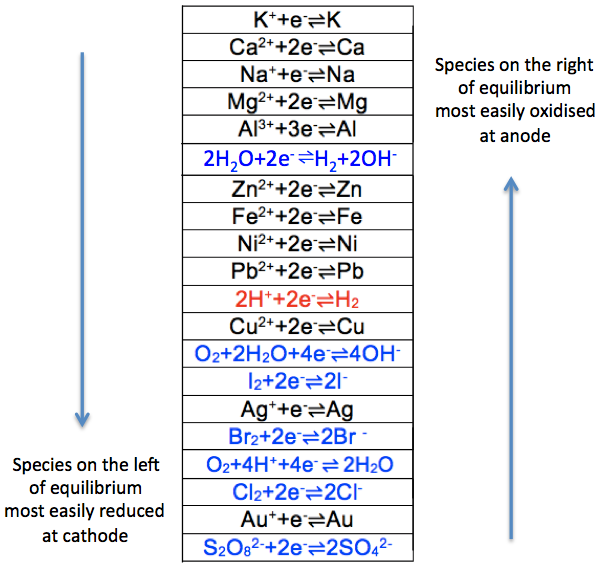
The electrochemical series is a tabulation of the half-cell standard electrode potentials of various chemical species.
Just as the metal reactivity series compares the reactivity of metals, the electrochemical series lists the reactivity of metals and ions in an electrochemical cell. A summary of the electrochemical series is as follows:-
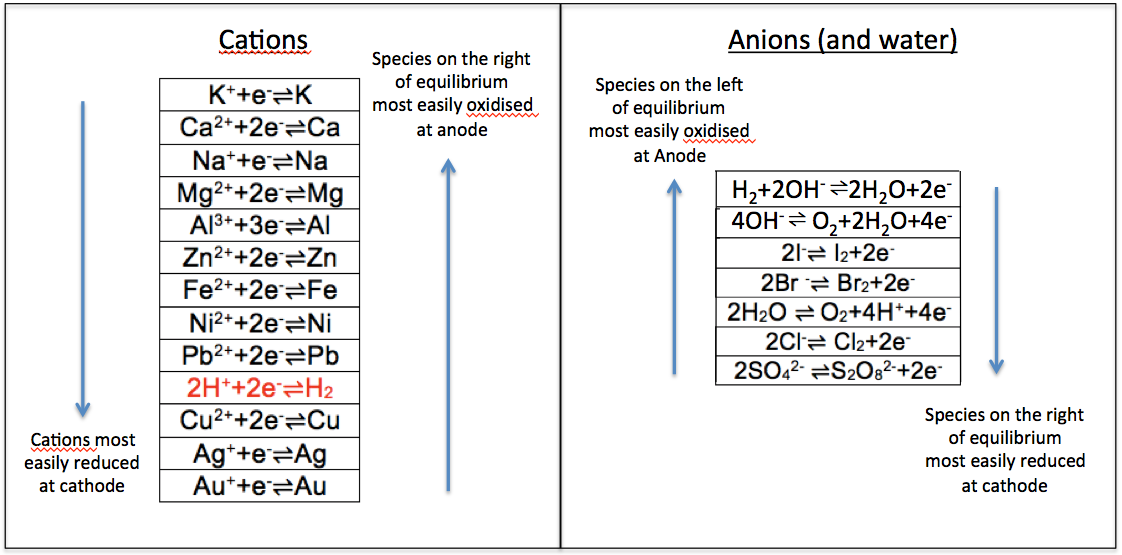
The cation series ranks positively charged ions from the least to the greatest tendency to undergo reduction. Here, the elemental potassium K is the most reactive and is therefore most easily oxidised to its ionic form at the anode compared with the other elements in the series. Consequently, its ionic form K+ is the least easily reduced at the cathode among the ions in the series.
The anion series ranks negatively charged ions from the greatest to the least tendency to undergo oxidation. Here, the hydroxide ion (OH⁻) has the greatest tendency to undergo oxidation and is therefore the most easily discharged at the anode among the anions in the series. As a result, hydroxide ions are preferentially oxidised to either water or oxygen gas in preference to the other anions below them in the series. Notably, the oxidation of the sulphate (and nitrate) ion at the anode is relatively thermodynamically unfavourable, as the anion is quite stable.
The cation and anion series are often combined into a single series of reduction potentials. In this series, each half-equation is written as a reduction reaction, with the oxidised form on the left and the reduced form on the right.