The generating function \(G(x,t)\) for the associated Laguerre polynomials is a mathematical tool that, when expanded as a power series, produces associated Laguerre polynomials as its coefficients in terms of a variable.
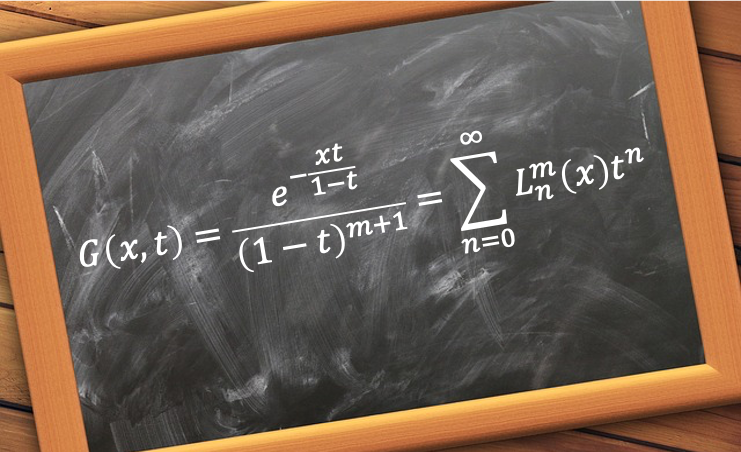
It is defined as
$$G(x,t)=\frac{e^{-\frac{xt}{1-t}}}{(1-t)^{m+1}}=\sum_{n=0}^{\infty}L_n^m(x)t^n\;\;\;\;\;\;\;\;448$$
To prove eq448, we differentiate the generating function for the Laguerre polynomials (see eq430) \(m\) times with respect to \(x\) to give
$$\frac{(-1)^mt^m}{(1-t)^{m+1}}e^{-\frac{xt}{1-t}}=\sum_{n=0}^{\infty}\frac{d^mL_n(x)}{dx^m}t^n$$
When \(n<m\), the terms in the summation equal zero. So,
$$\frac{(-1)^mt^m}{(1-t)^{m+1}}e^{-\frac{xt}{1-t}}=\sum_{n=m}^{\infty}\frac{d^mL_n(x)}{dx^m}t^n$$
From eq443, \(L_{n-m}^m(x)=(-1)^m\frac{d^mL_n(x)}{dx^m}\), which when substituted in the above equation yields,
$$\frac{(-1)^mt^m}{(1-t)^{m+1}}e^{-\frac{xt}{1-t}}=\sum_{n=m}^{\infty}(-1)^mL_{n-m}^m(x)t^n$$
Letting \(k=n-m\) gives
$$\frac{(-1)^mt^m}{(1-t)^{m+1}}e^{-\frac{xt}{1-t}}=t^m(-1)^m\sum_{k=0}^{\infty}L_{k}^m(x)t^k$$
which rearranges to eq448.