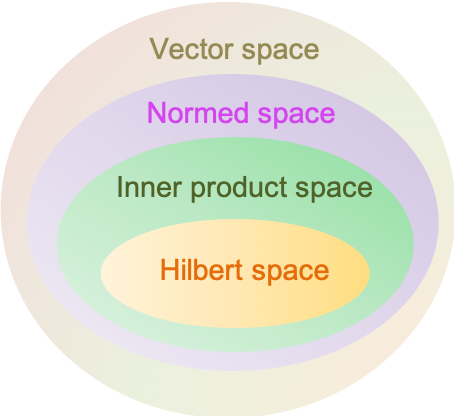
An inner product space is a vector space with an inner product.
An inner product is an operation that assigns a scalar to a pair of vectors , functions
, or matrices
. For vectors, the inner product is computed using matrix multiplication:
For functions, the inner product is defined by the integral
You may notice that eq3 resembles a dot product. The dot product pertains to vectors in , where
, which can be extended to
-dimensions, where
, and to include complex and real functions,
. Therefore, an inner product is a generalisation of the dot product.
An inner product space has the following properties:
-
- Conjugate symmetry:
- Additivity:
- Positive semi-definiteness:
, with
if
- Conjugate symmetry:

Question
i) Why is the inner product space positive semi-definite?
ii) Show that orthogonal vectors are linearly independent.
iii) Prove that .
Answer
i) A general vector space of can be positive or negative. The inner product space is defined such that
, with
if
, which is useful in quantum mechanics.
ii) Let the set of vectors in eq1 be orthogonal vectors. The dot product of eq1 with
gives
. Since the magnitudes of orthogonal vectors are non-zero,
. Hence, orthogonal vectors are linearly independent.
iii) Let’s consider two vectors and
as position vectors starting from the origin. Then the vector
forms a triangle with them. According to the law of cosines, we have:
Substituting into the above equation gives:
which completes the proof.
Two functions (or two vectors) are orthogonal if . Elements of a set of basis functions are orthonormal if
where
In other words, two functions (or two vectors) are orthonormal if they are orthogonal and normalised.
Next, the norm (or length) of a vector is denoted by
and is defined as
. With this association of inner product and the length of a vector, we can relate the inner product
and the Euclidean distance
between 2 vectors
and
. Using the
space as an example, where
and
, we have
Hence, the norm naturally comes from the inner product, i.e. every inner product space is a normed space, but not vice versa.
Finally, the Frobenius inner product of two matrices and
, both of the same size, is defined as:
where denotes the trace of
.
To show that this is analogous to the inner product of vectors: , consider the
matrices
and
, where
which is the inner product of all the corresponding matrix entries when the matrices are rearranged into vectors:
Just as the vector dot product defines the length (or norm) of a vector, the Frobenius inner product defines the Frobenius norm of a matrix:
with if
is Hermitian.