Neodymium magnets are permanent magnets made primarily from an alloy of neodymium, iron and boron (NdFeB), and are the strongest commercially available type of permanent magnet.
Pure iron is strongly ferromagnetic because of exchange interactions among its 3d electrons. However, despite its large magnetisation, it is not an ideal permanent magnet because its magnetic domains can reorient relatively easily in response to external magnetic fields, reflecting its weak magnetocrystalline anisotropy.
When iron is alloyed with rare-earth elements such as neodymium, additional exchange interactions arise between the rare-earth and iron atoms. Although the 4f orbitals of rare-earth elements are partially filled and carry substantial magnetic moments, they are spatially compact and lie deep within the atom. Consequently, the 4f electrons are highly localised and do not interact directly with the 3d electrons of iron. Instead, the coupling occurs through an indirect exchange mechanism involving the rare-earth 5d electrons.
This mechanism is a two-step coupling process. While the 5d shell of an isolated rare-earth atom is empty in its ground state, the formation of a metallic crystal lowers the energy of the 5d-derived states through bonding interactions, allowing some valence electrons to occupy them. In the first step, the localised 4f electrons interact through strong intra-atomic exchange with these more spatially extended 5d electrons, causing the spins of the 4f and 5d electrons to align (see diagram below).
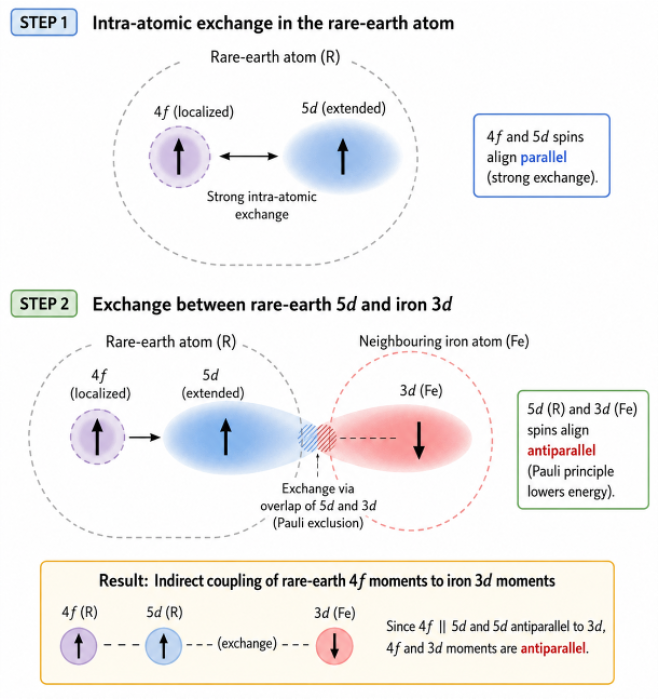
In the second step, the diffuse rare-earth 5d orbitals overlap with the 3d orbitals of neighbouring iron atoms, lowering the total energy of the crystal. This resulting exchange interaction is governed by the Pauli exclusion principle, which restricts how electrons of the same spin can occupy overlapping states. The lowest-energy configuration generally corresponds to antiparallel alignment between the rare-earth 5d spin and the iron 3d spin. Since the rare-earth 4f and 5d spins are already aligned from the first step, it follows that the rare-earth 4f spin and the iron 3d spin tend to align antiparallel. In this way, the localised 4f moments of the rare-earth ions become indirectly coupled to the iron sublattice.
However, because the total magnetic moment of a rare-earth ion is contingent on both spin and orbital angular momentum, the resulting alignment of the rare-earth magnetic moment relative to iron depends on Hund’s rules.
Consider the following rare-earth electron configurations, noting that the 4f subshell can accommodate up to 14 electrons:
Nd: [Xe]4f⁴6s² (less than half-filled 4f subshell)
Tb: [Xe]4f⁹6s² (more than half-filled 4f subshell)
Dy: [Xe]4f¹⁰6s² (more than half-filled 4f subshell)
According to Hund’s third rule, the ground state of Nd is characterised by J = L − S, whereas those of Tb and Dy are characterised by J = L + S. Consequently, the total Nd magnetic moment is oriented opposite to its spin angular momentum, while the Tb and Dy total magnetic moments are aligned with their spins. Since the Nd 4f spin is coupled antiparallel to the Fe 3d spin through indirect exchange mediated by the rare-earth 5d states, the total magnetic moment of Nd aligns parallel to that of iron, resulting in ferrimagnetic alignment between the Nd and Fe sublattices. In contrast, the total magnetic moments of Tb and Dy align antiparallel to the magnetic moment of iron, producing ferrimagnetic ordering in Tb–Fe and Dy–Fe systems with a reduced net magnetic moment.
Nevertheless, Nd and Fe alone do not readily form a stable crystal structure. This issue is resolved by adding boron to produce the inter-metallic compound Nd₂Fe₁₄B. In this phase, boron plays a crucial structural role in stabilising a complex tetragonal lattice that accommodates both a high density of Fe atoms and well-ordered Nd sites, resulting in a crystal with strong exchange-driven magnetisation and large magnetocrystalline anisotropy.
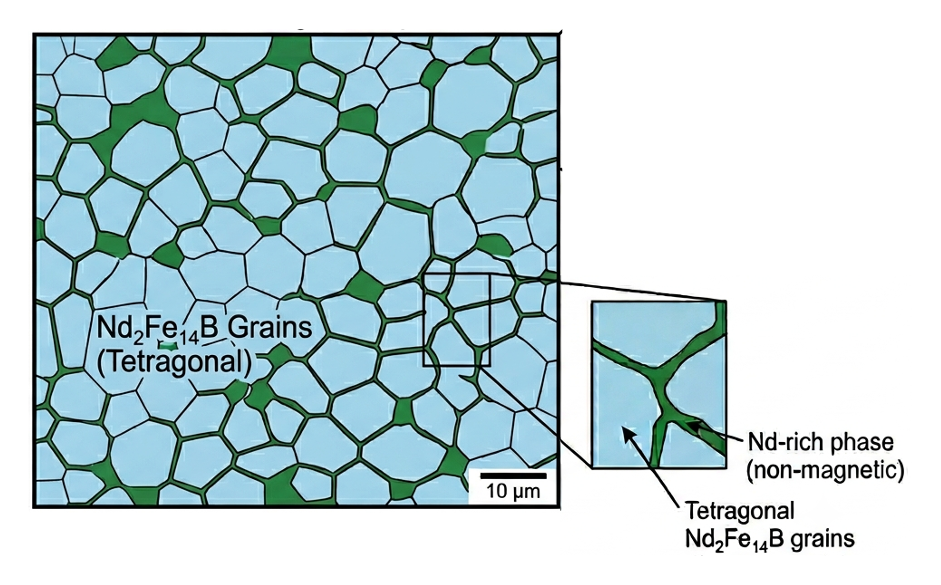
In practice, neodymium magnets are engineered so that the Nd₂Fe₁₄B phase constitutes the majority of the material. The remaining volume (10–15%) consists primarily of Nd-rich grain-boundary phases that separate neighbouring magnetic grains (see diagram above). If neighbouring Nd₂Fe₁₄B grains were strongly exchange-coupled throughout the entire magnet, reversal of the magnetic moment in one grain could more easily propagate into adjacent grains, reducing coercivity (i.e. the resistance to demagnetisation). By partially isolating neighbouring grains, the Nd-rich boundary phase inhibits the propagation of reversed magnetic domains and significantly improves coercivity.
Neodymium magnets are typically manufactured using a powder-metallurgy process. An alloy containing neodymium, iron and boron is first melted and cast, then crushed into a fine powder. The powder particles are aligned in a strong magnetic field so that their crystallographic-easy axes point in the same direction, maximising the magnetic performance of the final magnet. The aligned powder is then compacted and sintered at high temperature to form a dense solid. Subsequent heat-treatment steps optimise the microstructure by promoting the formation of Nd-rich grain-boundary phases that enhance coercivity. In addition, small amounts of Dy and Tb are often incorporated into the alloy to further increase coercivity and improve magnetic stability at elevated operating temperatures. Finally, the magnet is machined to the required shape, coated to improve corrosion resistance, and magnetised using a strong external magnetic field.
Applications that require strong magnetic fields in a compact volume often rely on neodymium magnets. Examples include electric vehicle traction motors, wind turbine generators, computer hard disk drives, magnetic resonance imaging (MRI) systems, industrial actuators, and consumer electronics such as headphones, loudspeakers and smartphones.