The normalisation constant ensures that the Legendre polynomials are properly scaled, thereby maintaining the probabilistic interpretation of quantum states.
To determine the normalisation constant, we square both sides of the generating function of the Legendre polynomials and integrate the expression with respect to \(x\) to give
$$\int_{-1}^1\frac{1}{1-2tx+t^2}dx=\int_{-1}^1\biggr[\sum_{m=0}^{\infty}\sum_{n=0}^{\infty}P_m(x)t^mP_n(x)t^n\biggr]dx\;\;\;\;\;\vert t\vert<1\;\;\;\;\;\;\;355$$

Question
Why are the limits of integration from -1 to 1?
Answer
The Legendre polynomials are used to describe spherical harmonics, where \(x=cos\theta\) and \(0\leq\theta\leq\pi\). Therefore, the Legendre polynomials are analysed within the interval of \(-1\leq x\leq 1\).
Expanding the RHS of eq355 and using the orthogonality of Legendre polynomials,
$$\int_{-1}^1\frac{dx}{1-2tx+t^2}=\int_{-1}^1P_0(x)P_0(x)dx+t^2\int_{-1}^1P_1(x)P_1(x)dx+\cdots=\sum_{n=0}^{\infty}\biggr[t^{2n}\int_{-1}^1P_n^2(x)dx\biggr]$$
Substituting \(u=1-2tx+t^2\) and integrating gives
$$\frac{1}{t}[ln(1+t)-ln(1-t)]=\sum_{n=0}^{\infty}\biggr[t^{2n}\int_{-1}^1P_n^2(x)dx\biggr]$$
Since \(\vert t\vert<1\), we can expand \(ln(1+t)\) and \(ln(1-t)\) as two Taylor series, where \(\small{ln(1+t)=t-\frac{t^2}{2}+\frac{t^3}{3}-\frac{t^4}{4}+\cdots}\) and \(\small{ln(1-t)=-t-\frac{t^2}{2}-\frac{t^3}{3}-\frac{t^4}{4}-\cdots}\), to yield
$$\sum_{n=0}^{\infty}\biggr[\frac{2}{2n+1}-\int_{-1}^1P_n^2(x)dx\biggr]t^{2n}=0$$
To satisfy the above equation for all \(t\), all coefficients must be zero. Therefore,
$$\int_{-1}^1P_l^2(x)dx=\frac{2}{2l+1}\;\;\;\;\;\;\;\;356$$
where we have changed the dummy index from \(n\) to \(l\).
Using the orthogonal property of the Legendre polynomials, we can also express eq356 as
$$\int_{-1}^1P_m(x)P_n(x)dx=\frac{2}{2l+1}\delta_{mn}\;\;\;\;\;\;\;\;357$$
Normalising the Legendre polynomials to 1,
$$N_l^2\int_{-1}^1P_l^2(x)dx=1$$
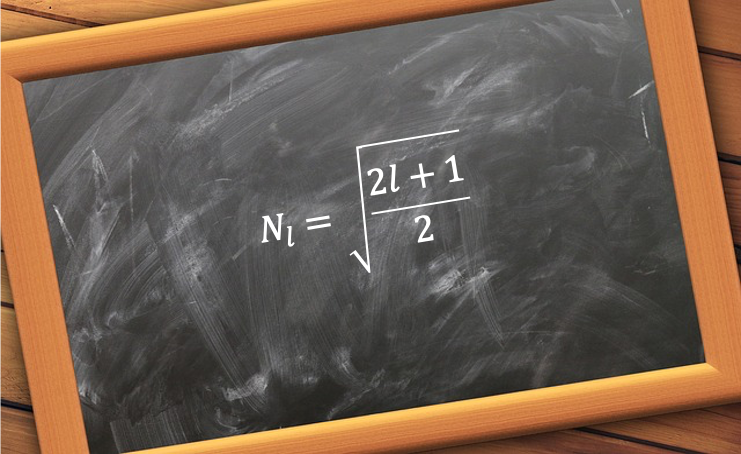
Substituting eq356 in the above equation, we have\(N_l=\sqrt{\frac{2l+1}{2}}\). With reference to eq342, the normalised Legendre polynomials are
$$P_l(x)=\sqrt{\frac{2l+1}{2}}\sum_{k=0}^m\frac{(-1)^k(2l-2k)!}{2^lk!(l-2k)!(l-k)!}x^{l-2k}\;\;\;\;\;\;\;\;358$$
where \(m=\frac{l}{2}\) for the even series, \(m=\frac{l-1}{2}\) for the odd series.