Parity of spatial wavefunctions is a property describing how a wavefunction behaves under inversion, being classified as even (g) if it remains unchanged or odd (u) if it changes sign.
Consider the hydrogenic wavefunction , where
and
are the radial and angular wavefunctions respectively. In spherical coordinates, an inversion (
) through the origin results in:
-
(the radius is always positive)
(polar angle reflects across the
-plane)
(azimuthal angle rotates by half a circle)
Therefore,
Since ,
are the associated Legendre polynomials given by
, or equivalently,
, where
. So,

Question
Prove by induction the expression .
Answer
For , let
. Applying the chain rule,
. So,
and the expression is valid. Assume the expression holds for some
, i.e.
. Then for
,
By mathematical induction, .
It follows that
and
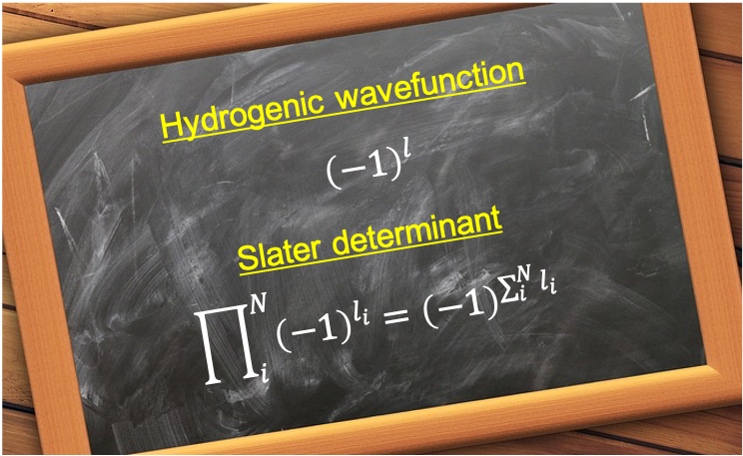
Hence, the parity of hydrogenic wavefunctions is given by , where
is even if
is even and odd if
is odd. For an
-electron atom with a wavefunction expressed as a product of hydrogenic orbitals
, its parity is
because .
So, the wavefunction is even if is even and odd if
is odd.
If the multielectron wavefunction is properly antisymmetrised, such as in a Slater determinant, each term in the determinant is a permutation of the same set of one-electon orbitals. Since parity depends only on the set of occupied orbitals and not their ordering, every permutation acquires the same overall factor . Therefore, the parity of the Slater determinant remains
.