Schur’s second lemma describes the restrictions on a matrix that commutes with elements of two distinct irreducible representations, which may have different dimensions.
Consider an arbitrary matrix \(M\) and two irreducible representations of a group, \(A_{\alpha}\) of dimension \(n\) and \(A_{\alpha}^{\prime}\) of dimension \(n^{\prime}\), such that
$$MA_{\alpha}=A_{\alpha}^{\prime}M\;\;\;\;\;\;\;\;10$$
where \(\alpha=1,2,\cdots,\vert G\vert\).
Taking the conjugate transpose of eq10 and using the matrix identity \((AB)^{\dagger}=B^{\dagger}A^{\dagger}\), we have \(A_{\alpha}^{\dagger}M^{\dagger}=M^{\dagger}A_{\alpha}^{^{\prime}\dagger}\). As every element of a representation of a group can be expressed as a unitary matrix \(U\) via a similarity transformation without any loss of generality, and as \(U^{\dagger}=U^{-1}\),
$$A_{\alpha}^{-1}M^{\dagger}=M^{\dagger}A_{\alpha}^{^{\prime}-1}\;\;\;\;\;\;\;\;11$$
Since the inverse property of a group states that \(A_{i}^{-1}=A_{j}\) and \(A_{i}^{^{\prime}-1}=A_{j}^{\prime}\), we can express eq10 as
$$MA_{\alpha}^{-1}=A_{\alpha}^{^{\prime}-1}M\;\;\;\;\;\;\;\;12$$
Multiplying eq11 on the left by \(M\) and using eq12, we have \(MA_{\alpha}^{-1}M^{\dagger}=MM^{\dagger}A_{\alpha}^{^{\prime}-1}\) and therefore \(A_{\alpha}^{^{\prime}-1}(MM^{\dagger})=(MM^{\dagger})A_{\alpha}^{^{\prime}-1}\), which implies that \(MM^{\dagger}\) commutes with all elements of an irreducible representation of \(G\). With reference to Schur’s first lemma,
$$MM^{\dagger}=cI\;\;\;\;\;\;\;\;13$$
where \(c\) is a constant and \(I\) is the identity matrix.
If we multiply eq11 on the right by \(M\) and repeat the steps above, we have
$$M^{\dagger}M=cI\;\;\;\;\;\;\;\;14$$
Let’s consider the following cases for eq13:
Case 1: \(n=n^{\prime}\)
Let the \((i,k)\)-th entry of \(M\) be \(m_{ik}\). If \(n=n^{\prime}\), we can rewrite eq13 in terms of matrix entries: \(\sum_{k=1}^nm_{ik}m^*_{ik}=c\delta_{mn}\implies \sum_{k=1}^n\vert m_{ik}\vert^2=c\delta_{mn}\). If \(c=0\), we have \(\sum_{k=1}^n\vert m_{ik}\vert^2=0\), which implies that \(M\) is the zero matrix because \(m_{ik}=0\) for all \(i,k\).
Combining eq13 and eq14, we have \(MM^{\dagger}=cI=M^{\dagger}M\) or \(M(\frac{1}{c}M^{\dagger})=I=(\frac{1}{c}M^{\dagger})M\). This implies that \(M^{-1}=\frac{1}{c}M^{\dagger}\) exists if \(c\neq 0\). We can therefore rewrite eq10 as \(A_{\alpha}=M^{-1}A_{\alpha}^{\prime}M\), which is a similarity transformation if \(c\neq 0\).
Case 2: \(n\neq n^{\prime}\)
If \(n\neq n^{\prime}\), the arbitrary matrix (denoted by \(M^{\prime}\)) is an \(n^{\prime}\times n\) matrix with reference to eq10. Suppose \(n<n^{\prime}\); we have:
$$M^{\prime}=\begin{pmatrix}m_{11}&m_{12}&\cdots&m_{1n}\\m_{21}&m_{22}&\cdots&m_{2n}\\\vdots&\vdots&\ddots&\vdots\\m_{n^{\prime}1}&m_{n^{\prime}2}&\cdots&m_{n^{\prime}n}\end{pmatrix}$$
If we enlarge \(M^{\prime}\) to form an \(n^{\prime}\times n^{\prime}\) matrix \(N\) with the additional elements equal to zero, we have
$$N=\begin{pmatrix}m_{11}&m_{12}&\cdots&m_{1n}&0&\cdots&0\\m_{21}&m_{22}&\cdots&m_{2n}&0&\cdots&0\\\vdots&\vdots&\ddots&\vdots&\vdots&\ddots&\vdots\\m_{n^{\prime}1}&m_{n^{\prime}2}&\cdots&m_{n^{\prime}n}&0&\cdots&0\end{pmatrix}\;\;\;N^{\dagger}=\begin{pmatrix}m_{11}^*&m_{21}^*&\cdots&m_{n^{\prime}1}^*\\m_{12}^*&m_{22}^*&\cdots&m_{n^{\prime}2}^*\\\vdots&\vdots&\ddots&\vdots\\m_{1n}^*&m_{2n}^*&\cdots&m_{n^{\prime}n}^*\\0&0&\cdots&0\\\vdots&\vdots&\ddots&\vdots\\0&0&\cdots&0\end{pmatrix}$$
Due to the zeroes, \(NN^{\dagger}=MM^{\dagger}=cI\) . Taking the determinants,
$$\vert NN^{\dagger}\vert=\vert cI\vert$$
Using the determinant identities \(\vert AB\vert=\vert A\vert\vert B\vert\), \(\vert cA\vert=c^n\vert A\vert\) and \(\vert I\vert=1\) , we have
$$\vert N\vert\vert N^{\dagger}\vert=c^n$$
Since one of the columns of \(N\) is zero, \(\vert N\vert=0\). So, \(c=0\), which implies that \(M\) must be a zero matrix according to the results of case 1.
Finally, we can summarise Schur’s second lemma as follows:
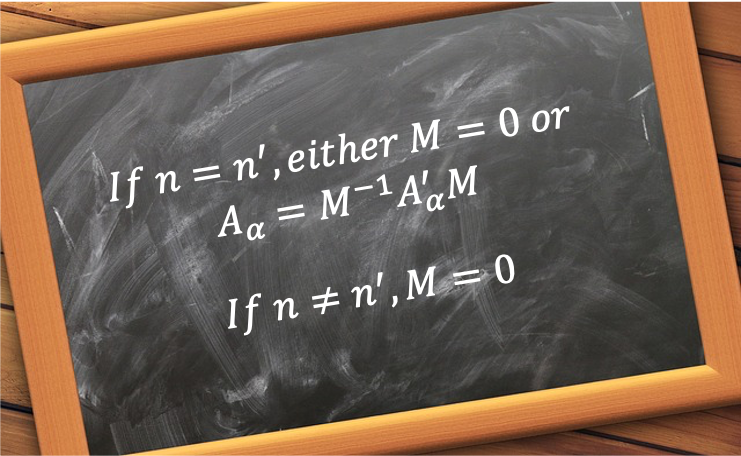
Given an arbitrary matrix \(M\) and two irreducible representations, \(A_{\alpha}\) of dimension \(n\) and \(A_{\alpha}^{\prime}\) of dimension \(n^{\prime}\), where \(MA_{\alpha}=A_{\alpha}^{\prime}M\) , then
-
- if \(n=n^{\prime}\), either \(M=0\) or the representations are related by a similarity transformation, i.e. equivalent representations.
- If \(n\neq n^{\prime}\), \(M=0\).