Secular equations in the variational method are linear equations obtained by minimising the energy with respect to trial-function coefficients, yielding a matrix eigenvalue problem whose solutions give approximate energy levels and corresponding wavefunctions.
Consider the eigenvalue equation , where
and the coefficients
are real. Multiplying the eigenvalue equation on the left by
and integrating over all space gives:
where .
Using the orthonormality condition results in:
Taking the partial derivative of with respect to each coefficient
gives:
Applying the variational method by setting and computing the remaining derivatives yield:
Assuming that the expectation values are real and the Hamiltonian is Hermitian, , and
Relabelling the second summation index from to
, we have
or equivalently,
which rearranges to the secular equations:
where we have relabelled the index to
.
We can express the secular equations in the following matrix form:
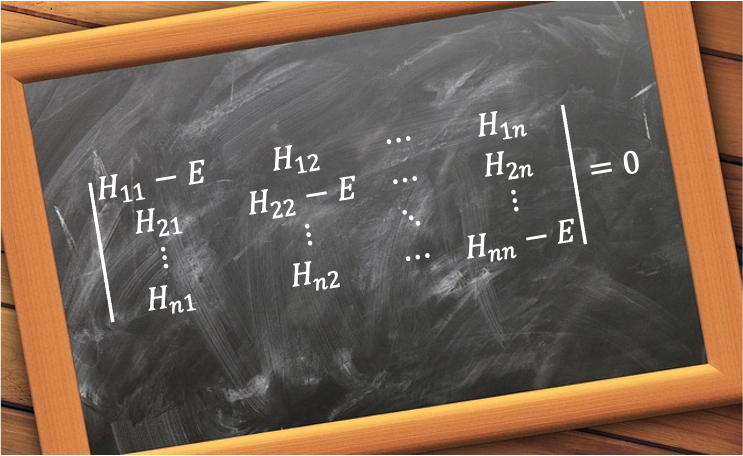
This is a linear homogeneous equation with non-trivial solutions only if
or equivalently, if
where is the Hamiltonian matrix with elements
and
is the
identity matrix.
Expanding the determinant gives the characteristic equation, which can then be solved for its roots.
Secular equations are used to determine the allowed energy levels and wavefunctions of electrons in molecules. They are fundamental in solving eigenvalue problems in many aspects of chemistry, including: