A Slater determinant represents a multi-electron wavefunction that satisfies the Pauli exclusion principle. It was named after the American physicist John Slater for his contribution to quantum mechanics.
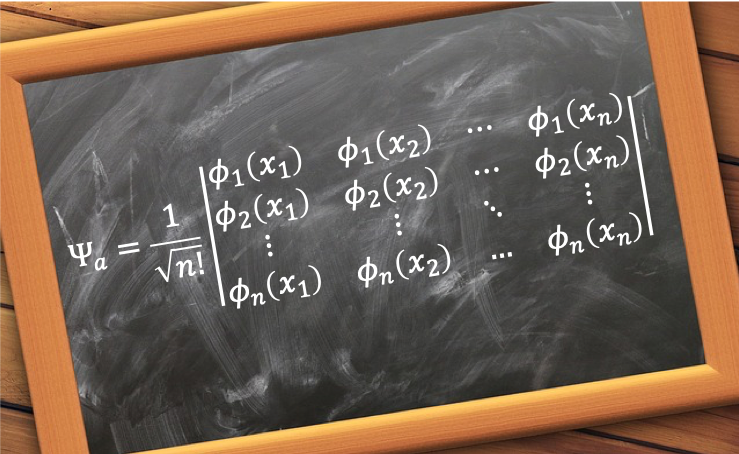
The normalised anti-symmetric wavefunction for an n-electron system with spin-orbitals \(\phi_i(x_j)\) can be expressed as \(\hat{A}\Psi_s(x_1,x_2,\cdots,x_n)\), where \(\Psi_s(x_1,x_2,\cdots,x_n)=\phi_1(x_1)\phi_2(x_2)\cdots\phi_n(x_n)\) and \(\hat{A}\) is the antisymmetriser. From eq59 and 62,
$$\hat{A}\Psi_s=\frac{1}{\sqrt{n!}}\sum_{r=1}^{n!}(-1)^r\hat{P}_r\Psi_s=\Psi_a$$
Comparing the above equation with the definition of a determinant, i.e. \(\vert G\vert=\sum_{i_1\cdots i_n}^n\varepsilon_{i_1\cdots i_n}a_{1,i_1}\cdots a_{n,i_n}\), we have \(\Psi_a=\frac{1}{\sqrt{n!}}\vert G\vert\) or
$$\Psi_a=\frac{1}{\sqrt{n!}}\begin{vmatrix} \phi_1(x_1)&\phi_2(x_1)&\cdots &\phi_n(x_1)\\ \phi_1(x_2)&\phi_2(x_2)& \cdots &\phi_n(x_2)\\ \vdots&\vdots &\ddots &\vdots \\ \phi_1(x_n)&\phi_2(x_n)&\cdots &\phi_n(x_n) \end{vmatrix}\;\;\;\;\;\;\;\;(66)$$
which is called an n-electron Slater determinant.
Since \(\vert G\vert=\vert G^T\vert\) (see this article for proof), the Slater determinant can also be written as
$$\Psi_a=\frac{1}{\sqrt{n!}}\begin{vmatrix} \phi_1(x_1)&\phi_1(x_2)&\cdots &\phi_1(x_n)\\ \phi_2(x_1)&\phi_2(x_2)& \cdots &\phi_2(x_n)\\ \vdots&\vdots &\ddots &\vdots \\ \phi_n(x_1)&\phi_2(n_2)&\cdots &\phi_n(x_n) \end{vmatrix}\;\;\;\;\;\;\;\;(67)$$
