Spherical unit vectors are three mutually perpendicular vectors that point in the directions of increasing radial distance, polar angle, and azimuthal angle, respectively.
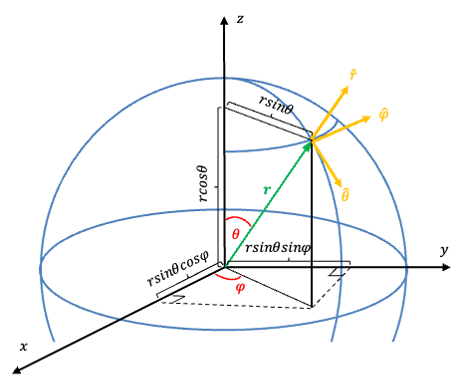
To derive these vectors, we begin with the relationship between Cartesian and spherical coordinates (see diagram above):
The position vector in Cartesian coordinates is , or equivalently,
When , the position vector becomes the radial unit vector:
The azimuthal unit vector lies in the
-plane, which is spanned by the unit vectors
and
. Since it is also perpendicular to the projection of
onto that plane, it makes an azimuthal angle of
with the positive
-axis. Therefore,
The polar unit vector can then be determined using the cross product :
Expanding the determinant yields
Eq76a, eq76b and eq76c give the three spherical unit vectors. To express the Cartesian unit vectors in terms of the spherical unit vectors, we perform a change of basis. Let the forward transformation be
, where
The reverse transformation is given by . Since the three spherical unit vectors are mutually perpendicular and have unit magnitude, the transformation matrix
is orthogonal. Therefore,
and the reverse transformation is
:
Expanding gives