The quark model is a theory in particle physics that explains hadrons, such as protons and neutrons, as being composed of fundamental particles called quarks.
In 1961, Murray Gell-Mann developed the Eightfold Way and found that the classification of the eight lightest spin-½ baryons could be explained using the SU(3) symmetry group. Since a basis vector that transforms according to the fundamental representation of SU(3) has three components, he proposed that the eight spin-½ baryons are composed of three fundamental particles called quarks:
where the labels ,
and
will become clear shortly.
Gell-Mann further suggested that the properties of isospin and hypercharge that characterise the baryons also apply to the three quarks. Given that the third component of the isospin operator, which is defined by convention as where
is the third Gell-Mann matrix, acts on a basis quark eigenstate to give an eigenvalue corresponding to the third component of the quark’s isospin, we have
Therefore, denotes the “up” quark, referring to its positive isospin projection of
, while
denotes the “down” quark, with an isospin projection of
. The terminology is analogous to the familiar “spin up” and “spin down” notation, although these quantum numbers refer to isospin rather than spin angular momentum.
Similarly, the hypercharge operator is defined as
where is the eighth Gell-Mann matrix.
Hence,

Question
Why are the eighth and third Gell-Mann matrices used to define the hypercharge and the third component of the isospin operators?
Answer
In quantum mechanics, two observables can have simultaneous definite values only if their corresponding operators commute. The third and eighth Gell-Mann matrices are the only two diagonal and mutually commuting generators of SU(3). Therefore, they are used to define two independent quantum numbers, conventionally identified with the third component of isospin and hypercharge.
To make these quantum numbers consistent with the baryon quantum numbers, each quark is assigned a baryon number of . Using the hypercharge relation
and the Gell-Mann–Nishijima formula
gives
and
for the
quark,
and
for the
quark, and
and
for the
quark (see table below). Hence, the third quark, with a non-zero strange quantum number, is labelled
, for “strange”. The up, down and strange properties of quarks are collectively known as flavours.
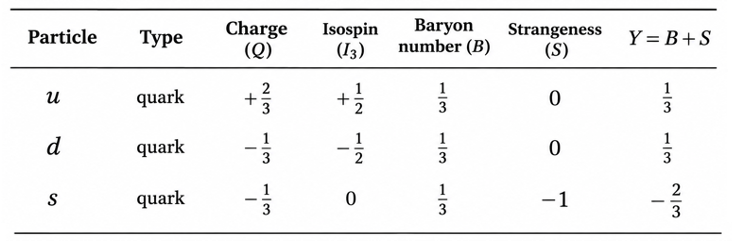
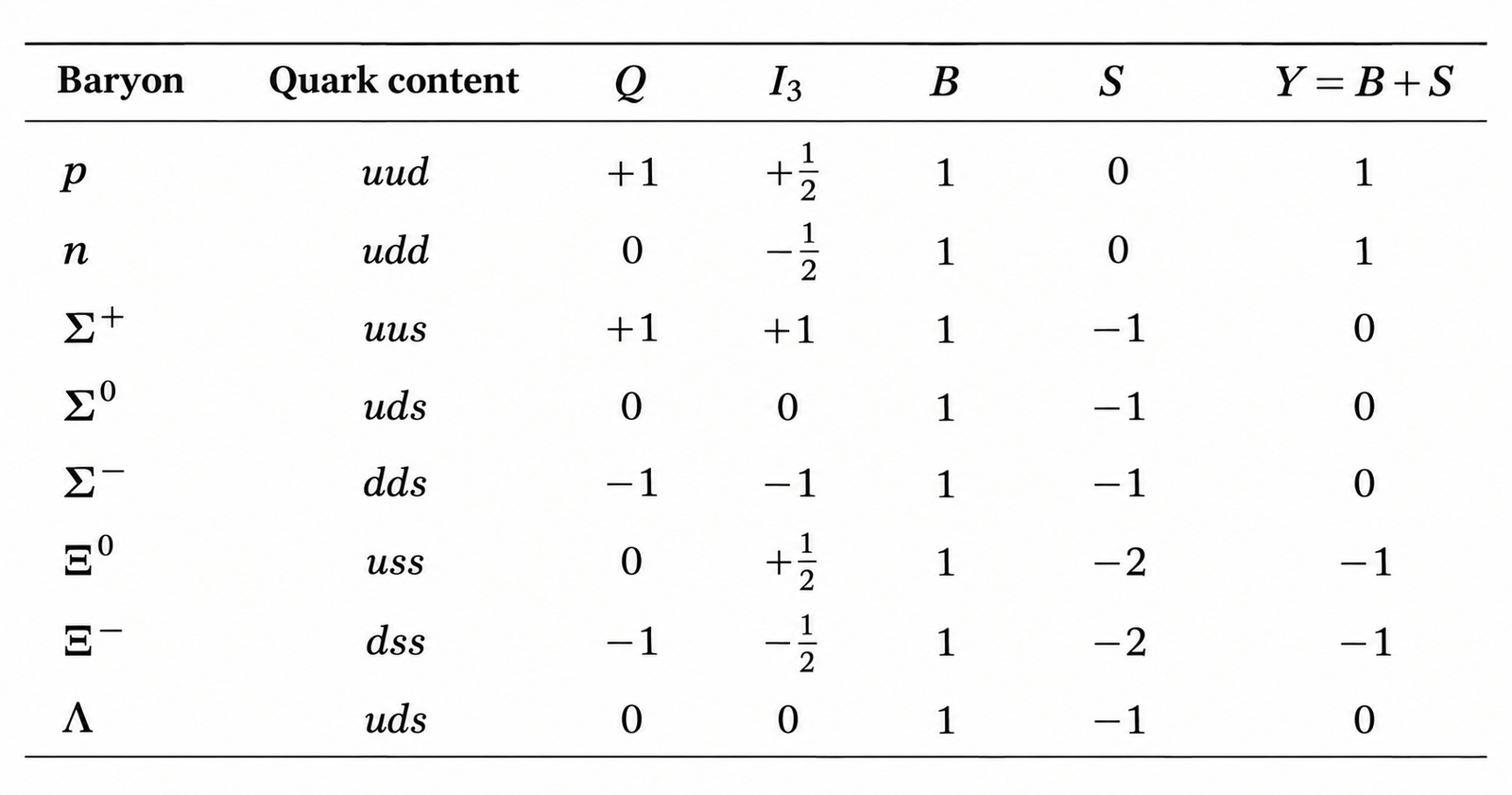
The definition of flavours allows Gell-Mann to assign combinations of the three quarks to the spin-½ baryons such that the additive quantum numbers of the constituent quarks, given by the eigenvalues of
where is the identity operator, reproduce the corresponding quantum numbers of the baryon. For example, the proton is composed of two
quarks and one
quark,
, where
,
,
,
and
. The quark compositions of the remaining baryons are listed in the table below.
Question
Explain why is equivalent to
?
Answer
When the Kronecker-product operators act on the composite state, each operator acts only on its corresponding substate, while the identity operators leave the other substates unchanged:
Adding the three above equations gives:
which in shorthand notation is .
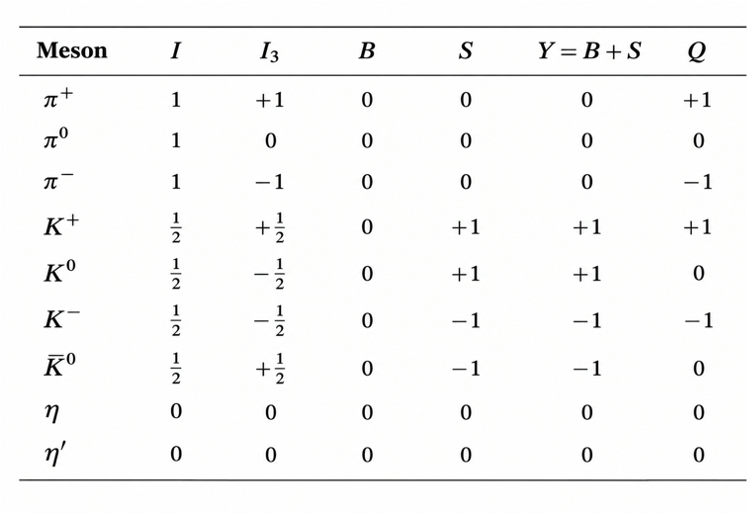
How about the nine spin-0 mesons? It would be mathematically impossible to construct these mesons, which have baryon number of , from three quarks (see above table). But if mesons can be arranged alongside baryons according to the Eightfold Way, then they should also, at least theoretically, be composed of quarks. Gell-Mann resolved this apparent contradiction by proposing that, unlike baryons, mesons are composed of a quark and an antiquark.
To generate the quantum numbers corresponding to antiquarks, we need to determine the antiquark operators. Consider the the quark electric charge operator acting on the flavour vector
:
The diagonal entries of the 3×3 matrix are the electric-charge eigenvalues corresponding to the ,
and
quarks respectively. For antiquarks, which are antiparticles, their quantum numbers have the opposite sign to those of quarks (see table below). So, we require
which is only possible if and
.
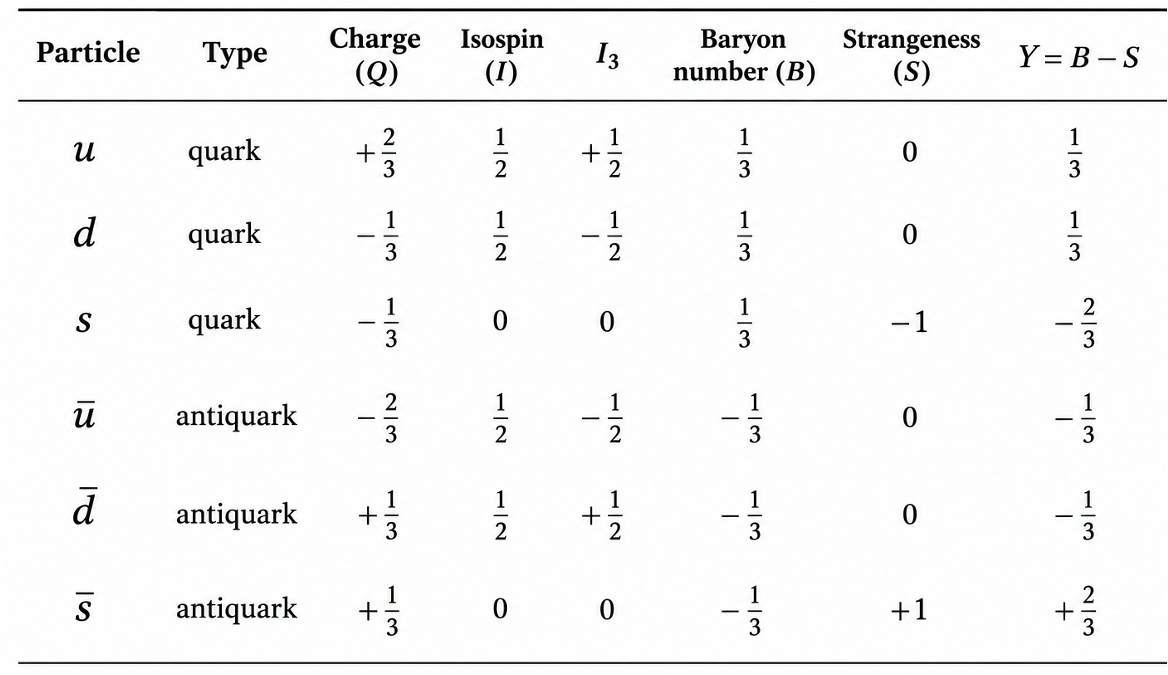
Additionally, the generators () defining the antiquark representation of SU(3) must satisfy the commutation relation
, where
are real coefficients known as the structure constants. However, this relation breaks down if we simply substitute
into it.
Taking the complex conjugate of the commutation relation gives , or equivalently,
Therefore, the antiquark generators must be chosen as . To see how this is used to derive antiquark operators, we refer to the quark raising operator
where ,
, and
and
are the first two Gell-Mann matrices.
If the quark basis states, which span a three-dimensional complex vector space called the 3 representation of SU(3), are written as
then
Similarly, and
.
Question
Show that .
Answer
The corresponding antiquark raising operator is
acting on the basic vector
gives
Thus, if the antiquark basis states, which span the complex conjugate vector space of the 3 representation of SU(3), are written as
then and
.
Similarly, , and
Thus, .
Using , where
we can determine the flavour states of the nine spin-0 mesons by requiring the additive quantum numbers of their constituent quarks to match those of the mesons, which had already been determined experimentally before the Eightfold Way was developed.
For example, the three mesons (
) form an isospin triplet
. The
, corresponding to
, is composed of an up quark and a down antiquark, giving the state:
because
This leads to the flavour states of the nine spin-0 mesons shown in the table below.
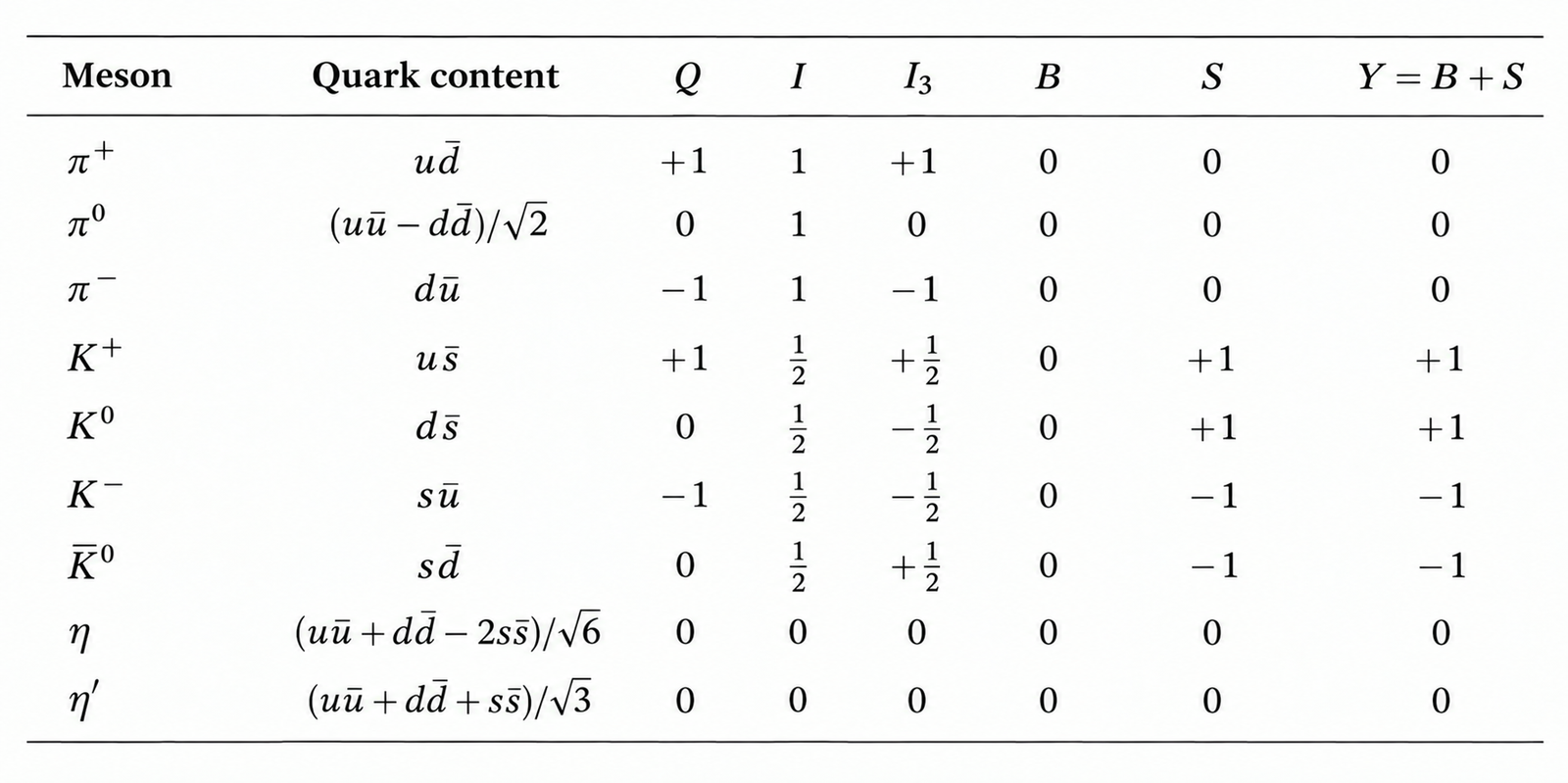
Interestingly, ,
and
are constructed from linear combinations of quark-antiquark pairs rather than from a single pair. To understand this, we begin by expressing the quark-antiquark pairs as composite quantum states:
The resulting 9×1 vector is characterised by the nine basis vectors ,
, …,
which span a nine-dimensional vector space. It can also be expressed as the matrix
where ,
, …,
are nine elementary matrices that equivalently span the nine-dimensional vector space.
Next, any 3×3 matrix can be decomposed into a traceless part and a part proportional to the identity: , where
is traceless. So, we can write
Each entry of the traceless matrix contributes to a degree of freedom. The six off-diagonal elements are unconstrained and give rise to six independent states (). However, the three diagonal elements are restricted by the traceless condition, removing one degree of freedom and resulting in two independent linear combinations. Together, these eight independent states form an octet.
On the other hand, the trace part has only one degree of freedom, given by the scalar multiplier , and hence corresponds to one independent state (a singlet). The normalised singlet state
cannot describe the
, which is part of the pion isospin triplet
, with isospin states
,
and
. This is because
rather than the required
.
Question
Show that .
Answer
With reference to eq116, in units where
. Since
,
,
and
, we have
,
and
. For the up and down quark–antiquark pairs,
,
,
and
. Using the previously derived identities of
,
,
and
, we obtain
Thus, , which implies that
. Therefore,
.
To determine the flavour state , we let the isospin analogue of eq147
act on to yield
, or equivalently,
. Using the identities
and
results in
and
differ only by an overall phase of -1 and therefore represent the same physical state. The choice of which overall phase to assign to
is a convention. Here, we choose
This leaves and the remaining diagonal linear combination, which is orthonormal to every state,
, unassigned. Since both have isospin
, they are identified as
and
, where the subscripts 1 and 8 denote the singlet and octet representations. The physical
and
mesons are, in general, linear combinations of
and
. However, as an approximation, the
and
can be identified with the pure
and
states respectively.
Question
How is the orthonormality of the nine spin-0 meson states verified?
Answer
The orthonormality of the nine spin-0 meson states is verified by taking the inner product of any two states, treating each distinct quark-antiquark pair as a basis vector. For example, and
are orthonormal to each other because
Thus, for any two of the nine distinct quark–antiquark basis states, .
Hence, Gell-Mann predicted the existence of quarks and antiquarks from a group-theoretical analysis of the then-known light baryons and mesons, which could be arranged according to the Eightfold Way. Definitive evidence for the internal structure of hadrons came subsequently from deep inelastic scattering experiments conducted in the late 1960s and early 1970s at the SLAC National Accelerator Laboratory. For example, when high-energy electrons were fired at protons, they were scattered at large angles rather than passing through as they would if the proton consisted of a uniform cloud of positive charge. Although quarks and antiquarks cannot be isolated individually due to colour confinement, these experiments demonstrated that protons contain point-like, electrically charged constituents.
As more hadrons were discovered in the years that followed, it became increasingly clear that the original ,
and
quarks, and their corresponding antiquarks, might not be sufficient to account for the growing spectrum of particles. Physicists therefore began to ask whether additional quark flavours might exist, particularly heavier ones that would give rise to new families of hadrons. This possibility soon acquired a strong theoretical motivation from the emerging theory of the weak interaction. In this framework, the
and
quarks formed a weak-interaction doublet, suggesting that the strange quark should likewise have a corresponding partner. This led to the prediction of a fourth quark, the charm quark, whose existence would eventually be confirmed experimentally. The discovery of charm, followed in time by the bottom and top quarks, extended the quark model far beyond its original three-flavour picture and revealed a much richer structure underlying the hadron spectrum.