A direct product representation of a group \(G\) is a representation with each element \(\Gamma_c(\alpha)\) being the Kronecker product of the elements of two other irreducible representations \(\Gamma_a(\alpha)\) and \(\Gamma_b(\alpha)\) of \(G\) corresponding to the same symmetry operation \(\alpha\).
For example, if the dimensions of \(\Gamma_a\) and \(\Gamma_b\) are 2 and 3 respectively, i.e. \(\Gamma_a(\alpha)=\begin{pmatrix}a_{11}&a_{12}\\a_{21}&a_{22}\end{pmatrix}\) and \(\Gamma_b(\alpha)=\begin{pmatrix}b_{11}&b_{12}&b_{13}\\b_{21}&b_{22}&b_{23}\\b_{31}&b_{32}&b_{33}\end{pmatrix}\), then
$$\Gamma_c(\alpha)=\Gamma_a(\alpha)\otimes\Gamma_b(\alpha)=\begin{bmatrix}a_{11}\Gamma_b(\alpha)&a_{12}\Gamma_b(\alpha)\\a_{21}\Gamma_b(\alpha)&a_{22}\Gamma_b(\alpha)\end{bmatrix}=\begin{pmatrix}a_{11}b_{11}&a_{11}b_{12}&a_{11}b_{13}&a_{12}b_{11}&a_{12}b_{12}&a_{12}b_{13}\\a_{11}b_{21}&a_{11}b_{22}&a_{11}b_{23}&a_{12}b_{21}&a_{12}b_{22}&a_{12}b_{23}\\a_{11}b_{31}&a_{11}b_{32}&a_{11}b_{33}&a_{12}b_{31}&a_{12}b_{32}&a_{12}b_{33}\\a_{21}b_{11}&a_{21}b_{12}&a_{21}b_{13}&a_{22}b_{11}&a_{22}b_{12}&a_{22}b_{13}\\a_{21}b_{21}&a_{21}b_{22}&a_{21}b_{23}&a_{22}b_{21}&a_{22}b_{22}&a_{22}b_{23}\\a_{21}b_{31}&a_{21}b_{32}&a_{21}b_{33}&a_{22}b_{31}&a_{22}b_{32}&a_{22}b_{33}\end{pmatrix}$$
In general, if the dimensions of \(\Gamma_a\) and \(\Gamma_b\) are \(m\) and \(n\) respectively, then the dimension of \(\Gamma_c\) is \(mn\):
$$\Gamma_c(\alpha)=\Gamma_a(\alpha)\otimes\Gamma_b(\alpha)=\begin{bmatrix}a_{11}\Gamma_b(\alpha)&\cdots &a_{1m}\Gamma_b(\alpha)\\\vdots &\ddots &\vdots\\a_{m1}\Gamma_b(\alpha)&\cdots &a_{mm}\Gamma_b(\alpha)\end{bmatrix}\;\;\;\;\;\;\;\;75$$

Question
Show that
$$[\Gamma_a(\alpha)\otimes\Gamma_b(\alpha)][\Gamma_a(\beta)\otimes\Gamma_b(\beta)]=[\Gamma_a(\alpha)\Gamma_a(\beta)]\otimes[\Gamma_b(\alpha)\Gamma_b(\beta)]$$
Answer
With reference to eq75, let’s denote the block \(a_{pq}\Gamma_b(\alpha)\) by \([\Gamma_a(\alpha)\otimes\Gamma_b(\alpha)]^{pq}\). So,
$$\begin{align*}\{[\Gamma_a(\alpha)\otimes\Gamma_b(\alpha)][\Gamma_a(\beta)\otimes\Gamma_b(\beta)]^{pq}&=\sum_ra_{pr}\Gamma_b(\alpha)a_{rq}\Gamma_b(\beta)\\&=\sum_ra_{pr}a_{rq}\Gamma_b(\alpha)\Gamma_b(\beta)\\&=[\Gamma_a(\alpha)\Gamma_a(\beta)]_{pq}\Gamma_b(\alpha)\Gamma_b(\beta)\\&=\{[\Gamma_a(\alpha)\Gamma_a(\beta)]\otimes[\Gamma_b(\alpha)\Gamma_b(\beta)]^{pq}\end{align*}$$
If \(\Gamma_c\) is also a representation of \(G\), then it must be consistent with the closure property of \(G\), i.e. \(\Gamma_c(\alpha)\Gamma_c(\beta)=\Gamma_c(\gamma=\alpha\beta)\). The proof is as follows:
$$\begin{align*}\Gamma_c(\alpha)\Gamma_c(\beta)&=[\Gamma_a(\alpha)\otimes\Gamma_b(\alpha)][\Gamma_a(\beta)\otimes\Gamma_b(\beta)]\\&=[\Gamma_a(\alpha)\Gamma_a(\beta)]\otimes[\Gamma_b(\alpha)\Gamma_b(\beta)]\\&=\Gamma_a(\alpha\beta)\otimes\Gamma_b(\alpha\beta)\\&=\Gamma_c(\alpha\beta)\end{align*}$$
where the 2nd equality uses the identity proven in the Q&A above.
With reference to eq75, the trace of \(\Gamma_c(\alpha)\) is
$$\begin{align*}\chi_c(\alpha)&=a_{11}tr[\Gamma_b(\alpha)]+a_{22}tr[\Gamma_b(\alpha)]+\cdots+a_{mm}tr[\Gamma_b(\alpha)]\\&=(a_{11}+a_{22}+\cdots+a_{mm})tr[\Gamma_b(\alpha)]\\&=\sum_{p=1}^ma_{pp}tr[\Gamma_b(\alpha)]\\&=\chi_a(\alpha)\chi_b(\alpha)\;\;\;\;\;\;\;\;76\end{align*}$$
It follows that the direct product of three representations is
$$\chi_v(\alpha)=\chi_j(\alpha)\chi_h(\alpha)=\chi_f(\alpha)\chi_g(\alpha)\chi_h(\alpha)\;\;\;\;\;\;\;\;77$$
which can be extended to direct products of more than three representations.
Question
With reference to the \(C_{3v}\) point group, show that \(A_1\otimes E=E\), while \(E\otimes E\) can be decomposed into the direct sum of \(A_1\oplus A_2\oplus E\).
Answer
Using eq76, we include \(A_1\otimes E\) and \(E\otimes E\) in the character table of the \(C_{3v}\) point group as follows:
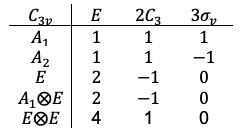
Clearly, \(A_1\otimes E=E\), which implies that \(A_1\otimes E\) is an irreducible representation of \(C_{3v}\). Since the number of irreducible representations of a point group is equal to the number of classes of the group, \(E\otimes E\) is a reducible representation because its characters are not equivalent to the characters of any of the 3 irreducible representations. We then use eq27 for the decomposition of \(E\otimes E\), where
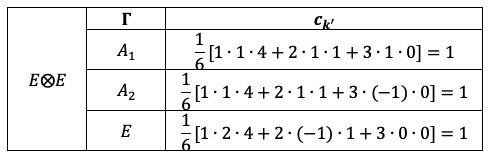
Therefore, \(E\otimes E=A_1\oplus A_2\oplus E\).
Finally, consider the sets of linearly independent functions
i) \(\{f_j(x,y,z)\}\), where \(j=1,2,\cdots,m\)
ii) \(\{g_l(x,y,z)\}\), where \(l=1,2,\cdots,n\)
iii) \(\{j_q(x,y,z)\}\), where \(q=1,2,\cdots,mn\)
that transform according to \(\Gamma_a\), \(\Gamma_b\) and \(\Gamma_c\) respectively.
Since \(\{f_j(x,y,z)\}\), \(\{g_l(x,y,z)\}\) and \(\{j_q(x,y,z)\}\) are sets of linearly independent functions, we can write
$$f_j=\sum_{i=1}^ma_{ij}f_i\;\;\;\;\;\;\;\;77a$$
$$g_l=\sum_{k=1}^nb_{kl}g_k\;\;\;\;\;\;\;\;77b$$
$$j_q=\sum_{p=1}^{mn}c_{pq}j_p\;\;\;\;\;\;\;\;77c$$
According to a previous article, we can also write
$$R_{\alpha}f_j=\sum_{i=1}^ma_{ij}f_i\;\;\;\;\;\;\;\;77d$$
$$R_{\alpha}g_l=\sum_{k=1}^nb_{kl}g_k\;\;\;\;\;\;\;\;77e$$
$$R_{\alpha}j_q=\sum_{p=1}^{mn}c_{pq}j_p\;\;\;\;\;\;\;\;77f$$
where \(R_{\alpha}\) is a symmetry operation of \(G\) and \(a_{ij}\), \(b_{kl}\) and \(c_{pq}\) are the matrix entries of \(\Gamma_a(\alpha)\), \(\Gamma_b(\alpha)\) and \(\Gamma_c(\alpha)\) respectively.
Question
What is the relation between the matrix entries of \(\Gamma_a(\alpha)\), \(\Gamma_b(\alpha)\) and \(\Gamma_c(\alpha)\) in \(\Gamma_c(\alpha)= \Gamma_a(\alpha)\otimes\Gamma_b(\alpha)\)?
Answer
Let the matrix entries of \(\Gamma_a(\alpha)\), \(\Gamma_b(\alpha)\) and \(\Gamma_c(\alpha)\) be \(a_{ij}\), \(b_{kl}\) and \(c_{pq}\) respectively, where
$$\begin{matrix} i=1,\cdots ,m &j=1,\cdots ,m \\ k=1,\cdots ,n &l=1,\cdots ,n \\ p=1,\cdots ,mn &q=1,\cdots ,mn \end{matrix}$$
Using the ordering convention called dictionary order, where the order of \(c_p=a_ib_k\) or \(c_q=a_jb_l\) is given by
$$\begin{matrix}c_1=a_1b_1&c_2=a_1b_2&c_3=a_1b_3&\cdots &c_n=a_1b_n\\c_{n+1}=a_2b_1&c_{n+2}=a_2b_2&c_{n+3}=a_2b_3&\cdots &c_{2n}=a_2b_n\\\cdots&\cdots&\cdots&\cdots&\cdots\\\cdots&\cdots&\cdots&\cdots&c_{mn}a_mb_n\end{matrix}$$
or in terms of the notation \((p,i,k)\) or \((q,j,l)\),
$$\begin{matrix}(1,1,1)&(2,1,2)&(3,1,3)&\cdots &(n,1,n)\\(n+1,2,1)&(n+2,2,2)&(n+3,2,3)&\cdots &(2n,2,n)\\\cdots&\cdots&\cdots&\cdots&\cdots\\\cdots&\cdots&\cdots&\cdots&(mn,m,n)\end{matrix}$$
In other words, \(p\) is determined by \(i\) and \(k\), and \(q\) is determined by \(j\) and \(l\). For example, if \(m=2\) and \(n=3\),

We can then express the matrix entries of \(\Gamma_c(\alpha)\) as
$$c_{pq}=a_{ij}b_{kl}\;\;\;\;\;\;\;\;77g$$
Multiplying eq77a by eq77b,
$$f_jg_l=\sum_{i=1}^m\sum_{k=1}^na_{ij}b_{kl}f_ig_k\;\;\;\;\;\;\;\;77h$$
From eq77g, we have \(\sum_{i=1}^m\sum_{k=1}^na_{ij}b_{kl}=\sum_{p=1}^{mn}c_{pq}\) and we can rewrite the RHS of eq77h as \(\sum_{p=1}^{mn}c_{pq}j_p\), where \(j_p=f_ig_k\). Hence, eq77h is equivalent to eq77c. Combining eq77f and eq77h, we have
$$\begin{align*}R_{\alpha}j_q&=\sum_{p=1}^{mn}c_{pq}j_p\\&=R_{\alpha}(f_jg_l)\\&=\sum_{i=1}^m\sum_{k=1}^na_{ij}b_{kl}f_ig_k\\&=\biggr(\sum_{i=1}^ma_{ij}f_i\biggr)\biggr(\sum_{k=1}^nb_{kl}g_k\biggr)\\&=(R_{\alpha}f_j)(R_{\alpha}g_l)\;\;\;\;\;\;\;\;77i\end{align*}$$
This implies that if the functions \(f_j\) and \(g_l\) are bases for the irreducible representations of \(\Gamma_a\) and \(\Gamma_b\) of a point group respectively, then \(j_q=f_jg_l\) is the basis for \(\Gamma_c\), which is the direct product of \(\Gamma_a\) and \(\Gamma_b\). In other words,
If the functions \(\boldsymbol{f_j}\) and \(\boldsymbol{g_l}\) transform according to the irreducible representations of \(\boldsymbol{\Gamma_a}\) and \(\boldsymbol{\Gamma_b}\) of a point group respectively, then the function \(\boldsymbol{j_p}\), which is the product of the functions \(\boldsymbol{f_j}\) and \(\boldsymbol{g_l}\) must transform according to the direct product of \(\boldsymbol{\Gamma_a\otimes\Gamma_b}\).
Question
Show that the reducible representation of the direct product of two irreducible representations \(\Gamma_a\) and \(\Gamma_b\) contains the totally symmetric representation if and only if \(\Gamma_a\) is the complex-conjugate representation of \(\Gamma_b\).
Answer
Using eq27a, the number of times the totally symmetric representation appears in the decomposition of \(\Gamma_a\otimes\Gamma_b\) is
$$c_{k^{\prime}}=\frac{1}{\vert G\vert}\sum_{\beta}\chi_{k^{\prime}}^*(\beta)\chi_{a\otimes b}(\beta)=\frac{1}{\vert G\vert}\sum_{\beta}\chi_{a\otimes b}(\beta)\;\;\;\;\;\;\;\;78$$
Substitute eq76 in eq78
$$c_{k^{\prime}}=\frac{1}{\vert G\vert}\sum_{\beta}\chi_{a}(\beta)\chi_{b}(\beta)\;\;\;\;\;\;\;\;79$$
Comparing eq79 with eq22, \(c_{k^{\prime}}=1\) if and only if \(\chi_a(\beta)=\chi_b^*(\beta)\) and vanishes otherwise.