A Hilbert space \(H\) is a complete inner product space. It allows the application of linear algebra and calculus techniques in a space that may have an infinite dimension.
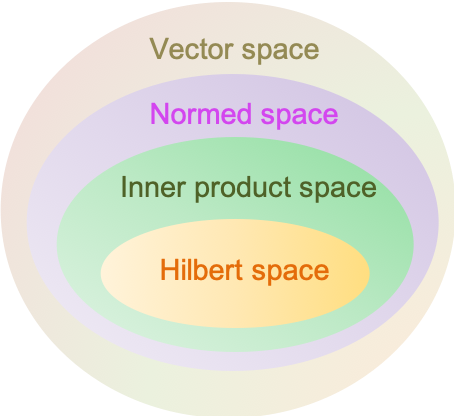
The inner product in a Hilbert space has the following properties:
-
- Conjugate symmetry: \(\langle\phi_1\vert\phi_2\rangle=\langle\phi_2\vert\phi_1\rangle^{*}\)
- Linearity with respect to the 2nd argument: \(\langle\phi_1\vert c_2\phi_2+c_3\phi_3\rangle=c_2\langle\phi_1\vert \phi_2\rangle+c_3\langle\phi_1\vert \phi_3\rangle\)
- Antilinearity with respect to the first argument: \(\langle c_1\phi_1+c_2\phi_2\vert \phi_3\rangle=c_1^{*}\langle\phi_1\vert \phi_3\rangle+c_2^{*}\langle\phi_2\vert \phi_3\rangle\)
- Positive semi-definiteness: \(\langle\phi_1\vert \phi_1\rangle\geq 0\), with \(\langle\phi_1\vert \phi_1\rangle= 0\) if \(\phi_1=0\)
The last property can be illustrated using the \(\mathbb{R}^{2}\) space that is equipped with an inner product. Such a space is an example of a real finite-dimensional Hilbert space. The inner product of the vector \(\boldsymbol{u}\) with itself is:
$$\boldsymbol{u}\cdot\boldsymbol{u}=\begin{pmatrix} u_1 &u_2 \end{pmatrix}\begin{pmatrix} u_1\\u_2 \end{pmatrix}=u{_{1}}^{2}+u{_{2}}^{2}=\{\begin{matrix} >0 &if\; \boldsymbol{u}\neq 0 \\ 0&if \; \boldsymbol{u}=0\end{matrix}$$
We define a complete Hilbert space as one where every Cauchy sequence in \(H\) converges to an element of \(H\). If you recall, a Cauchy sequence is a sequence, e.g. \(\left \{ x_n \right \}_{n=1}^{\infty}\) where \(x_n=\sum_{k=1}^{n}\frac{(-1)^{k+1}}{k}\), for which
$$\lim_{m,n\rightarrow \infty}\left | x_n-x_m \right |=0$$
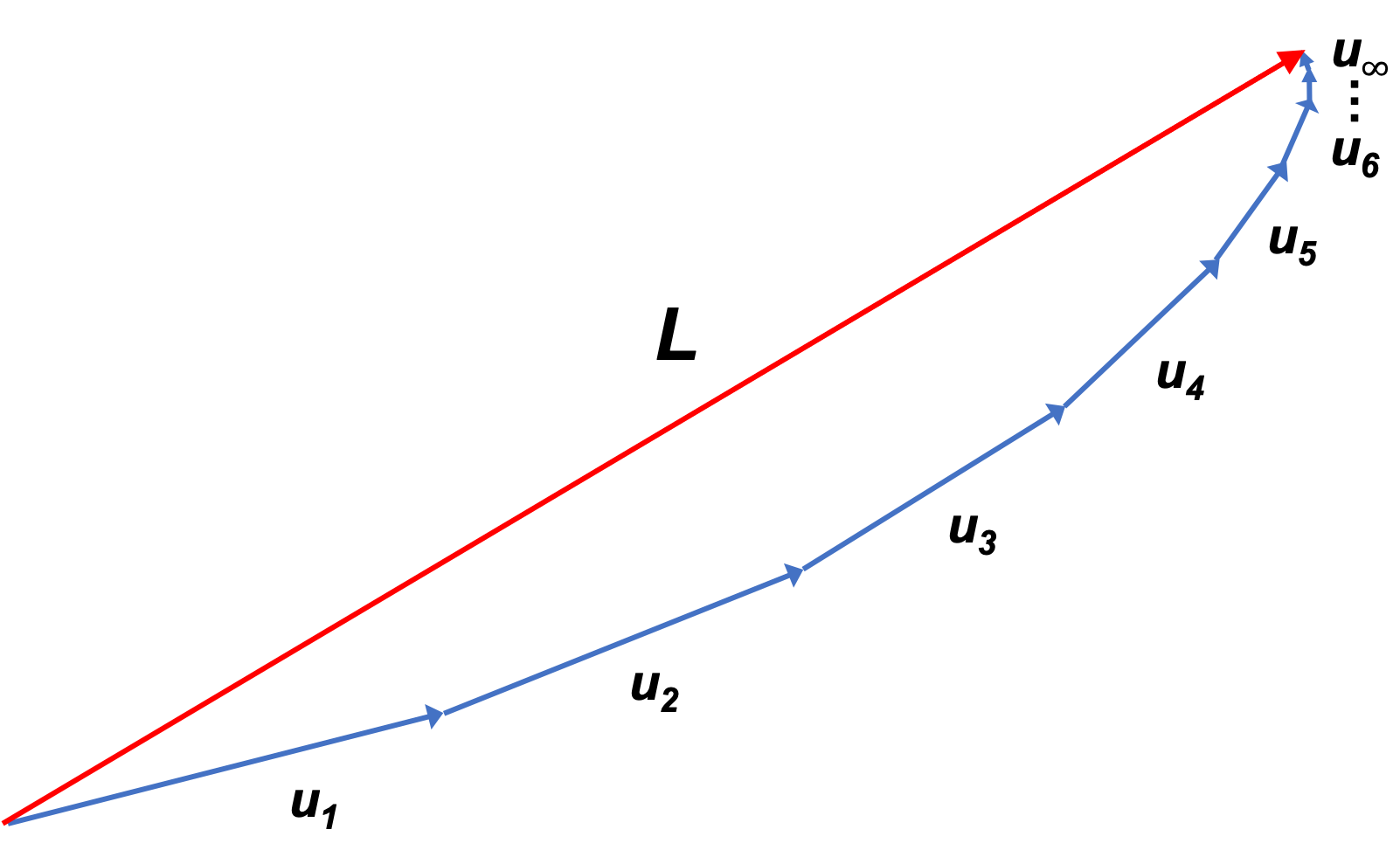
We can also define the completeness of a Hilbert space in terms of a sequence of vectors \(\left \{ \boldsymbol{v_n} \right \}_{n=1}^{\infty}\), where \(\boldsymbol{v_n} =\sum_{k=1}^{n}\boldsymbol{u_k}\). Each element \(\boldsymbol{v_n}\) is represented by a series of vectors, which converges absolutely (i.e. \(\sum_{k=1}^{\infty}\left \| \boldsymbol{u_k} \right \|< \infty\)) and converges to an element of \(H\). In other words, the series of vectors in \(H\) converges to some limit vector \(\boldsymbol{L}\) in \(H\):
$$\lim_{n\rightarrow \infty}\left \|\boldsymbol{L}-\sum_{k=1}^{n}\boldsymbol{u_k} \right \|=0$$
Generally, every element of a vector space can be a point, a vector or a function. In quantum mechanics, we are interested in a Hilbert space called the \(L^{2}\) space, where the eigenfunctions of a Hermitian operator are square integrable, i.e. \(\int_{-a}^{b}\left | \phi(x) \right |^{2}dx< \infty\).
Not to be confused with the completeness of a Hilbert space, the completeness of a set of basis eigenfunctions refers to the property that any eigenfunction of the Hilbert space can be expressed as a linear combination of the basis eigenfunctions. An example is the \(\mathbb{R}^{2}\) space, where the set of basis vectors \(\left \{\boldsymbol{\hat i},\boldsymbol{\hat j}\right \}\) is complete, with a linear combination of \(\boldsymbol{\hat i}\) and \(\boldsymbol{\hat j}\) spanning \(\mathbb{R}^{2}\). In \(H\), the number of basis vectors \(\boldsymbol{u_k}\) may be infinite. If the set of \(\boldsymbol{u_k}\) is complete, we say that it spans \(H\), which is itself complete.
Just as the orthonormal vectors \(\boldsymbol{\hat i}\) and \(\boldsymbol{\hat j}\) form a complete set of basis vectors in the \(\mathbb{R}^{2}\) space, where any vector in \(\mathbb{R}^{2}\) can be expressed as a linear combination of \(\boldsymbol{\hat i}\) and \(\boldsymbol{\hat j}\), we postulate the existence of a complete basis set of orthonormal wavefunctions of any Hermitian operator in \(L^{2}\).