The intermediate-field case of the Zeeman effect is the regime in which an atom or molecule in an external static magnetic field exhibits splitting of its spectral lines into multiple components, with the field strength comparable to the internal spin–orbit interaction.
To analyse the intermediate-field regime, we consider a hydrogen atom in an external magnetic field whose strength is comparable to that of the internal spin-orbit coupling (). In this case, neither the coupled basis
nor the uncoupled basis
is strictly a good quantum state. Nevertheless, the Hamiltonian
remains invariant under rotations about the direction of the external magnetic field (taken as the lab
-axis).
With reference to eq330 and eq331, where the spin-orbit Hamiltonian is , the perturbed part of the Hamiltonian becomes
if we take , where
is a unit vector.
The spin-orbit term commutes with
and
but not with
or
, while the Zeeman term
commutes with
and
, and hence with
, but not with
. Consequently,
and
may still be regarded as a good quantum number.

Question
Show that .
Answer
The ladder operators of quantum orbital angular momentum are defined as and
. Therefore,
and
. Similarly, the ladder operators of spin angular momentum are
and
, with
and
. It follows that
and
. Therefore,
.
Substituting into
gives:
To determine the energy levels, we can no longer rely on the simple first-order perturbation formulas derived in eq334 or eq336. Instead, the spin-orbit Hamiltonian and the Zeeman Hamiltonian
must be treated on equal footing. One qualitative approach is to interpolate between the energy sublevels obtained in the weak-field and strong-field limits. However, a more rigorous method involves the following steps:
-
- choosing the basis state,
- identifying the eigenstates, and
- using the degenerate perturbation theory to determine the energy levels.
To illustrate this method, we consider the 2p1 configuration of the hydrogen atom, with and
. In the absence of an external magnetic field, spin-orbit coupling (using LS coupling) splits the configuration into two energy levels,
and
, with degeneracies
and
respectively. Even though only
remains a good quantum number, we can choose
as the uncoupled basis state and form linear combinations as needed to generate the eigenstates.
Question
Explain further why can be chosen as the basis state even though
and
are not good quantum numbers.
Answer
In Hilbert space, the set of states forms a complete orthonormal basis and therefore spans the entire space, regardless of whether
and
are good quantum numbers. Quantum numbers only need to be good if we want the Hamiltonian to be diagonal in the chosen basis.
As mentioned earlier, the spin-orbit Hamiltonian and the Zeeman Hamiltonian must be treated on equal footing. The basis diagonalises the spin-orbit Hamiltonian but not the Zeeman Hamiltonian, while the basis
diagonalises the Zeeman Hamiltonian but not the spin-orbit Hamiltonian. Since neither term dominates, no basis diagonalises the full Hamiltonian. Nevertheless,
is a convenient choice because the Zeeman term is diagonal in this basis and the matrix elements of the spin–orbit operator
can be calculated relatively easily.
Since is the only conserved quantity, we group the eigenstates according to their
values. For
and
, the possible
values are
and
.
The basis states and
corresponding to
and
respectively are regarded as unmixed states because each value of
corresponds to a unique pair of
and
. Consequently, these states,
and
, are eigenstates of the perturbed part of the Hamiltonian.
For , there are two possible basis states,
and
, and the corresponding eigenstates are linear combinations of these states:
. Similarly, for
, the eigenstates are linear combinations of
and
, i.e.
. We refer to these linear combinations as mixed states.
Having identified the eigenstates, the remaining task is to determine the energy levels. The expectation value for is
, in which
is given by eq340. From eq144, and noting that
can be expressed as the Krönecker product
,
For , we have
. Similarly, using the spin analogue of eq144,
Furthermore, and
. Therefore,
where .
Using eq147 and its spin analogue, and repeating the above logic,
For the mixed state , where
and
, the Hamiltonian is:
Repeating the steps used for the unmixed states to compute the matrix elements gives:
To find the eigenvalues, we solve the secular equation or equivalently,
Expanding the determinant gives the characteristic equation:
Solving the quadratic equation yields two energy levels that depend on :
A similar analysis for , where
and
leads to:
with
and
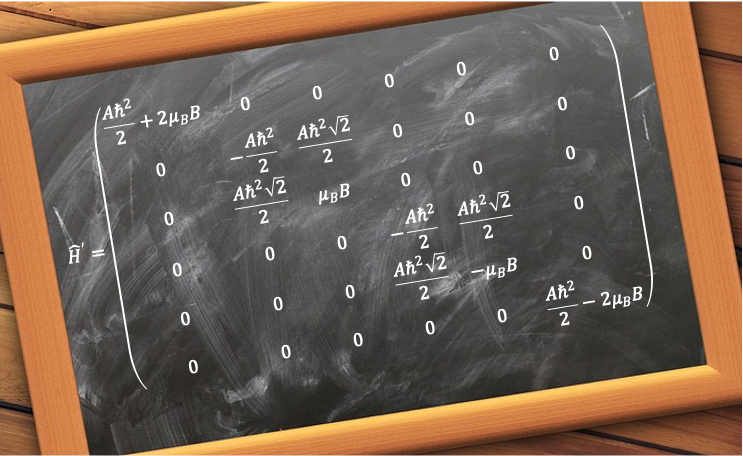
Therefore, the intermediate-field case results in six energy levels for the 2p1 configuration of the hydrogen atom, consistent with the weak-field and strong-field cases, with the perturbed portion of the Hamiltonian given by a matrix:
To show that the matrix elements of are consistent with the eigenvalues at the extreme limits of
, we consider the cases
and
.
When eq343 and eq345 reduce to the same equation:
, with solutions
and
. These correspond to the spin-orbit energy levels
and
in the absence of an external magnetic field. Similarly, the eigenvalues of the unmixed states collapse onto the same energy as the
level, namely
. In other words, the degeneracies are restored, with
being four-fold degenerate and
being two-fold degenerate.
In the opposite limit , the unmixed-state eigenvalues become
, which agrees with the strong-field regime for the states
. For the mixed states, we refer to eq346, where the
and
terms dominate the discriminant, allowing it to be approximated by the perfect square
. So,
Similarly, eq346 yields
The energies given by eq347 and eq348 are again consistent with those obtained in the strong-field case.
Question
Why is the intermediate-field case of the Zeeman effect analysed using degenerate perturbation theory, while the weak-field and strong-field cases are not?
Answer
Degenerate perturbation theory can be applied to all three cases. However, in the weak-field and strong-field regimes the eigenvalues are usually obtained more simply by computing expectation values, since the relevant Hamiltonians are already diagonal in the corresponding unmixed eigenstate bases.