Term symbols are notations representing energy levels of a particular electron configuration of a chemical species.
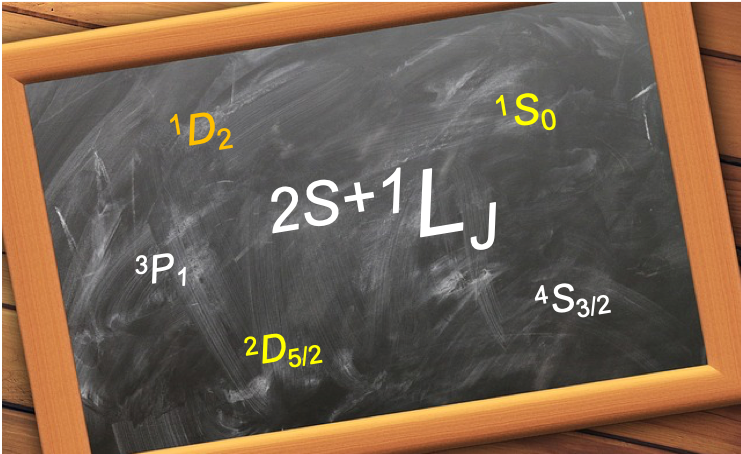
Atomic term symbols
For light atoms, an atomic term symbol is based on Russell Saunders (LS) coupling and can be expressed either as:
or
where is called the multiplicity of the term symbol,
is the total spin angular momentum quantum number,
is the total orbital angular momentum quantum number and
is the total angular momentum quantum number.
Each value of is further assigned a letter:
| L | 0 | 1 | 2 | 3 | 4 | 5 | 6 | 7 | 8 |
| Letter | S | P | D | F | G | H | I | K | L |
Energy levels denoted by eq291 ignore spin-orbit coupling and are called terms, while those denoted by eq292 take into account spin-orbit coupling and are known as levels. Eq291 implies that for a particular electron configuration of an atom, states with the same set of angular momentum quantum numbers and
have the same energy. We have shown in an earlier article how this is possible. When spin-orbit coupling effects are considered, degenerate states corresponding to a term are split into multiple levels. From eq248 and eq289, energy levels of a particular electron configuration of an atom are dependent on the quantum numbers
,
and
.

Question
Write the term symbols for i) the ground state of the hydrogen atom, and ii) the excited state of the hydrogen atom with the electron in the 2p orbital.
Answer
For the ground state of hydrogen, where and
, it is denoted by
. For the excited state, the electron can be in any of the three degenerate 2p orbitals with either an up spin or a down spin. We would therefore expect two term symbols. The first symbol is
, while the second symbol is obtained using the Clebsch-Gordan series of eq219 and is
.
Question
Why is a term symbol not described by the principal quantum number ?
Answer
Term symbols focus on the variation of energy resulting from the arrangement and interaction of electrons in subshells. These arrangements, known as microstates, depend on whether the electrons are equivalent (belonging to the same subshell) or non-equivalent (belonging to different subshells). For example, the electrons in the configuration are equivalent, while those in
are not. The term symbols for
and
are
and
respectively. Although the term symbols for
and
are the same, the energies of the terms for
, which are determined spectroscopically, differ from those for
. Therefore, while the energy associated with
does influence the overall energy of the electron within the atom, it doesn’t directly contribute to the variation in energies of electrons within the subshells.
As we move down the periodic table to heavier elements, such as lead or the actinides, spin-orbit interactions become so strong that and
are no longer good quantum numbers. In these cases, we switch to jj-coupling, where the individual
and
couple to form a
for each electron, and the total angular momentum of the atom is obtained by vectorially adding these:
. The corresponding atomic term symbol is:
For example, the term symbols for the configuration (see this article for details) are
,
,
,
and
.
Even when jj-coupling is technically more accurate for heavy atoms, chemists often stick to the LS notation because it’s more intuitive for discussing symmetry and spectroscopy.
Molecular term symbols
Molecular term symbols are denoted by irreducible representations of the molecule’s point group because eigenstates of the molecular Hamiltonian transform according to irreducible representations of that group.
In an atom, the total angular momentum is a good quantum number due to the atom’s spherical symmetry. In linear molecules, the spherically symmetric electric field experienced by an electron is replaced by a cylindrically symmetric field about the molecular axis. As a result, only the projection of the total angular momentum along the molecular axis remains constant. To reflect this change in symmetry, scientists adopted Greek letters (rather than the Latin letters used for atoms) to label the corresponding quantum numbers in linear molecules.
The fact that the projection of the total angular momentum along the molecular axis is a good quantum number can be further understood by noting that electrons in a linear molecule experience a non-zero torque , which causes their orbital angular momentum
to precess about the molecular axis (taken as the
-axis).
Question
Explain why a non-zero torque is generated on the electrons.
Answer
Classically, electrons are constantly moving around the nucleus of an atom. In an isolated atom, the potential is spherically symmetric, so the force on an electron is purely radial: . As a result, the torque
vanishes.
In a linear molecule, however, the electronic potential is no longer spherically symmetric but cylindrically symmetric about the molecular axis. When an electron’s orbital motion is tilted relative to this axis, the force acting on the electron generally has components that are not parallel to . Consequently,
, and a non-zero torque is generated on the electrons.
To explain the precessional motion, we show that the Hamiltonian is invariant under rotations about the
-axis, but not the
– and
-axes. Consider the Hamiltonian of a diatomic molecule in which the electronic potential term is:
where ,
and
are the position vectors of the electron, the first nucleus and the second nucleus respectively.
Using the Born-Oppenheimer approximation, the nuclear positions are fixed and a rotation operator acts only on the electronic coordinates. Let ,
and
. Then
and
. Therefore,
and hence
is invariant under a rotation about the
-axis (
doesn’t change), but not around the
– and
-axes (both
and
changes). It follows that
, while
and
(see this article for details). Thus, only the projection of
(denoted by
) along the molecular axis is a constant of motion.
The corresponding molecular term symbol for a linear molecule is:
where
-
is the magnitude of the projection of the total electronic orbital angular momentum along the molecular axis. Instead of writing
, spectroscopists denote these values using Greek letters:

-
is the total electron spin quantum number, and the factor
gives the spin multiplicity.
-
is the magnitude of the projection of the total electronic angular momentum (orbital + spin) along the molecular axis:
. Here,
is the projection of the total electron spin angular momentum along the molecular axis (not to be confused with the state symbol
corresponding to
). For a given
Additional symmetry labels such as and
(gerade and ungerade), as well as
and
, apply depending on the symmetry of the molecule. For example, the ground state of molecular oxygen, for which spin-orbit coupling is weak, is
. If high-resolution spectroscopy is used, then we label the split states
and
. Furthermore, the symbol
may be placed before a term symbol to indicate the ground electronic state, while
denote excited electronic states in order of increasing energy. For example, the ground state of N2 is
, while the second excited state is
.
For non-linear molecules, Mulliken symbols are used. For example, the ground state of water is .