The Hückel method is a semi-empirical method that makes additional assumptions to the \(\pi\)-electron approximation in order to determine the energies of \(\pi\) molecular orbitals in planar molecules that are conjugated.

Question
What is a semi-empirical method?
Answer
A semi-empirical method combines theoretical approximations with experimental data to derive useful parameters, such as the energy of a molecular orbital (MO).
Like the \(\pi\)-electron approximation, the Hückel method assumes that \(\sigma\) valence electrons in planar conjugated organic compounds are relatively unreactive for reactions that do not involve in breaking these \(\sigma\) bonds. Furthermore, they are assumed not to interact with the \(\pi\) valence electrons, which participate in many reactions. Consequently, the \(\sigma\) valence electrons are ignored in deriving the energies of the MOs.
To solve for the energies \(E_{\pi}\) of \(\pi\)-electron MOs, consider the general MO wavefunction \(\psi=\sum_{r=1}^{n_c}c_{r}\phi_r\)., where \(n_c\) refers to the number of carbon atoms forming the conjugated framework of the planar molecule, while \(\phi_r\) is a real and normalised \(2p_z\) orbital of the \(r\)-th carbon atom. Non-trivial solutions are given by the secular determinant:
$$\vert H_{rs}-E_iS_{rs}\vert=0$$
where
\(H_{rs}=\langle \phi_r\vert H_{eff}\vert\phi_s\rangle\) is known as the Coulomb integral if \(r=s\).
\(H_{rs}=\langle \phi_r\vert H_{eff}\vert\phi_s\rangle\) is known as the resonance integral if \(r\neq s\).
\(S_{rs}=\langle \phi_r\vert \phi_s\rangle\) is the normalisation expression of \(\phi_r\) if \(r=s\).
\(S_{rs}=\langle \phi_r\vert \phi_s\rangle\) is known as the overlap integral if \(r\neq s\).
\(E_i\) is the eigenvalue associated with \(\psi_i\).
Unlike ab initio methods, the exact form of the effective Hamiltonian \(H_{eff}\) in \(H_{rs}\) is not important (see below for explanation). The additional assumptions used in the Hückel method are:
$$H_{rs}=\biggr\{\begin{matrix}\alpha,& r=s\\\beta,&r\neq s\;for\;adjacent\;carbon\;atoms\\0,&otherwise\end{matrix}$$
$$S_{rs}=\delta_{rs}$$
In other words, all Coulomb integrals (interaction energy) have the same value of \(\alpha\), which is reasonable if all the atoms forming the conjugated framework are the same. It follows that \(H_{rs}=\beta\) for adjacent atoms is similarly a good approximation. From ab initio calculations, both \(\alpha\) and \(\beta\) are negative. As non-adjacent carbons atoms are well separated in space, the conjecture that \(H_{rs}=0\) for non-adjacent carbons atoms \(r\) and \(s\) is also reasonable. The integral \(S_{rr}=1\) is a result of the normalisation of \(2p_z\) orbitals. However, \(S_{rs}=0\) for adjacent carbon atoms is a poor approximation because \(2p_z\) orbitals of adjacent carbon atoms are not orthogonal to one another. In reality, the overlap of \(2p_z\) orbitals of adjacent carbon atoms leads to a stabilisation (lower energy) of bonding MOs and a destabilisation (increase in energy) of antibonding MOs. Nevertheless, the relative order of the MOs along the energy axis generally remains unchanged.
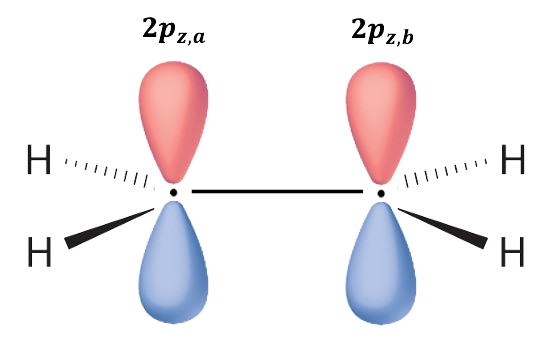
Let’s look at a simple example: ethene. The wavefunction is \(\psi_{\pi}=c_12p_{z,a}+c_22p_{z,b}\) and the secular determinant is
$$\begin{vmatrix}H_{11}-E_iS_{11}&H_{12}-E_iS_{12}\\H_{21}-E_iS_{21}&H_{22}-E_iS_{22}\end{vmatrix}=0$$
Since the \(2p_z\) orbitals are real and \(H_{eff}\) is Hermitian, \(S_{rs}=S_{sr}\) and \(H_{rs}=H_{sr}\). Furthermore, \(S_{rr}=1\) and we have
$$\begin{vmatrix}\alpha-E_i&\beta\\\beta&\alpha-E_i\end{vmatrix}=0$$
This implies that \(E_i=\alpha\pm\beta\) and the ground state electron configuration of the \(\pi\) electrons in ethene is
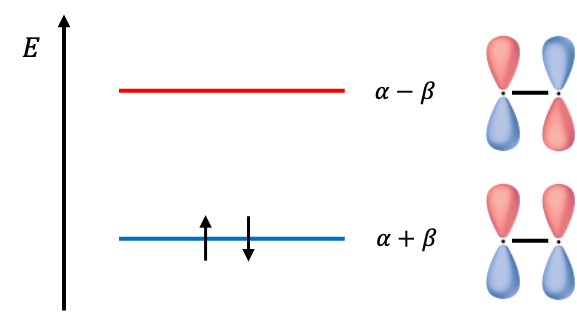
Consequently, the Hückel method provides a quick way of predicting the number and order of a conjugated molecule’s valence MOs that likely to participate in a reaction, without explicitly specifying the Hamiltonian. The parameters \(\alpha\) and \(\beta\) are adjusted to give the best fit to experimental data, which is why the Hückel method is considered a semi-empirical method. The total ground state \(\pi\) electronic energy of ethene is \(E_{\pi}=2\alpha+2\beta\).
Question
Show that i) \(c_1=c_2\) when \(E_1=\alpha+\beta\) and \(c_2=-c_1\) when \(E_2=\alpha-\beta\), and that ii) the normalisation constant \(N\) of \(\psi_{\pi}=c_1(\phi_1+\phi_2)\) is \(N=\frac{1}{\sqrt{2}}\).
Answer
i) Multiplying the eigenvalue equation \(H_{eff}(c_1\phi_1+c_2\phi_2)=E_i(c_1\phi_1+c_2\phi_2)\) by \(c_1\phi_1+c_2\phi_2\), integrating over all space and using the Hückel assumptions, we get
$$(c_1^2+c_2^2)(\alpha-E_i)+2c_1c_2\beta=0$$
For \(E_1=\alpha+\beta\) and \(E_2=\alpha-\beta\), we have \(c_1=c_2\) and \(c_2=-c_1\), respectively.
Therefore, the occupied MO wavefunction and unoccupied MO are \(\psi_{\pi}=c_1(\phi_1+\phi_2)\) and \(\psi_{\pi}=c_1(\phi_1-\phi_2)\) respectively. Since the two electrons occupying \(\psi_{\pi}=c_1(\phi_1+\phi_2)\) lead to a stable molecule, the MO is known as the bonding MO. The higher energy MO, which obviously results in a relatively less state when occupied, is known as the antibonding MO.
ii)
$$\int N(\phi_1+\phi_2)^*N(\phi_1+\phi_2)d\tau=1$$
$$N^2\biggr(\int \phi_1^*\phi_1d\tau+\phi_1^*\phi_2d\tau+\cdots\biggr)=1$$
Since \(S_{rs}=\delta_{rs}\), we have \(N=\frac{1}{\sqrt{2}}\)
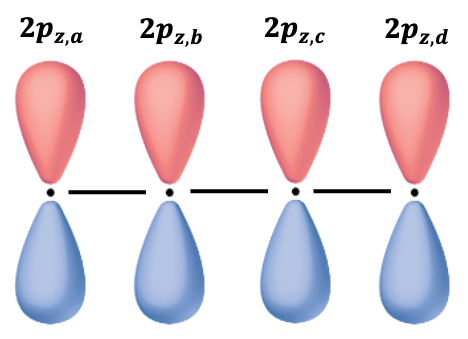
Let’s consider another molecule: 1,3-Butadiene. The secular determinant is:
$$\begin{vmatrix}H_{11}-E_iS_{11}&H_{12}-E_iS_{12} &H_{13}-E_iS_{13}&H_{14}-E_iS_{14}\\H_{21}-E_iS_{21}&H_{22}-E_iS_{22} &H_{23}-E_iS_{23}&H_{24}-E_iS_{24}\\H_{31}-E_iS_{31}&H_{32}-E_iS_{32} &H_{33}-E_iS_{33}&H_{34}-E_iS_{34}\\H_{41}-E_iS_{41}&H_{42}-E_iS_{42} &H_{43}-E_iS_{43}&H_{44}-E_iS_{44}\end{vmatrix}=0$$
The Hückel assumptions give
$$\begin{vmatrix}\alpha-E_i&\beta &0&0\\\beta&\alpha-E_i &\beta&0\\0&\beta &\alpha-E_i&\beta\\0&0 &\beta&\alpha-E_i\end{vmatrix}=0$$
Using the determinant identity \(\vert cA\vert=c^n\vert A\vert\), we multiply both sides of the above equation by \(\frac{1}{\beta^4}\) to yield
$$\begin{vmatrix}x&1&0&0\\1&x &1&0\\0&1 &x&1\\0&0 &1&x\end{vmatrix}=0$$
where \(x=\frac{\alpha-E_i}{\beta}\).
Expanding the determinant, we have \(x^4-3x^2+1=0\). The roots to the polynomial are \(x=\pm\sqrt{\frac{3+\sqrt{5}}{2}},\pm\sqrt{\frac{3-\sqrt{5}}{2}}\) and the energies of the MOs are
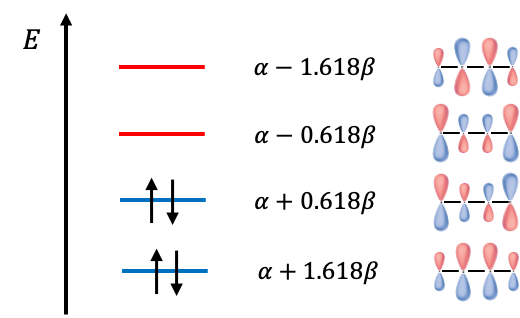
If we regard two \(\pi\) electrons in 1,3-Butadiene as localised between carbons atoms \(a\) and \(b\), and another two between carbon atoms \(c\) and \(d\), we can compare the total ground state \(\pi\) electronic energy of 1,3-Butadiene with that of two molecules of ethene. The difference of \(0.472\beta\) implies an energy stabilisation for 1,3-Butadiene that is due to the delocalisation of electrons over the length of the molecule, rather than being localised.
The general form of the wavefunction for the four MOs is \(\psi_{\pi}=c_1\phi_1+c_2\phi_2+c_3\phi_3+c_4\phi_4\) . To determine each individual wavefunction, we apply the Hückel assumptions to eq157, giving
$$(\alpha-E_i)c_1+\beta c_2=0\;\;\;\;\;\;\;\;162$$
$$\beta c_1+(\alpha-E_i) c_2+\beta c_3=0\;\;\;\;\;\;\;\;163$$
$$\beta c_2+(\alpha-E_i) c_3+\beta c_4=0\;\;\;\;\;\;\;\;164$$
$$\beta c_3+(\alpha-E_i) c_4=0\;\;\;\;\;\;\;\;165$$
From eq162 and eq165, we have
$$c_1=-\frac{\beta}{\alpha-E_i} c_2\;\;\;\;\;\;\;\;166$$
$$c_4=-\frac{\beta}{\alpha-E_i} c_3\;\;\;\;\;\;\;\;167$$
Substituting eq166 in eq163 gives \([-\beta^2+(\alpha-E_i)^2]c_2+\beta(\alpha-E_i)c_3=0\). When \(E_i=E_1=\alpha+\sqrt{\frac{3+\sqrt{5}}{2}}\beta\), we have \(c_2=c_3\).
Substituting \(c_2=c_3\) in eq166 and comparing with eq167, \(c_1=c_4\). It follows that \(c_1=c_4=0.618c_2=0.618c_3\). Therefore, \(\psi_1=c_2(0.618\phi_1+\phi_2+\phi_3+0.618\phi_4)\), which becomes \(\psi_1=0.3717\phi_1+0.6015\phi_2+0.6015\phi_3+0.3717\phi_4\) after normalisation. Using the same logic, we have
$$\psi_2=0.6015\phi_1+0.3717\phi_2-0.3717\phi_3-0.6015\phi_4$$
$$\psi_3=0.6015\phi_1-0.3717\phi_2-0.3717\phi_3+0.6015\phi_4$$
$$\psi_4=0.3717\phi_1-0.6015\phi_2+0.6015\phi_3-0.3717\phi_4$$
Question
Show that in the analysis of a molecule using the Hückel method, the total electron density \(q\) of an atom \(k\) is \(q_k=\sum_in_ic^2_{ki}\), where \(n_i\) represents the number of electrons in an MO and \(c_{ki}\) are the coefficients corresponding to atom \(k\) across all the one-electron MO wavefunctions \(\psi_i\).
Answer
The Born interpretation states that \(\int\psi_i^2d\tau=1\), where \(\psi_i=\sum_kc_{ki}\phi_k\). So,
$$\int\biggr(\sum_kc_{ki}\phi_k\biggr)^2d\tau=\sum_kc^2_{ki}\int\phi^2_kd\tau+\sum_{k\neq l}c_{kl}c_{li}\int\phi_k\phi_ld\tau=1$$
Since \(\int\phi_k\phi_ld\tau=\delta_{kl}\),
$$\sum_kc^2_{ki}=1$$
This shows that the sum of the electron probability (density) contributions of atom \(k\) across all the one-electron MO wavefunctions is normalised. If the MO contains \(n_i\) electrons,
$$q_k=\sum_in_ic^2_{ki}$$
For more complicated molecules, such as benzene, the Hückel method is combined with group theory to derive the wavefunctions and solve for their associated eigenvalues.