Electronic selection rules for atoms are quantum-mechanical conditions (based on changes in quantum numbers and symmetry) that determine whether transitions between energy levels in the atoms are allowed or forbidden.
According to the time-dependent perturbation theory, the transition probability between the states
and
of an atom is proportional to
, where
is the operator for the atom’s electric dipole moment. Although an atom has no permanent dipole moment in a stationary state, it can acquire a transient, time-dependent dipole moment when interacting with an oscillating electromagnetic field. During this interaction, the atomic state is described as a time-dependent superposition of the initial and final states:
. When the incident frequency is far from resonance, the coefficient
remains very small. Near resonance, however, the mixing between the states becomes significant (
). This coherent superposition (for example between
and
) leads to interference between the wavefunctions of the two states, creating an asymmetric, time-dependent electron distribution. As a result, the centre of negative charge oscillates relative to the nucleus, generating a transient dipole moment that oscillates at (or near) the driving frequency of the incident radiation.
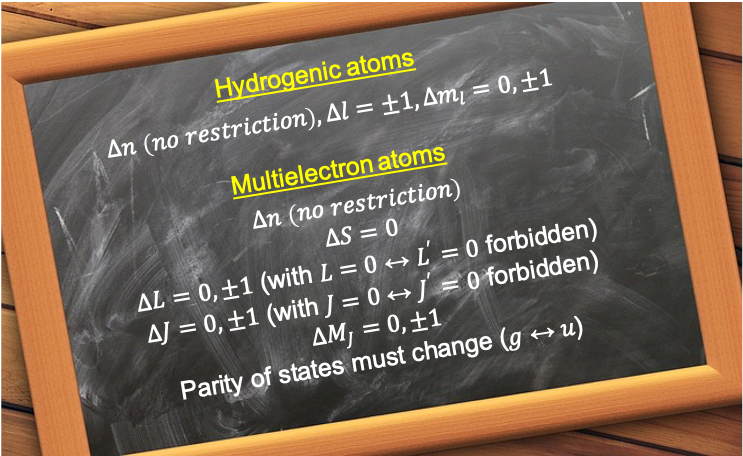
Hydrogenic atoms
Consider a hydrogenic atom, for which and
. For a plane-polarised electromagnetic wave with its electric field oscillating along the
-direction, only the
-component of the dipole operator contributes. Thus,
and
The angular integral involving the spherical harmonics is non-zero only when (see this link for derivation):
This leaves the radial integral:
where .

Question
Show that is square-integrable.
Answer
For to be square-integrable,
When , we have
. So,
. Consider the integral
. If
, then
. If
, then
. As
,
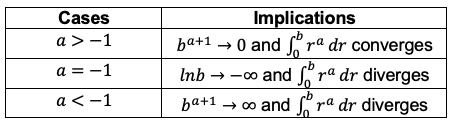
Thus, converges as
because
. Furthermore,
, so that
, where
and
are polynomial functions of
. As
, the exponential term decays to zero faster than
, ensuring that
converges. Therefore,
.
Since is square-integrable with respect to
, it belongs to the radial Hilbert space. Additionally,
forms a complete set for the radial Hilbert space for a fixed
. We can therefore expand
as a linear combination of
for any fixed
:
with
If there were a restriction such as , the expansion
would contain only a finite number of terms. However, multiplying
by
generally produces a function with a different shape that requires infinitely many basis functions to represent. This corresponds to an infinite number of nonzero coefficients
, and hence infinitely many possible values of
. In other words,
is nonzero for infinitely many values of
, resulting in no selection rule for
. Therefore, the combined selection rules for electronic transitions in hydrogenic atoms are:
Multi-electron atoms
For multi-electron atoms, the initial and final states, and
, must satisfy the Pauli exclusion principle. This can be accomplished by representing them using Slater determinants built from orthogonal spin-orbitals
:
where
, with
and
being the spatial and spin wavefunctions respectively, and
.
denotes the antisymmetric form of
and
, i.e.
or
.
denotes the symmetric form of
and
, i.e.
or
.
The electric dipole operator is a sum of one-electron operators:
Determining the selection rules requires evaluating , in which the initial and final states must differ. Let us assume that
and
differ by one spin orbital, i.e.
and
. Applying the Slater-Condon rule for one-electron operators, where
, in which
is the antisymmetriser, gives:
Thus,
Due to spin orthogonality, . So,
only if
. This implies
and therefore
because the electron spins in a multi-electron atom are coupled such that
, where
. Since the spin wavefunctions of the initial and final states are identical, this further requires that the total spin quantum number does not change, i.e.
. It follows that:
Due to the orthogonality of the spatial wavefunctions, only the first term on the RHS survives, giving:
All terms vanish except for , yielding
It is evident from the integrals in the derivation above that if and
differ by more than one spin orbital,
. This is why double or multiple electon excitations are forbidden in electric dipole transitions. Therefore,
reduces to a single one-electron integral, whose selection rules are those of the hydrogenic atom:
remains unrestricted for multi-electron atoms. The dipole operator acts on a single electron and enforces the hydrogenic selection rule
. In a multi-electron atom, the total orbital angular momentum is obtained by vector coupling
. A change in one electron’s orbital angular momentum by one unit therefore changes the coupled total orbital angular momentum by at most one unit, leading to the selection rule
(with
forbidden). Since
and
, any change in the total angular momentum between the initial and final states (
and
) must arise entirely from the change in
, which is governed by
. Therefore,
, with
forbidden. Furthermore, since
, it follows that
and hence
. Because
and
in the Slater-Condon reduction, we obtain
.
The final selection rule for multi-electron atoms is based on the Laporte selection rule, which states that the electric dipole transition matrix element is non-zero only if the integrand is even under spatial inversion over all space. This follows from the fact that if the integrand is odd under the transformation
, then each configuration has a corresponding inverted configuration contributing equal magnitude with opposite sign, leading to cancellation and a vanishing integral.
Since is odd under inversion (
), the matrix element
is non-zero only if the initial and final states have opposite parity. For a multi-electron atom, the parity of a Slater determinant is given by
. So, the wavefunction is even if
is even and odd if
is odd.
The combined selection rules for multi-electron atoms are:
Question
Why is forbidden? Evaluate whether the transition
is allowed (see this link for how atomic term symbols are derived).
Answer
Electric dipole transitions in centrosymmetric atoms involve the generation of a transient dipole moment, which is directional, leading to the redistribution of charge density. Such a transition cannot occur if both the initial and final states are spherically symmetric. Since an state is spherically symmetric and has no directional dependence, transitions with
are forbidden. The same reasoning explains why
transitions are forbidden.
For the transition ,
-
: allowed, since there is no restriction on
.
: satisfies the selection rule.
: allowed, since
.
: satisfies the selection rule.
- For
and
, the magnetic quantum numbers are
and
respectively. Transitions are allowed only for
.
- The parity of both the initial and final states is
, which violates the parity rule.
Therefore, the transition is forbidden.
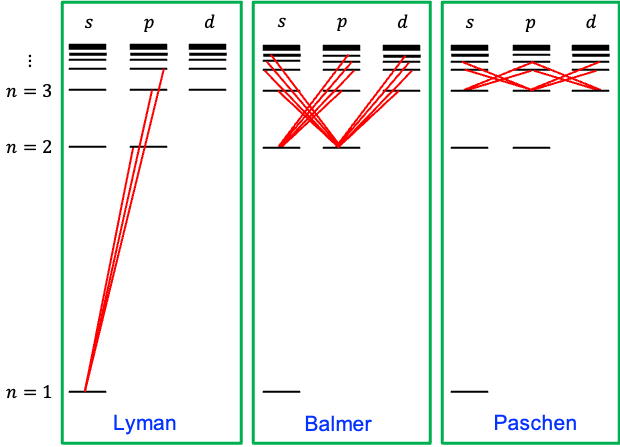
The selection rules for hydrogenic and multi-electron atoms are best illustrated by Grotrian diagrams (see above Grotrian diagram for hydrogen).
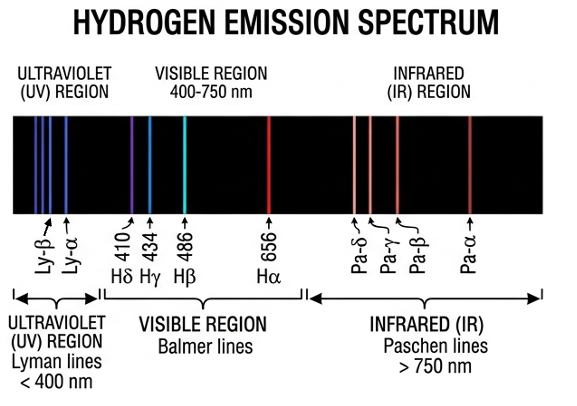
In summary, electronic transitions in hydrogenic and multi-electron atoms produce discrete spectral lines (see diagram above), even when fine structures is taken into account. However, in molecules, each electronic transition is accompanied by many possible simultaneous vibrational and rotational transitions. These thousands of closely-spaced lines overlap, creating the appearance of a continuous band.