The Biot-Savart law is an equation describing the magnetic field generated by a current segment.
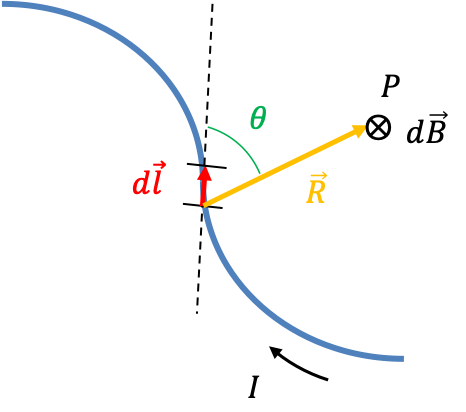
Consider a point in the vicinity of a wire carrying a current
(see diagram below). The magnitude of
represents the rate at which electric charge flows through a cross-section of the wire. For a steady current, a larger current produces a proportionally larger magnetic field. Suppose an infinitesimal segment of the wire is represented by the vector
. The contribution of this current element to the magnetic field at
is proportional to
. Furthermore, this contribution depends on the orientation of the current element relative to the position vector
, which points from the current element towards
. Specifically, only the component of
perpendicular to
contributes to the magnitude of the magnetic field. This perpendicular component is
, where
is the angle between
and
. Hence,
Additionally, empirical observations show that the magnitude of the magnetic field contribution decreases in proportion to the square of the distance between the current element and . Therefore,
The magnetic field also depends on the permeability of the surrounding medium. Assuming that the system is in a vacuum, the experimentally established proportionality constant is , where
is the vacuum permeability. Thus,
To express this relationship in vector form, we use the cross product, which accounts for both the angular dependence and the direction of the magnetic field:
Therefore, the total field at is
Eq150, eq151 and eq152 are different forms of the Biot-Savart law.
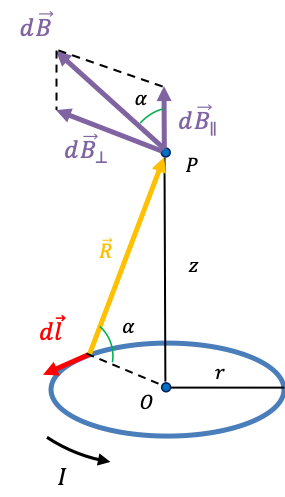
If the wire is a circle, the direction of at
is determined by the right hand rule and is perpendicular to the plane formed by
and
, where the angle
between
and
is
(see diagram below).
From eq150,
Let’s analyse the components of . If we sum all the vectors of
at
from all current elements around the wire, they cancel out. The vectors of
at
, however adds. Therefore, in scalar form,
, where
, which when combined with eq153 gives
Since and
, eq154 becomes
and
Substituting into the above equation gives
For the case of at point
, we have
, which is the length
, equals to zero. So,
For the case of , eq155 becomes
, where
. Substituting eq60 and eq61 into
yields,
Eq156 and eq157 are useful in constructing the orbit-orbit coupling term and the spin-orbit coupling term of the Hamiltonian.
Finally, the Biot-Savart law is also used fo derive the diamagnetic and paramagnetic shielding constants in nuclear magnetic resonance spectroscopy.