Non-relativistic multi-electron Hamiltonian

The three dimensional Hamiltonian operator \hat{H}_T for an n-electron atom (excluding spin-orbit and other interactions) is:

\hat{H}_T=\frac{1}{2m_e}\sum_{i=1}^{n}\hat{p}_i^{\;2}-\sum_{i=1}^{n}\frac{Ze^{2}}{4\pi\varepsilon_0r_i}+\sum_{i=1}^{n-1}\sum_{j=i+1}^{n}\frac{e^{2}}{4\pi\varepsilon_0r_{ij}}\; \; \; \; \; \; \; \; 239

where \hat{p}_i^{\;2}=\hat{p}_{ix}^{\;2}+\hat{p}_{iy}^{\;2}+\hat{p}_{iz}^{\;2}=\left ( \frac{\hbar}{i}\frac{\partial}{\partial x} \right )^{2}+\left ( \frac{\hbar}{i}\frac{\partial}{\partial y} \right )^{2}+\left ( \frac{\hbar}{i}\frac{\partial}{\partial z} \right )^{2}, r_i=\sqrt{x_i^{\;2}+y_i^{\;2}+z_i^{\;2}} and r_{ij}=\vert\boldsymbol{\mathit{r}}_i-\boldsymbol{\mathit{r}}_j\vert=\sqrt{(x_i-x_j)^{2}+(y_i-y_j)^{2}+(z_i-z_j)^{2}}

or

\hat{H}_T=-\frac{\hbar^{2}}{2m_e}\sum_{i=1}^{n}\nabla_i^{\;2}-\sum_{i=1}^{n}\frac{Ze^{2}}{4\pi\varepsilon_0r_i}+\sum_{i=1}^{n-1}\sum_{j=i+1}^{n}\frac{e^{2}}{4\pi\varepsilon_0r_{ij}}\; \; \; \; \; \; \; \; 240

where \nabla_i^{\;2}=\frac{\partial^{2}}{\partial x_i^{\;2}}+\frac{\partial^{2}}{\partial y_i^{\;2}}+\frac{\partial^{2}}{\partial z_i^{\;2}}.

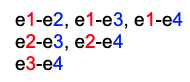
It is the total energy operator of the atom. The first term consists of the kinetic energy operators of the atom’s electrons and acts on a function of r, \theta and \phi. The second term, which is the electrostatic potential energy for the attractions between the electrons and the protons, acts on a function of just r because we have assumed an infinitely heavy nucleus that is reduced to a point at the origin. The third term, which acts on a function of r, \theta and \phi, is the electrostatic potential energy of electron repulsions. To illustrate the double summation for the last term, we consider a four-electron system with electrons e1, e2, e3 and e4. The possible interacting potentials, in the form of ejek, are:

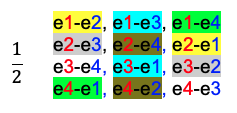
which can be represented by the double summation {\color{Red} \sum_{i=1}^{n-1}}{\color{Blue} \sum_{j=i+1}^{n}}. Note that this double summation can also be represented as \frac{1}{2}{\color{Blue} \sum_{j\neq i}}{\color{red} \sum_{i=1}^{n}}, which is illustrated as:

or {\color{Blue} \sum_{j> i}}{\color{red} \sum_{i=1}^{n}}, which is


Question

How is the potential energy term derived?

Answer

Let’s assume an electron with charge produces a spherically symmetric electric field , whose magnitude is proportional to the number of field lines crossing an element of area perpendicular to the field. This is, in turn, proportional to the amount of charge enclosed by the surface:

where the proportionality constant is experimentally determined to be , and is the permittivity of free space (8.8542 x 10⁻¹² Fm-1).

If we place another electron in this field, the potential energy between the two electrons is the work done to move the second electron from infinity to a distance  from the first electron:


To show that eq239 commutes with the components of the total orbital angular momentum operator \hat{\boldsymbol{\mathit{L}}}^{(T)}, we consider a two electron system. As we know, \hat{\boldsymbol{\mathit{L}}}^{(T)}=\hat{\boldsymbol{\mathit{L}}}_1+\hat{\boldsymbol{\mathit{L}}}_2, where \hat{\boldsymbol{\mathit{L}}}_1 and \hat{\boldsymbol{\mathit{L}}}_2 are the individual orbital angular momentum of the system. Using eq76, we have

\hat{\boldsymbol{\mathit{L}}}^{(T)}=\hat{\boldsymbol{\mathit{i}}}\hat{L}_{1x}+\hat{\boldsymbol{\mathit{j}}}\hat{L}_{1y}+\hat{\boldsymbol{\mathit{k}}}\hat{L}_{1z}+\hat{\boldsymbol{\mathit{i}}}\hat{L}_{2x}+\hat{\boldsymbol{\mathit{j}}}\hat{L}_{2y}+\hat{\boldsymbol{\mathit{k}}}\hat{L}_{2z}

\hat{\boldsymbol{\mathit{L}}}^{(T)}=\hat{\boldsymbol{\mathit{i}}}(\hat{L}_{1x}+\hat{L}_{2x}) +\hat{\boldsymbol{\mathit{j}}}(\hat{L}_{1y}+\hat{L}_{2y}) +\hat{\boldsymbol{\mathit{k}}}(\hat{L}_{1z}+\hat{L}_{2z})

where (\hat{L}_{1x}+\hat{L}_{2x}), (\hat{L}_{1y}+\hat{L}_{2y}) and (\hat{L}_{1z}+\hat{L}_{2z}) are components of \hat{\boldsymbol{\mathit{L}}}^{(T)}.

For the uncoupled case, where the orbital angular momenta of the two electrons do not interact, eq239 becomes \hat{H}_{T,uc}=\frac{1}{2m_e}\sum_{i=1}^{2}\hat{p}_i^{\;2}-\sum_{i=1}^{2}\frac{Ze^{2}}{4\pi\varepsilon_0r_i}. From eq103, eq104 and eq105, we have [\hat{L}_{mk},\frac{1}{r}]=0 and [\hat{L}_{mk},\hat{p}^{2}]=0, where m=1,2 and k=x,y,z. This implies that the components of \hat{\boldsymbol{\mathit{L}}}_1 and \hat{\boldsymbol{\mathit{L}}}_2 commutes with \hat{H}_{T,uc}, and that \left [ \hat{L}_k^{\;(T)}=\hat{L}_{1k}+\hat{L}_{2k},\frac{1}{r} \right ]=0 and \left [ \hat{L}_k^{\;(T)},\hat{p}^{2} \right ]=0, and hence \left [ \hat{L}_k^{\;(T)},\sum_{i=1}^{2}\frac{1}{r}_i \right ]=0 and \left [ \hat{L}_k^{\;(T)},\sum_{i=1}^{2}\hat{p}_i^{\;2} \right ]=0. Therefore, when we analyse the commutation relations of the components of \hat{\boldsymbol{\mathit{L}}}_1 and \hat{\boldsymbol{\mathit{L}}}_2 with \hat{H}_T, we are left with the commutation relations of the components of \hat{\boldsymbol{\mathit{L}}}_1 and \hat{\boldsymbol{\mathit{L}}}_2 with \frac{1}{\vert\boldsymbol{\mathit{r}}_1-\boldsymbol{\mathit{r}}_2\vert}.


Question

Show that the components of \hat{\boldsymbol{\mathit{L}}}^{(T)}, but not those of \hat{\boldsymbol{\mathit{L}}}_1 and \hat{\boldsymbol{\mathit{L}}}_2, commute with \frac{1}{\vert\boldsymbol{\mathit{r}}_1-\boldsymbol{\mathit{r}}_2\vert}.

Answer

Using eq74,

\left [ \hat{L}_{1z},\frac{1}{\vert\boldsymbol{\mathit{r}}_1-\boldsymbol{\mathit{r}}_2\vert} \right ]=\frac{\hbar}{i\vert\boldsymbol{\mathit{r}}_1-\boldsymbol{\mathit{r}}_2\vert^{3/2} }\left [ -x_1(y_1-y_2)+y_1(x_1-x_2) \right ]\neq0\; \; \; \; \; \; \; \; 241

\left [ \hat{L}_{2z},\frac{1}{\vert\boldsymbol{\mathit{r}}_1-\boldsymbol{\mathit{r}}_2\vert} \right ]=\frac{\hbar}{i\vert\boldsymbol{\mathit{r}}_1-\boldsymbol{\mathit{r}}_2\vert^{3/2} }\left [ x_2(y_1-y_2)-y_2(x_1-x_2) \right ]\neq0\; \; \; \; \; \; \; \; 242

Similarly,  the x,y-components of the uncoupled operators \hat{\boldsymbol{\mathit{L}}}_1 and \hat{\boldsymbol{\mathit{L}}}_2 do not commute with with \frac{1}{\vert\boldsymbol{\mathit{r}}_1-\boldsymbol{\mathit{r}}_2\vert}. Therefore, all components of \hat{\boldsymbol{\mathit{L}}}_1 and \hat{\boldsymbol{\mathit{L}}}_2 do not commute with the Hamiltonian \hat{H}_T.

Using the identity [\hat{A}+\hat{B},\hat{C}]=[\hat{A},\hat{C}]+[\hat{B},\hat{C}] and substituting eq241 and eq242 into \left [ \hat{L}_{1z}+\hat{L}_{2z},\frac{1}{\vert\boldsymbol{\mathit{r}}_1-\boldsymbol{\mathit{r}}_2\vert} \right ], we have \left [ \hat{L}_{1z}+\hat{L}_{2z},\frac{1}{\vert\boldsymbol{\mathit{r}}_1-\boldsymbol{\mathit{r}}_2\vert} \right ]=0. Similarly, we find that \left [ \hat{L}_{1x}+\hat{L}_{2x},\frac{1}{\vert\boldsymbol{\mathit{r}}_1-\boldsymbol{\mathit{r}}_2\vert} \right ]=0 and \left [ \hat{L}_{1y}+\hat{L}_{2y},\frac{1}{\vert\boldsymbol{\mathit{r}}_1-\boldsymbol{\mathit{r}}_2\vert} \right ]=0. So,

\left [ \hat{L}_x^{\;(T)},\hat{H}_T \right ]=\left [ \hat{L}_y^{\;(T)},\hat{H}_T \right ]=\left [ \hat{L}_z^{\;(T)},\hat{H}_T \right ]=0 \; \; \; \; \; \; \; \; 243


Therefore, the components of the coupled total orbital angular momentum operator commutes with the Hamiltonian \hat{H}_T. If so, we can evaluate \left [ \hat{{L}^{2}}^{(T)},\hat{H}_T \right ] using the identities [\hat{A}+\hat{B}+\hat{C},\hat{D}]=[\hat{A},\hat{D}]+[\hat{B},\hat{D}]+[\hat{C},\hat{D}] and [\hat{A}\hat{B},\hat{C}]=[\hat{A},\hat{C}]\hat{B}+\hat{A}[\hat{B},\hat{C}] and eq243, which gives us

\left [ \hat{{L}^{2}}^{(T)},\hat{H}_T \right ]=0\; \; \; \; \; \; \; \; 244

Finally, \hat{H}_T also commutes with \hat{{S}^{2}}^{(T)} and \hat{S}_z^{\;(T)} because \hat{H}_T and spin angular momentum operators act on different vector spaces.


Question

Show that \hat{\boldsymbol{\mathit{L}}}^{(T)}\cdot\hat{\boldsymbol{\mathit{S}}}^{(T)} commutes with \hat{H}_T, where \hat{\boldsymbol{\mathit{L}}}^{(T)}=\sum_{i=1}^{n}\hat{\boldsymbol{\mathit{L}}}_i and .\hat{\boldsymbol{\mathit{S}}}^{(T)}=\sum_{i=1}^{n}\hat{\boldsymbol{\mathit{S}}}_i.

Answer

\left [ \hat{\boldsymbol{\mathit{L}}}^{T}\cdot\hat{\boldsymbol{\mathit{S}}}^{T},\hat{H}_T\right ]=\left [\hat{L_x^{\;(T)}}\hat{S_x^{\;(T)}}+\hat{L_y^{\;(T)}}\hat{S_y^{\;(T)}}+\hat{L_z^{\;(T)}}\hat{S_z^{\;(T)}},\hat{H}_T \right ]

Using the identities [\hat{A}+\hat{B}+\hat{C},\hat{D}]=[\hat{A},\hat{D}]+[\hat{B},\hat{D}]+[\hat{C},\hat{D}] and [\hat{A}\hat{B},\hat{C}]=[\hat{A},\hat{C}]\hat{B}+\hat{A}[\hat{B},\hat{C}], and noting that every component of \hat{\boldsymbol{\mathit{L}}} commutes with every component of \hat{\boldsymbol{\mathit{S}}} because they act on different vector spaces, and that the components of \hat{\boldsymbol{\mathit{S}}} commutes with \hat{H}_T because they act on different vector spaces, we have

\left [ \hat{\boldsymbol{\mathit{L}}}^{T}\cdot\hat{\boldsymbol{\mathit{S}}}^{T},\hat{H}_T\right ]=0\; \; \; \; \; \; \; \; 245


Next article: Exchange force
Previous article: Pauli exclusion principle
Content page of quantum mechanics
Content page of advanced chemistry
Main content page

Leave a Reply

Your email address will not be published. Required fields are marked *

Mono Quiz