Kirchhoff’s law (thermodynamics)

Kirchhoff’s law describes the change in enthalpy of a reaction with respect to the change in temperature.

From eq37, the heat capacity at constant pressure is defined as the change of enthalpy with respect to the change in temperature at constant pressure, i.e. . In other words, is the gradient of the curve of enthalpy versus temperature at constant pressure.

for a perfect gas is independent of temperature and we get a straight line with a constant gradient when the enthalpy of a perfect gas at constant pressure is plotted against temperature,. However, for an ideal or real gas,  varies with temperature and eq37 becomes:

Integrating both sides of eq64 with respect to temperature,

Since is a state function, the line integral of eq65 gives

or, for the change in enthalpy of a reaction,

Eq66 (or eq66a) is known as Kirchhoff’s law, which is used to calculate the change in enthalpy of a substance (or a reaction) from to .

The computation of eq65 to eq66 (or eq66a) is only valid if the function  is continuous and differentiable within the limits of to . If eq66a has a temperature range that includes phase transitions, which result in points of discontinuity in (see diagram above), it has to be modified as follows:

To find an expression for , we use a power series to generate curves that fit experimental values of for different substances on versus temperature plots:

The set of constants , , , , etc. are specific to each chemical species and are the outcome of the polynomial regression. As the contribution of higher powers of to  is small, the expression is fairly well represented by:


Previous article: Equipartition theorem: Internal energy and heat capacity
Next article: Using Kirchhoff’s law to determine the standard enthalpy change of reaction at 298K
Content page of chemical thermodynamics
Content page of advanced chemistry
Main content page

Equipartition theorem: Vibrational motion

The vibrational energy of a diatomic molecule consists of a kinetic energy component and a potential energy component:

In classical mechanics, the potential energy  is equal to the work done against a force in moving a body from the reference point, where , to the displacement . In other words,

According to Hooke’s law, the vibrating diatomic molecule experiences a restoring force that is proportional to the displacement between the two atoms relative to its equilibrium or undistorted length:

where is the force constant.

Substituting eq55 in eq54 and integrating yields

Substituting eq56 in eq53 gives

From the theory of conservation of energy, the average kinetic energy of the molecule undergoing simple harmonic vibrational motion equals to the average potential energy of that molecule (see diagram above), i.e. . Hence, for a system of molecules, the average vibration energy of a molecule is:

According to the equipartition theorem mentioned in an earlier article, each kinetic energy component of a molecule has an average energy of . Hence, a diatomic molecule has an average vibrational energy of (vibration is along one axis).

For a molecule with atoms, we can derive its total component of motion as follows:

The motion of an atom is described by three Cartesian coordinates: , and . The components of the motion of independently moving atoms are therefore . However, if these free atoms are bound together to form a molecule, the translational motion of the molecule has three degrees of freedom regardless of its structure (see this article). The molecule’s rotational motion has two degrees of freedom if it is linear and three degrees of freedom if it is non-linear. The remaining degrees of freedom are attributed to the vibrational motion of the -atom molecule. Therefore, we have:


Previous article: Equipartition theorem: rotational motion
Next article: Equipartition theorem: Internal energy and heat capacity
Content page of chemical thermodynamics
Content page of advanced chemistry
Main content page

Equipartition theorem: Rotational motion

The equipartition theorem, when applied to rotational motion, allows us to predict the distribution of energy among rotational states in gases and other materials. To understand how this works, we begin by deriving the classical expression for the energy of a body rotating about an axis (see diagram below).

The body has an angular velocity  of

where  is the period, i.e. the time taken for the body rotate an angle of  radians about the -axis.

Multiplying eq47 on both sides by the radius , we have:

where is the tangential velocity of the body with respect to the -axis.

The energy of the rotating body is purely kinetic:

Substituting the definition of rotational inertia or moment of inertia about the -axis, , in eq48 gives:

In three dimensions, the total rotational energy of the body is:

If the body is a molecule, its moment of inertia about an axis is the sum of the moments of the inertia of atoms making up the molecule about that axis:

where  is the perpendicular distance from the -th atom to the rotational axis, which passes through the centre of mass of the molecule.

For a non-linear molecule (see above diagram), its total rotational energy is:

In other words, there are three degrees of freedom of rotational motion for a non-linear molecule associated with three rotational energy components. For a linear molecule, its moment of inertia about one of the axes (arbitrarily taken as the -axis) is zero because . Hence, there are only two degrees of freedom associated with two energy components for a linear molecule:

According to the equipartition theorem mentioned in the previous article, each kinetic energy component of a molecule has an average energy of . Hence, for a system of molecules, the average rotation energy of a linear molecule and the average rotation energy of a non-linear molecule are  and respectively.


Previous article: Equipartition theorem: Translational motion
Next article: Equipartition theorem: Vibrational motion
Content page of chemical thermodynamics
Content page of advanced chemistry
Main content page

Equipartition theorem: Internal energy and heat capacity

The internal energy of a gas is the sum of the gas molecules’ translational energy , rotational energy , vibrational energy , electronic transition energy , intermolecular forces of interaction , and rest-mass energy of electrons and nuclei :

is constant for any gas, while is constant at if no chemical reaction takes place. For an ideal gas, is zero, leaving the internal energy of an ideal gas as:

, and are given by , and , which are functions of temperature only (see table in previous article). Furthermore, vibrational modes are active only at relatively high temperatures. If temperatures are not too high (e.g., at room temperature), and the internal energy of a gas is

When ,

Therefore,

Multiplying eq58 throughout by ,

Although the equations are derived based on gases, they are applicable to any fluid system. We cannot determine precisely and are not able to calculate the absolute internal energy of a fluid. However, we can compute the change in the internal energy of a fluid from one state to another, as a change in internal energy cancels out the value of . For example, the change in internal energy for a mole of from 200K to 300K at constant volume is:

The heat capacity of a gas at constant volume is defined as . Hence, we can obtain the heat capacity of an ideal gas where vibrational modes are inactive by differentiating eq59 to give:

Eq60 shows that the derived heat capacity for an ideal gas at relatively low temperatures is independent of any thermodynamic property. We call such an ideal gas a perfect gas, i.e., an ideal ideal gas. Since the heat capacity of a perfect gas at constant pressure is related to the heat capacity of a perfect gas at constant volume by (see this article for derivation),

As mentioned in an earlier article, and in reality are functions of temperature. This is due to contributions from as temperature increases.


Previous article: Equipartition theorem: vibrational motion
Next article: Kirchhoff’s law
Content page of chemical thermodynamics
Content page of advanced chemistry
Main content page

Equipartition theorem: Translational motion

The translational motion of an atom, i.e. its position in the Cartesian coordinate system, is described by three coordinates: x, y and z. The translational motion of a molecule composed of multiple atoms is similarly described by only three coordinates, which indicate the centre of mass of the molecule. The energy associated with this motion is kinetic energy:

where is the velocity vector of the molecule with .

So, the translational motion of a molecule has three degrees of freedom with energies components of:

For a system of particles, the average translational energy of a particle is:

where  is the square of the root mean square speed of the gas in the -direction.

We have shown in the article on kinetic theory of gases that , with . Hence, each velocity energy component of the molecule has an average energy of .


Previous article: Equipartition theorem (overview)
Next article: Equipartition theorem: rotational motion
Content page of chemical thermodynamics
Content page of advanced chemistry
Main content page

Equipartition theorem (overview)

The equipartition theorem states that the total energy of a system of particles at thermal equilibrium is equally divided among all the energy components of the particles’ motion, resulting in each energy component having the same average value.

We classify the components of motion into three types: translational, rotational and vibrational motions. The theorem is applicable to systems where no electronic transitions occur, usually at .


Previous article: Heat capacity
Next article: Equipartition theorem: Translational motion
Content page of chemical thermodynamics
Content page of advanced chemistry
Main content page

Heat capacity

Heat capacity, , is the ratio of heat transferred to a system from its surroundings to the temperature change of the system due to the transfer. In other words, the heat capacity of a system or substance is the amount of heat the system or substance can hold per Kelvin. The transfer of heat to a system can take place at either constant pressure or constant volume, resulting in two types of heat capacities, and respectively.

To define the heat capacity of a system at constant pressure, we begin with eq30 of the previous article or its differential form:

where the symbol is to signify that is a path function.


Question

Does eq34 say that a state function is equal to a path function?

Answer

No, eq34 means that the value of is equal to the change in along a path, but is always the same regardless of the path taken .


Dividing both sides of eq34 by ,

For a process at constant pressure, we rewrite eq35 as:

The difference in symbols on the LHS versus the RHS of eq36 for indicating the process at constant pressure is due to being a state function and , a path function. According to the definition of heat capacity in the first paragraph of the article,

Since the quantities and are easily found for different systems (or substances) via experiments like the neutralisation reaction mentioned in the previous article, the heat capacities for various systems or substances at constant pressure are easily determined. The molar heat capacity of a substance at constant pressure is:

and the specific heat capacity of a substance at constant pressure, , is found by dividing eq37 with the mass, , of the substance:

Eq39 is a useful equation to calculate the change in enthalpy of a system or substance. From eq37, the heat capacity of a substance at constant pressure is the gradient of a curve on a plot of enthalpy against temperature at constant pressure. If the curve is a straight line, is a constant at all temperatures. In reality, it is a function of temperature.

For experiments over a small temperature range, may be assumed to be constant to simplify calculations. For experiments that are carried out over a large temperature range, we need to find an expression for . This is done by using a power series to generate curves that fit experimental values of for different substances on versus temperature plots:

The set of constants , , , , etc. are specific to each substance and are the outcome of the polynomial regression. As the contribution of higher powers of to is small, the expression is fairly well represented by:

Eq40 is then substituted in eq39 and the resultant equation is integrated throughout to obtain:

Using the same logic, to define the heat capacity of a system at constant volume, we begin with eq31 of the previous article or its differential form , resulting in

and

Since the value of the heat capacity of a system depends on whether we increase the amount of heat of the system at constant volume or at constant pressure, heat capacity is a path function. However, if the path is chosen, then or are state functions.

Finally, we shall show that  and  for a system containing an ideal gas.

The internal energy of a gas is the sum of the molecules’ translational energy , rotational energy , vibrational energy , electronic transition energy , intermolecular forces of interaction  and rest-mass energy of electrons and nuclei :

is constant for any gas, while  is constant at  and if no chemical reaction takes place. For an ideal gas,  is zero, leaving the internal energy of an ideal gas as:

It can be shown that , and  are functions of temperature (independent of volume). Since the internal energy of an ideal gas is only dependent on temperature, . With , we write, for an ideal gas:

Eq44 is a useful relation that is applicable to all reversible processes that involves an ideal gas (not just constant volume processes because the internal energy of an ideal gas is only dependent on temperature). Irreversible processes have systems with poorly defined and therefore have internal energy changes that cannot be accurately predicted by eq44. For the enthalpy of an ideal gas,

As of an ideal gas is only dependent on temperature, the enthalpy of an ideal gas according to eq45 is also only dependent on temperature. Using the same logic as above, and


Question

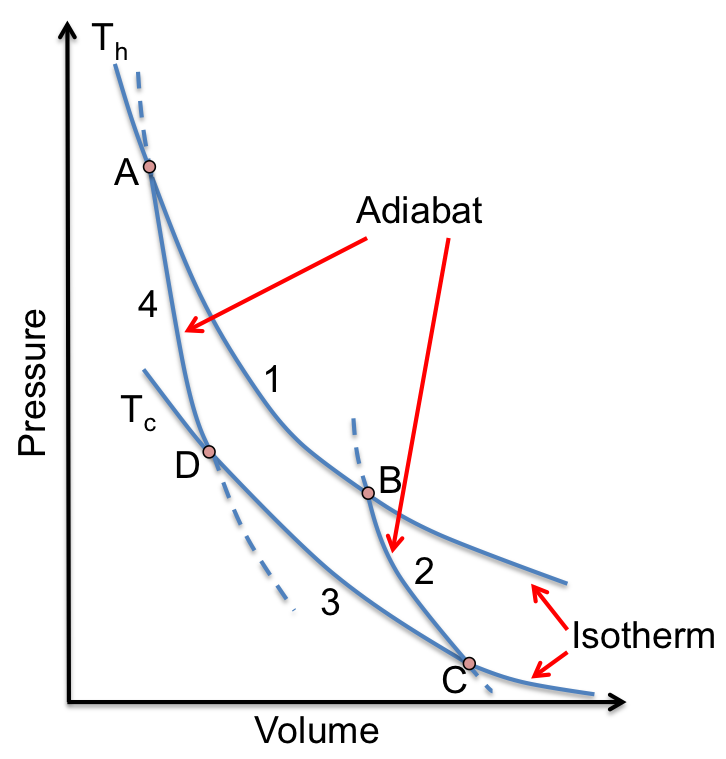
Show that for a perfect gas (one that obeys the ideal gas law and exhibits a heat capacity that is independent of temperature) using the above diagram where

AC: reversible isothermal process
AB: reversible isochoric process
BC: reversible isobaric processes

Answer

The change in internal energy  from point A to C along the isotherm AC is zero for an ideal gas. Since is a state function,  for the process AC and ABC is the same:

The change in internal energy for path ABC is:

Assuming  and are constant over the temperature range,

Since  and , we have, after applying the ideal gas law,

Rearranging gives


Previous article: Enthalpy
Next article: Equipartition theorem (overview)
Content page of chemical thermodynamics
Content page of advanced chemistry
Main content page

Enthalpy

The enthalpy of a thermodynamic system is the sum of the system’s internal energy and the product of its pressure and volume.

In the previous article, we showed that the change in internal energy of the system at constant volume can be experimentally determined by quantifying the transfer of heat to the system. However, many chemical reactions are carried out under constant pressure instead of constant volume.

It would be useful to identify another state function that has a relationship with analogous to eq27, i.e. one that analyses the energy change of a system at constant pressure by quantifying the transfer of heat. From eq25, the 1st law of thermodynamics of a closed system that does only pV work at constant pressure can be expressed as

Since the system is at constant pressure, where , and we can rewrite eq28 as:

Let’s define . Eq29 becomes

or

We have identified a new state function called enthalpy. Therefore, the change in enthalpy of a closed system at constant pressure is a change in energy of the system that equals to the transfer of heat to the system. We can now determine the change in energy of a chemical reaction in a closed system at constant pressure that does only pV work by experimentally measuring the amount of heat transferred to the system.


Question

Explain why is a state function.

Answer

As explained in an earlier article, the product of two state functions is a state function and the sum of two state functions is again a state function. Since ,  and are all state functions,  is a state function.


A process that, as a whole, absorbs heat from the surroundings, resulting in a positive change in the enthalpy of the system, is called an endothermic process. Conversely, a process that, as a whole, releases heat to its surroundings resulting in a negative change in the enthalpy of the system is called an exothermic process.

Consider the neutralisation reaction of hydrochloric acid and sodium hydroxide in a styrofoam cup calorimeter at (see diagram above).

Let’s regard the system as the reacting acid and alkali, and the surroundings as water, with both system and surroundings maintained at constant atmospheric pressure. We assume that heat and material are neither transferred from the solution to the styrofoam cup nor to the atmosphere. This means that the system is considered a closed one, as the reactants and products are confined within the cup throughout the reaction. Since any heat evolved by the reaction (system) is released to the water (surroundings),

where and .

The enthalpy change of neutralisation is:

where
 is the number of moles of water
is molar heat capacity of water at constant pressure
is the change in temperature of the solution

If , for the reaction, i.e. an exothermic reaction. The volume of the system may change, but for reactions in solutions, the change is usually very small. Therefore, we can also regard the above experiment as measuring the energy change in a constant volume system with negligible pressure changes. With reference to eq27 and eq30, for such a reaction.

Let’s look at another common chemical reaction, combustion.

The change in enthalpy of a combustion reaction is often measured using a bomb calorimeter (see diagram above). However, the system in the device is not subject to constant pressure but constant volume. Therefore, we need to compute the change in internal energy of the process and convert the value to the change in enthalpy. The sample is placed in a crucible, which is enclosed in a chamber that is made of a thermally conductive material. Oxygen is pumped into the chamber and the reaction is initiated by a current flowing through a wire that is embedded in the sample. The energy released by the combustion reaction flows across the chamber walls to heat up the water in the reservoir, which is the surroundings.

For a process at constant volume, the first law of thermodynamics becomes:

can be estimated to be where is the specific heat capacity of water at constant volume and is the mass of water. is therefore negative for combustion reactions. Consider the combustion of naphthalene:

The general change in enthalpy is:

At constant volume,

The change in pressure of the system is mainly due to the change in gaseous content in the system as solids and liquids in most experiments do not occupy significant volume in the calorimeter. Substituting the ideal gas law in eq32,

If the change in temperature is small,

with its integrated form as

where for the combustion of naphthalene.

Substituting the value of obtained via eq31 in eq33, we have the change in enthalpy for the reaction. Since both and are negative, is negative, validating that combustion reactions are exothermic. The change in enthalpy of a reaction can also be determined by other methods, e.g. via the van’t Hoff equation.


Previous article: First law of thermodynamics
Next article: Heat capacity
Content page of chemical thermodynamics
Content page of advanced chemistry
Main content page

First law of thermodynamics

The first law of thermodynamics states that the change in internal energy of a system is the sum of the energy transferred to the system, due to a difference in temperature between the system and its surroundings, and the work done on the system by the surroundings.

The internal energy of a system is defined as the sum of all the energies of molecules in the system. These energies include:

  • Relativistic rest mass energies of electrons and nuclei (i.e. energies attributed to the existence of the molecules)
  • Intramolecular translational, rotational, vibrational and electronic energies
  • Intermolecular forces of interaction

is a thermodynamic property of a system. However, judging from the composition of , it is very difficult to measure  directly. An alternate representation of therefore needs to be established to characterise the internal energy of a system.

According to the theory of conservation of energy, energy can neither be created nor destroyed but can be transformed from one form to another. Energy can also be transferred between thermodynamic systems or from a system to its surroundings.

Consider a closed piston-cylinder system containing a gas (see diagram above). The internal energy of the system increases when thermal energy flows into it, or when a force is applied on the piston, compressing the gas. By the theory of conservation of energy,

where

  • is the change in internal energy of the system
  • (or heat) is the transfer of energy to the system due to a difference in temperature
  • (or work) is work done on the system by the surroundings (transfer of energy to the system not due to a difference in temperature)

Eq24 is known as the first law of thermodynamics. Instead of considering the absolute internal energy of a system when we study processes, we analyse the change in internal energy of the system, which is easily quantified by accounting for the amount of energy transferred to and from the system in the form of and (refer to the next article for quantification of ). From an earlier article, reversible work done on the system is given by . Therefore, for a system undergoing a reversible PV process, eq24 becomes

If the walls of the cylinder and piston are adiabatic, the system is isolated and . Eq24 becomes

which states that work done on an isolated system is exactly equal to the increase in the internal energy of the system.


Question

Describe the work-energy theorem and show that it is consistent with eq26 for work done on a monoatomic ideal gas in an adiabatic piston-cylinder system.

Answer

The work-energy theorem states that the net work done on a particle is equal to the change in the kinetic energy of the particle. This can be shown as follows:

Since the internal energy of a monoatomic ideal gas is entirely in the form of the kinetic energy of the gas, the work done on the gas in an adiabatic system is equal to the change in the internal energy of the gas.


Suppose the piston is now rendered immovable and the walls of the cylinder are thermally conducting, we have a closed constant volume system. Eq25 becomes

The change in internal energy of the system at constant volume can then be experimentally determined by quantifying the heat transferred to the system.


Previous article: Zeroth law of thermodynamics
Next article: Enthalpy
Content page of chemical thermodynamics
Content page of advanced chemistry
Main content page

Zeroth law of thermodynamics

The zeroth law of thermodynamics states that two thermodynamic systems, each in thermal equilibrium with a third, are in thermal equilibrium with each other.

Consider two systems, A and B, in contact with each other via an immovable thermally conducting boundary, achieving thermal equilibrium over time.

B is then brought in contact with a third system, C, via the same type of boundary.

If no net energy and matter transfer is observed between B and C, we can deduce that A is also in thermal equilibrium with C. When this happens, there must be at least one measurable thermodynamic property that is common among the three systems.

We call this common thermodynamic property, temperature, and the above-mentioned principle that allows us to define temperature, the zeroth law of thermodynamics. Temperature is therefore defined as the thermodynamic property that has the same magnitude in two systems that are in thermal equilibrium.

This conceptual framework has a long history. The principle that eventually became the zeroth law of thermodynamics was first mentioned in 1871 by James Maxwell, who said, “bodies whose temperatures are equal to that of the same body have themselves equal temperatures”. A modern version of the zeroth law of thermodynamics utilises the term ‘thermal equilibrium’ and states that

Two thermodynamic systems, each in thermal equilibrium with a third, are in thermal equilibrium with each other.


Question

Which of the three systems described above is the thermometer?

Answer

B, as it indicates that A and C have the same temperature. If B contains a substance with relatively high coefficient of thermal expansion, e.g., helium, it can be used to assess A and C at various temperatures by monitoring its volume at constant pressure. Thus, the zeroth law of thermodynamics forms the basis of thermometry.


Previous article: Path function
Next article: First law of thermodynamics
Content page of chemical thermodynamics
Content page of advanced chemistry
Main content page
Mono Quiz