Path function

A path function is a mathematical function that describes thermodynamic processes that are involved in a change of equilibrium states. Unlike a state function, whose output is independent of the path taken to reach it, the output of a path function is path-dependent.

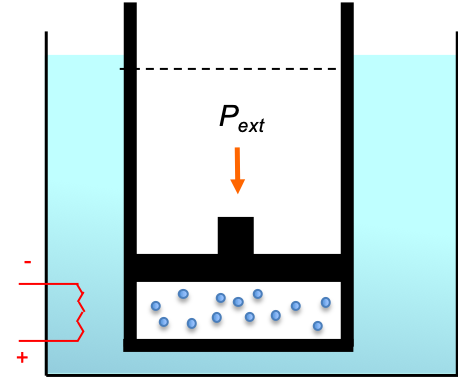
An example of a path function is the work done by an ideal gas. Consider an ideal gas in a piston-cylinder device immersed in a water bath (see diagram below).


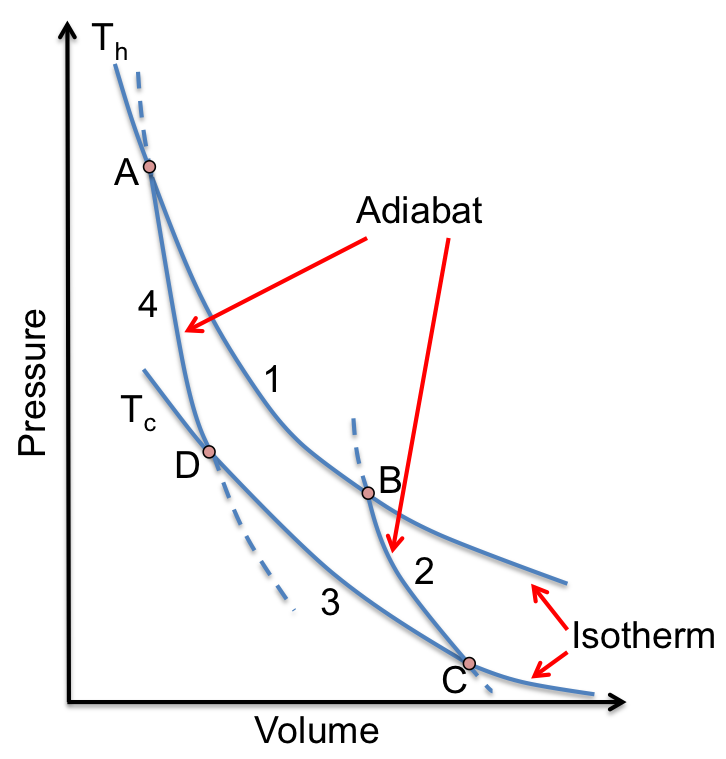
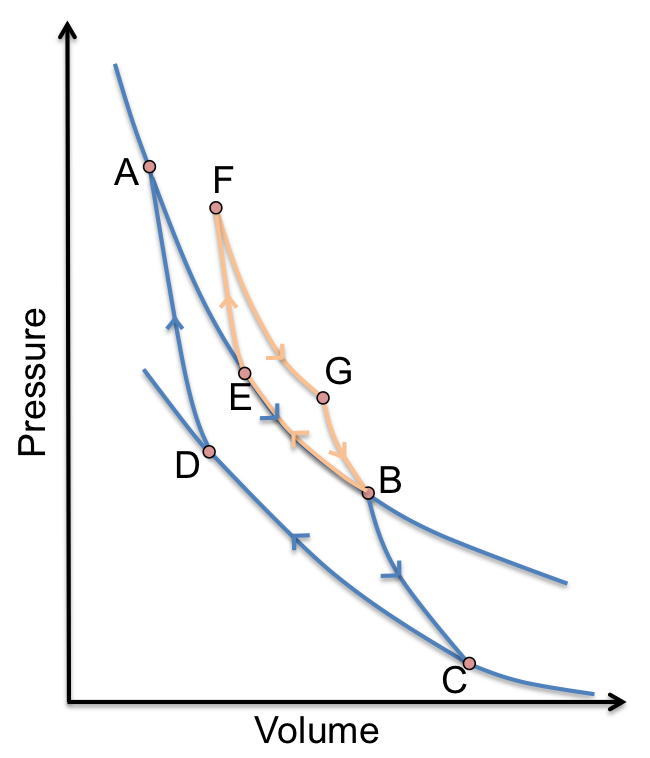
It is evident from the above PV diagram that there are three different paths for work done in bringing the system from one equilibrium state to another equilibrium state :

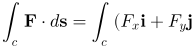
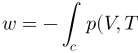
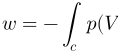
Amongst the three paths, A to B to C requires the greatest work, while A to D to C requires the least amount of work. This is because the system is expanding reversibly against a higher constant pressure throughout the process from A to B at , versus that from D to C at . The path from A to C requires intermediate work done as the system is expanding reversibly against a decreasing pressure from to . Relative work done by the three paths can be inspected visually by estimating the areas under the respective PV curves. The precise values are calculated using eq6 and eq7. Since work done has values that are dependent on the path taken from one thermodynamic state to another, it is a path function.

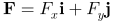
Lastly, the differential form of the reversible isobaric expansion of an ideal gas is

We have used the symbol to emphasise that is a path function but the symbol is also acceptable. Eq23 is called an inexact differential because its integral is not path independent. Even though work has the same units (Joules) as energy, it is misleading to say that work is a form of energy, which if it is, will be described by a thermodynamic function that is path-independent. Work is rather, a process of energy transfer between a system and its surroundings.


Question

Show that is an inexact differential, while is an exact differential.

Answer

Comparing the first equation to the general form of a differential equation , we have and . We need to show that for an inexact differential:

and

For , its second cross partial derivatives are and . Therefore is an exact differential.


Previous article: State function
Next article: zeroth law of thermodynamics
Content page of chemical thermodynamics
Content page of advanced chemistry
Main content page

State function

A state function is a mathematical function that describes the thermodynamic state of a system at equilibrium.

The ideal gas equation is a state function because it describes the state of a gas at equilibrium with a specific set of values: volume, temperature and pressure. In other words, a state function for a system at equilibrium relates one or more input thermodynamic properties to an output thermodynamic property.

Since a particular state of a system at equilibrium is characterised by a set of numbers, the output value of a state function for that state is independent on the path (i.e. process) taken to reach that value.


Question

Show that the output of the state function  is independent on the path taken to reach it.

Answer

The total differential of  is

The second cross partial derivatives of are

and

Eq19 refers to the path where the function V is changed with respect T at constant p, followed by a change with respect to p at constant T, whereas eq20 refers to another path where the function V is changed with respect to p at constant T, followed by a change with respect to T at constant p. If eq19 is equal to eq20, the change of V is independent of the path taken. Substituting in eq19 and eq20 gives for both equations. Therefore, the change of V is path-independent and the differential given by eq18 is called an exact differential.


Finally, if the output value of the function of pressure and the output value of the function of volume are path-independent, then the output value of the product of the two functions or the output value of the sum of the two functions are also path-independent.


Previous article: Exact and inexact differentials
Next article: Path function
Content page of chemical thermodynamics
Content page of advanced chemistry
Main content page

Exact and inexact differentials

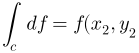
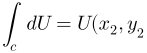
An exact differential is a differential equation , for instance of two variables, of the form , where .

Consider the function , where is a constant. Its total differential is . Comparing with the general form of an exact differential, we have and . Since , is an exact differential. The equality of the mixed partials implies that the change in is independent of the path taken.

Conversely, an inexact differential is a differential equation of the form , where . The change in , in this case, is dependent on the path taken.


Question

Show that is an inexact differential.

Answer

We have  and . So, .


Another difference between an exact differential and an inexact differential is that an exact differential integrates directly to give the function , whereas an inexact differential does not.

Question

Using the integral criterion, show that is an exact differential, while is an inexact differential.

Answer

The integrated form of the first differential is evidently . The detailed analysis involves two steps. First, integrating with respect to , treating as a constant, yields

The function accounts for terms in involving  or constants, which differentiate to zero when differentiating with respect to . Secondly, integrating with respect to , with as a constant, gives

Comparing eq17a and eq17b, we find , where . In other words, integrates directly from .

For the second differential, integrating with respect to yields , and integrating with respect to gives . Clearly, , for all and , indicating that the second differential does not directly integrate to give a function.


The fact that an exact differential integrates directly to give the function but an inexact differential does not, implies that and for a differentiable function must be of the appropriate forms of  and , respectively. In other words, the total differential of a differentiable function must be an exact differential.


Previous article: Partial derivatives, the total differential and the multivariable chain rule
Next article: State function
Content page of chemical thermodynamics
Content page of advanced chemistry
Main content page

Partial derivatives, the total differential and the multivariable chain rule

A partial derivative of a multi-variable function is its derivative with respect to one of those variables, with the other variables held constant. For example, the partial derivatives of with respect to and are defined as

respectively, where the symbol means that the variable is held constant (the symbol may be omitted for simplicity).

If , then .

The total differential of a multi-variable function is its change with respect to the changes in all the independent variables. For example, the total differential of the function is


Question

How is eq14 derived?

Answer

The total change in is , which is equivalent to

Multiplying the 1st and 2nd terms on the RHS of the above equation by and the 3rd and 4th terms by ,

Taking the limits and

Since the 1st term on the RHS of the above equation is with respect to a change in , is a constant with  and

Substituting eq12 and eq13 in the above equation, we have eq14.


In general, the total differential of the function is

If the variables themselves depend on another variable , i.e. and , we divide eq14a throughout by to give

Since  and as , if we take the limit , we have

Eq14b is known as the multivariable chain rule, which is also known as the total derivative of .

Next, we shall derive some of useful identities. With respect to eq14, if is a constant, , which when divided throughout by  gives or

If is a constant, eq14 becomes , which when divided by gives . Using the reciprocal identity of eq15, we have

If in eq14b, we have the chain rule:

Finally, the second partial derivative of is defined as .


Previous article: Irreversible work
Next article: Exact and inexact differentials
Content page of chemical thermodynamics
Content page of advanced chemistry
Main content page

Irreversible work

Irreversible PV work falls under non-equilibrium thermodynamics, which is hard or sometimes impossible to calculate using simple equations. This is due to the difficulty of defining the properties of the system during the process. For example, during an irreversible expansion of a gas against a piston, the piston accelerates away from the system, resulting in regions of varying pressures in the system. To overcome this problem, broad assumptions are made to expresss irreversible PV work mathematically.

Consider the irreversible expansion of a system consisting of a gas in an isolated vertical cylinder. The frictionless piston, which is part of the surroundings, has mass and is held stationary with catches (see diagram above).

If the force exerted by the gas on the bottom surface of the piston is greater than the weight of the piston, the gas expands and pushes the piston up when the catches are removed. The piston moves over a distance , until the force exerted by the expanded gas on the bottom surface of the piston equals to the weight of the piston. This implies that the gas is expanding against a constant force , which is due to the weight of the piston.

The change in energy of the surroundings is

where is acceleration due to gravity and is the kinetic energy of the piston.

Since the initial and final  are both zero, and eq8 becomes

Noting that energy in the universe is conserved, where , and that , eq9 becomes

Since the system is isolated, there is no transfer of heat. The change in energy of the system, according to the first law of thermodynamics, is therefore the change in work done on the system:

The integral form is:

If , the gas expands freely into the vacuum. In this case, and therefore . In general, irreversible PV work against constant pressure is estimated using eq11.


Expansion work by a system on its surroundings is always greater when the process is carried out reversibly than irreversibly. This can be seen by plotting eq6 from the previous article and eq11 on the same PV graph (see upper diagram above), where the area under AC (reversible) is greater than the area under BC (irreversible). for the irreversible process is made equal to the final pressure at when the piston stops, similar to our piston illustration above.

Conversely, compression work by the surroundings on the system is always greater when the process is carried out irreversibly (BA) than reversibly (CA, see lower diagram above). for the irreversible process is now made equal to the final pressure at when the piston stops.

It is important to remember that the above is a crude attempt to associate an irreversible process with an equation.


Previous article: Reversible isochoric process
Next article: Partial derivatives, the total differential and the multivariable chain rule
Content page of chemical thermodynamics
Content page of advanced chemistry
Main content page


Reversible isochoric process

A reversible isochoric process is a reversible thermodynamic process that occurs at constant volume. Consider an ideal gas in a piston-cylinder device immersed in a water bath. The piston is soldered to the cylinder walls and is immovable.


AD and BC in the above diagram are reversible isochoric processes. According to the ideal gas law, a system undergoing a reversible isochoric process from A to D requires the ratio of to be constant as the pressure of the system decreases. This is, in practice, carried out by continuously decreasing the temperature of the water bath by infinitesimal amounts. Since , work done for a reversible isochoric process is zero (see eq5). Many chemical reactions that take place in a bomb calorimeter are carried out under isochoric conditions.


Previous article: Reversible isobaric process
Next article: Irreversible work
Content page of chemical thermodynamics
Content page of advanced chemistry
Main content page


Reversible isobaric process

A reversible isobaric process is a reversible thermodynamic process that occurs at constant pressure.


Specifically, a reversible isobaric process that follows the path of either A to B or D to C is a reversible isobaric expansion, while one that goes from either B to A or C to D is a reversible isobaric compression. We shall use the same setup of a piston-cylinder device immersed in a water bath as the one described in the previous article to illustrate reversible isobaric processes.

With reference to the ideal gas law, an isobaric expansion of a gas requires the ratio of to be constant as the volume of the system increases. Theoretically, for a reversible isobaric expansion to occur, the system has to be in contact with an infinite sequence of temperature baths, with one bath having a temperature that is infinitesimally higher than the next one. In practice, to achieve a result that is close to reversibility, the temperature of the water bath is continuously increased by infinitesimal amounts to maintain a temperature gradient across the cylinder walls so as to supply the system with energy for the expansion at constant pressure.

Since the pressure of the system remains constant and equals to that of the external pressure throughout the process, eq5 becomes

For a reversible isobaric compression, the temperature of the water bath is continuously decreased by infinitesimal amounts to maintain a constant pressure in the system. Many chemical reactions that involve phase changes are conducted under isobaric conditions, e.g. .


Question

The change in work done is sometimes represented by . How does this relate to eq6 and eq7?

Answer

The expression or by convention is the general differential equation for work. If the change in pressure is infinitesimal, , then the expression reduces to . If the process is a reversible isothermal process, we substitute the ideal gas law in to give , which is the differential form of eq6. If the process is isobaric, , and again reduces to , which is the differential form of eq7.


Previous article: Reversible isothermal process
Next article: Reversible isochoric process
Content page of chemical thermodynamics
Content page of advanced chemistry
Main content page

Reversible isothermal process

A reversible isothermal process is a reversible thermodynamic process that occurs at constant temperature.


A reversible isothermal expansion process for an ideal gas follows the path from A to C, while a reversible isothermal compression moves from C to A (see diagram above). The curve that describes an isothermal process is called an isotherm. We can express work done for a reversible isothermal process, which involves the change in pressure and volume of the system, by substituting the ideal gas law in eq5 to give:

To determine the work done on a system undergoing reversible isothermal expansion or compression, we immerse the piston-cylinder device in a constant temperature water bath. For a reversible isothermal compression, the external force balances the force exerted by the gas on the underside of the piston before the system is compressed. At the start of the compression, the external force is increased infinitesimally causing the piston to move down over an infinitesimal distance.

Consequently, infinitesimal energy is transferred via work to the system, leading to an infinitesimal increase in the kinetic energy of the gas and hence, an increase in the system’s temperature. The infinitesimal difference in temperature between the system and the water bath results in the flow of energy from the system through the thermally conducting cylinder walls to the temperature controlled water bath. Hence, constant temperature of the system is maintained throughout the process. This compression process is repeated stepwise with further infinitesimal increases in the external force until the desired final volume of the system is achieved. Work done is then calculated using eq6. If the external force is now decreased infinitesimally in a stepwise manner, we have a reversible isothermal expansion of the gas. Many chemical reactions involving the determination of rates of reactions are carried out isothermally.


Question

Does the temperature of the water bath increase if energy is continuously transferred from the system to the water bath in the compression process?

Answer

Theoretically, the constant temperature water bath is infinitely large. This means that transfer of energy from the system to the layer of water in the vicinity of the system (due to a temperature difference between the two) is the first of infinite steps of transfer, with the second step being the transfer of energy from the body of water in the vicinity of the system to a layer of water further away from the system and so on. In practice, the temperature of the water bath is controlled by a computer and adjusted throughout the process to maintain constant temperature for the system.


Previous article: Reversible work in thermodynamics
Next article: Reversible isobaric process
Content page of chemical thermodynamics
Content page of advanced chemistry
Main content page

Reversible work in thermodynamics

In classical mechanics, the amount of work done on an object, , is the product of the external force, , acting on the object and the distance moved in the direction of the force, :

Pressure-volume work, the most common form of work in chemical thermodynamics, uses the same concept and is defined as the transfer of energy between a system and its surroundings due to a force differential between the two. Another type of work usually encountered in chemical thermodynamics, which is discussed in the article on electrochemistry, is electrical work.

Consider a system containing an ideal gas in a frictionless, closed piston-cylinder with a weightless piston of area (see diagram above). Initially, the piston, which is part of the surroundings, is stationary and the gas molecules are evenly distributed in the system. This implies that the force exerted by the atmosphere on the piston balances the internal force on the piston.

When an additional external force is exerted on the piston, the gas is compressed. Substituting in eq1, the work done on the system is:

However, there are two ways to move the piston to compress the gas. If the piston moves rapidly over a relatively great distance that results in a large change in volume, , there may be a momentary uneven distribution of molecules in the system, where the density of molecules adjacent to the piston wall is greater than that further away from the piston. In this case, we cannot equate the external pressure on the piston with the internal pressure. Instead, if the piston moves very slowly over an infinitesimal distance that results in an infinitesimal change in volume, , such that the molecules in the system have enough time to equilibrate and redistribute themselves evenly throughout the infinitesimally smaller volume, the external pressure is equal to the internal pressure for the infinitesimal compression. As the internal pressure is the pressure of the gas :

Substituting eq3 in eq2,

The total work done for a series of infinitesimal compressions on the system from an initial volume to a final volume is:

As explained in the previous section, we call such a process of a series of infinitesimal changes that occur very slowly so that the system is always in equilibrium, a reversible process. According to IUPAC convention, the negative sign is added so that work done on the system by the surroundings is positive. In other words, if , , we have reversible compression with work done by the surroundings on the system, and if , , we have reversible expansion with work done by the system on the surroundings.

Reversible processes can occur under the following conditions:

  1. Isothermal (constant temperature)
  2. Isobaric (constant pressure)
  3. Isochoric (constant volume)
  4. Adiabatic

We shall discuss the four reversible processes in subsequent articles.


Previous article: Reversible and irreversible thermodynamic processes
Next article: Reversible isothermal process
Content page of chemical thermodynamics
Content page of advanced chemistry
Main content page

Reversible and irreversible thermodynamic processes

A reversible process is an idealised thermodynamic process that occurs infinitesimally slow in a system to the extent that the thermodynamic properties of the system are well defined at all times throughout the process.

Consider a thermally-conducting, frictionless, piston-cylinder device immersed in a water bath whose temperature can be adjusted (see above diagram). The device is regarded as the system and contains a gas at an initial state of equilibrium A, which is characterised by thermodynamic properties like volume, pressure, temperature and entropy. The external pressure is set equal to the pressure of the gas , and the bath, which is defined as the surroundings, has the same temperature as the device.

The change of state A to another equilibrium state B can be achieved through different paths or processes (see diagram below, which depicts the paths linking the two states of the system).

For example, we can successively reduce  in infinitesimal steps at constant temperature such that each infinitesimal change is slow enough for the molecules to have sufficient time to equilibrate and spread evenly throughout the cylinder, resulting in uniform pressure and temperature throughout the system. This ensures that the thermodynamic properties of the system are well defined at every infinitesimal step and that we can determine and plot the change of values of these properties on a graph.

We can reverse the process from B to A by infinitesimally increasing , with the path taken being exactly the same as the forward process, except in the reverse direction. The infinitesimal increase or decrease in pressure implies that a reversible process requires infinite time to accomplish.

Another way to alter the state of the gas in the piston-cylinder device above is to instantaneously lower to the extent that the system only has enough time to equilibrate at the initial and final states but not at the intermediate states. We called such a path, an irreversible process.

As a reversible process is an idealised process, all real processes occurring within a finite timescale are considered irreversible. An irreversible path is shown as a dotted line on the graph, with only two points – the initial state and the final state – having defined properties and hence defined coordinates. The dotted line is drawn arbitrarily because there isn’t sufficient time for the system to equilibrate at the intermediate states, and hence no exact coordinates between A and B. Since the forward path of the irreversible process is poorly defined to begin with, we cannot explicitly describe the reverse path (other than another arbitrarily drawn dotted line) when we reverse the reaction irreversibly from B to A by instantaneously compressing the gas and transferring some heat from the system to its surroundings.

Although a reversible process is an idealised construct, it is used to derive most of the thermodynamic equations because equations require variables to be well defined to work.


Question

How do we apply thermodynamic equations that are derived from an idealised process to real processes?

Answer

A real process, when carried out slowly within a finite timeframe, approximates an ideal process. The graph below shows that the greater the number of well-defined intermediate points, the closer the real process is to an ideal one. Even if a real process cannot be carried out slowly, we can use thermodynamic equations to approximate results by making certain assumptions, e.g. uniform pressure and temperature of the system is maintained.


The concepts of reversibility and irreversibility are further elucidated in subsequent sections (see sections on entropy of an isolated system and Clausius inequality).


Question

Why is an irreversible process a spontaneous process?

Answer

This is due to the definition of a spontaneous process, which is defined as an irreversible process that occurs naturally under certain conditions in one direction, but requires continual external input in the reverse direction. See this article for details.


Lastly, reversible and irreversible processes can also be defined as follows:

A reversible process involves the passage of a system from its initial state to its final state and then back to the initial state without any change to either the system or the surroundings. However, the system and its surroundings cannot be simultaneously restored to their original states for an irreversible process.

In the above example involving the device in a water bath, both the system and the surroundings are precisely restored to their initial states for the reversible process (including no change in entropy of either the system and surroundings). As for the irreversible process, the system and its surroundings cannot be simultaneously restored to their initial states. If the system is restored to its initial state, a finite amount of heat must be transferred to the surroundings, leading to a positive change in entropy of the surroundings.


Question

What is the difference between a reversible reaction and a reversible process?

Answer

A reversible chemical reaction, e.g. , is where X forms Y, and at the same time, Y forms X in a particular thermodynamic state. An irreversible reaction, denoted by , is when the reverse reaction cannot proceed in any state under reasonable conditions. On the other hand, a reversible process describes a path linking two thermodynamic states of a system, where thermodynamic properties of the system are well defined at all times.

For example, the above diagram shows four different states of the reaction , each with a set of well defined p, V and T.  Since the reaction is reversible, X forms Y and Y forms X at any point on the graph. Let’s assume that the equilibrium amounts of X and Y at the four states are in the ratio of:

State

X:Y

A

4:1

B

3:2

C

1:1

D

1:4

Clearly, there are different paths linking any two states. For example, if we want to convert an initial equilibrium amount of X and Y in the ratio 4:1 to a final equilibrium amount in the ratio of 1:1, we can accomplish that by infinitesimally increasing the volume of the system from to , followed by infinitesimally reducing of the pressure of the system from to . Alternatively, we can proceed from A to D to C or directly from A to C.

Previous article: Thermodynamic property, state, equilibrium and process
Next article: Reversible work in thermodynamics
Content page of chemical thermodynamics
Content page of advanced chemistry
Main content page
Mono Quiz