Standard enthalpy change of electron gain

The standard enthalpy change of electron gain, ΔHego, is the change in enthalpy when one mole of electrons is attached to atoms or anions in the gaseous state to form one mole of anions under standard conditions.
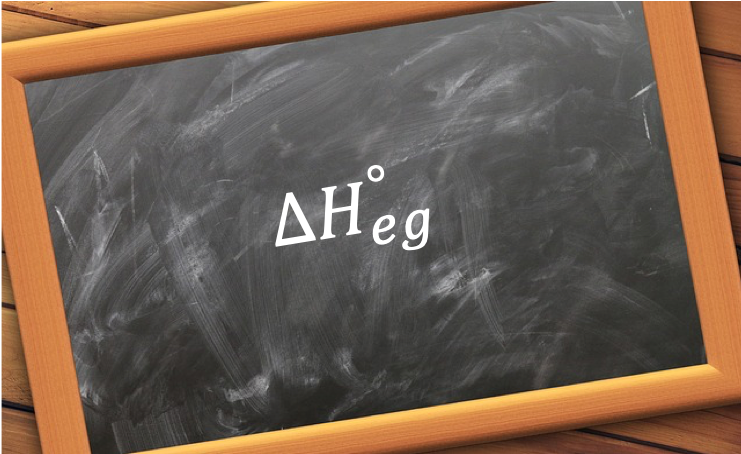
When one mole of electrons is attached to atoms to form one mole of monovalent anions, the change in enthalpy is called the first electron gain enthalpy, e.g.

Cl(g)+e^-\rightarrow Cl^-(g)\; \; \; \; \; \; \; \Delta H_{eg}^{\: o}=-355.2\: kJmol^{-1}

When one mole of electrons is attached to monovalent anions to form one mole of divalent anions, the change in enthalpy is called the second electron gain enthalpy, e.g.

O^-(g)+e^-\rightarrow O^{2-}(g)\; \; \; \; \; \; \; \Delta H_{eg}^{\: o}=837.8\: kJmol^{-1}

The standard enthalpy change of electron gain of a substance is calculated from the substance’s electron affinity (the two are not the same, as electron affinity is defined at absolute zero) using Kirchhoff’s law, or from the relationship:

\Delta H_{eg}^{\: o}\left [ X^n \right ]=-\Delta H_{ion}^{\: o}\left [ X^{n-1} \right ]\; \; \; \; \; \; 4

which states that the standard enthalpy change of electron gain of a species is the negative of the standard enthalpy change of ionisation of that species with an additional electron attached, e.g.

\Delta H_{eg}^{\: o}\left [ Cl(g) \right ]=-\Delta H_{ion}^{\: o}\left [Cl^-(g) \right ]\; \; \; \; \; \; 5

Substituting eq3 from the previous section in eq5,

\Delta H_{eg}^{\: o}\left [ Cl(g) \right ]=-355.2\: kJmol^{-1}

Electron affinities are determined experimentally using photoelectron spectroscopy (PES) where the known energy of an incident photon on an anion equals to the atom’s electron affinity plus the measured kinetic energy of the ionised electron. These electron affinities are then converted to electron affinities at absolute zero, which are then converted to standard enthalpies of electron gain, with both conversions using Kirchhoff’s law. It is easier to measure ionisation energies than electron affinities and therefore standard enthalpies of electron gain of substances are usually calculated using eq4.
 

Next article: Standard enthalpy change of hydration
Previous article: Standard enthalpy change of ionisation
Content page of intermediate chemical energetics
Content page of intermediate chemistry
Main content page

Standard enthalpy change of hydration

The standard enthalpy change of hydration, ΔHhydo, is the change in enthalpy when one mole of an ion in the gaseous state dissolves in water to form an infinitely dilute solution under standard conditions. This means that we need to dissolve the solute in excess water until there is no change in the energy absorbed or released by the system.

Some examples are:

Zn^{2+}(g)\rightarrow Zn^{2+}(aq)\; \; \; \; \; \; \; \Delta H_{hyd}^{\: o}=-2046\: kJmol^{-1}

ClO_4^-(g)\rightarrow ClO_4^-(aq)\; \; \; \; \; \; \; \Delta H_{hyd}^{\: o}=-238\: kJmol^{-1}

The standard enthalpy of hydration is always exothermic (negative) and increases (more negative) for ions with higher charge densities, i.e. higher charge-to-radius ratios.


Next article: Standard enthalpy change of solution
Previous article: Standard enthalpy change of electron gain
Content page of intermediate chemical energetics
Content page of intermediate chemistry
Main content page

Standard enthalpy change of solution

The standard enthalpy change of solution, ΔHsolo, is the change in enthalpy when one mole of a solute dissolves in a solvent to form an infinitely dilute solution under standard conditions. This means that we need to dissolve the solute in excess solvent until there is no change in the energy absorbed or released by the system.

Some examples are:

KOH(s)\rightarrow KOH(aq)\; \; \; \; \; \; \; \Delta H_{sol}^{\: o}=-57.6\: kJmol^{-1}

HCl(g)\rightarrow HCl(aq)\; \; \; \; \; \; \; \Delta H_{sol}^{\: o}=-74.8\: kJmol^{-1}

Since KOH(aq) and HCl(aq) are fully dissociated in water, we can also write the above equation as:

KOH(s)\rightarrow K^+(aq)+OH^-(aq)\; \; \; \; \; \; \; \Delta H_{sol}^{\: o}=-57.6\: kJmol^{-1}

HCl(g)\rightarrow H^+(aq)+Cl^-(aq)\; \; \; \; \; \; \; \Delta H_{sol}^{\: o}=-74.8\: kJmol^{-1}

ΔHsolo can be positive or negative. Compounds with large positive ΔHsolo are relatively insoluble.


Next article: Standard enthalpy change of lattice energy
Previous article: Standard enthalpy change of hydration
Content page of intermediate chemical energetics
Content page of intermediate chemistry
Main content page

Standard enthalpy change of neutralisation

The standard enthalpy change of neutralisation, ΔHn o, is the change in enthalpy when one mole of water is formed from an acid reacting with an alkali, both in their most stable forms, under standard conditions.

For example,

\frac{1}{2}H_2SO_4(aq)+NaOH(aq)\rightarrow \frac{1}{2}Na_2SO_4(aq)+H_2O(l)\; \; \; \Delta H_n^{\: o}=-57.1\: kJmol^{-1}

or in the ionic form,

H^+(aq)+OH^-(aq)\rightarrow H_2O(l)\; \; \; \; \; \; \Delta H_n^{\: o}=-57.1\: kJmol^{-1}

Since acids and alkalis, by definition, are in the aqueous state, their most stable form is the aqueous form. The standard enthalpy change of neutralisation in the above example is also the standard enthalpy change of reaction between sulphuric acid and sodium hydroxide to give sodium sulphate and water, i.e., ΔHn o =ΔHr o.


Question

Is the standard enthalpy change of neutralisation, H+(aq) + OH(aq)  H2O(l), the same as the standard enthalpy change of formation of water?

Answer

No. The definition of the standard enthalpy change of formation of water requires the reactants to be in their standard states, i.e., H2(g) and O2(g).


Next article: Standard enthalpy change of atomisation
Previous article: Standard enthalpy change of combustion
Content page of intermediate chemical energetics
Content page of intermediate chemistry
Main content page

Standard enthalpy change of lattice energy

The standard enthalpy change of lattice energy, ΔHlatto, is the change in enthalpy for breaking the bonds in one mole of a solid ionic compound and separating its gaseous ions to an infinite distance under standard conditions.

Since a large amount of energy is required to carry out the process, the standard enthalpy change of lattice energy of a compound is always positive (endothermic), e.g.

KCl(s)\rightarrow K^+(g)+Cl^-(g)\; \; \; \; \; \; \; \Delta H_{latt}^{\: o}=717\: kJmol^{-1}

However, it may be defined as the change in enthalpy when one mole of an ionic solid is formed from its gaseous ions that are initially infinitely apart under standard conditions. If so, it will always be a negative value (exothermic).

The magnitude of the standard enthalpy change of lattice energy increases for ions with higher charge densities, leading to stronger electrostatic forces of attraction between them in the ionic lattice. Hence,

The standard enthalpy change of lattice energy of an ionic compound is determined theoretically using a Born-Haber cycle, as it is very hard to measure it precisely through experiments.


Next article: Other Standard enthalpy changes
Previous article: Standard enthalpy change of solution
Content page of intermediate chemical energetics
Content page of intermediate chemistry
Main content page

Other standard enthalpy changes

There are possibly as many standard enthalpy changes as there are types of reactions. Some common ones other than those mentioned in previous articles include:

    1. Standard enthalpy of hydrating an anhydrous salt (not to be confused with standard enthalpy of hydration), e.g.

CuSO_4(s)+5H_2O(l)\rightarrow CuSO_4\cdot 5H_2O(s)\; \; \; \; \; \; \; \Delta H_{hydt}^{\: o}=-78.2\: kJmol^{-1}

    1. Standard enthalpy of precipitation, e.g.

AgNO_3(aq)+NaCl(aq)\rightarrow AgCl(s)+NaNO_3(aq)\; \; \; \; \; \Delta H_{ppt}^{\: o}=-65.8\; kJmol^{-1}

Question

Calculate the enthalpy of precipitation of PbBr2 when 150.0 mL of 0.500 M Pb(NO3)2 is added to 80.0 mL of 1.000 M NaBr in a calorimeter with the temperature rising from 298.15 K to 299.28 K (assuming that the solution’s specific heat capacity is 4.200 Jg-1K-1 and its density is 1.0 g/ml).

Answer

0.0800 moles of NaBr precipitates 0.0400 moles of PbBr2. Using eq5 from a basic level article,

\Delta H_{ppt}=-(4.200)(150.0+80.0)(299.28-298.15)=-1092\: J

\Delta H_{ppt}=\frac{-1092}{0.0400}=-27.3\: kJmol^{-1}


Next article: Hess’s law
Previous article: Standard enthalpy change of lattice energy
Content page of intermediate chemical energetics
Content page of intermediate chemistry
Main content page

Hess’s law (chemical energetics)

Hess’s law is named after Germain Hess, a Russian chemist, who published it in 1840. It is based on the principle of conservation of energy, and states that:

The total enthalpy change in a chemical reaction is sum of enthalpy changes of all steps from the reactants to the products regardless of the route taken.

For example, there are two possible chemical routes (indicated by red arrows in the diagram below) for the combustion of methane to form carbon dioxide and water:

On closer scrutiny, ΔH1o is composed of the following standard enthalpy changes of formation:

C\left ( graphite \right )+2H_2\left ( g \right )\rightarrow CH_4\left ( g \right )\; \; \; \; \; \; \left ( \Delta H_{f}^{o} \right )_{R=1}

2O_2\left ( g \right )\rightarrow 2O_2\left ( g \right )\; \; \; \; \; \; 2\times \left ( \Delta H_{f}^{o} \right )_{R=2}

Similarly, ΔH2o is composed of the following standard enthalpy changes of formation:

C\left ( graphite \right )+O_2\left ( g \right )\rightarrow CO_2\left ( g \right )\; \; \; \; \; \; \left ( \Delta H_{f}^{o} \right )_{P=1}

2H_2\left ( g \right )+O_2\left ( g \right )\rightarrow 2H_2O\left ( g \right )\; \; \; \; \; \; 2\times \left ( \Delta H_{f}^{o} \right )_{P=2}

The choice of the indices R and P will be apparent shortly. Hence,

\Delta H_1^{\: o}=\sum _Rv_R\left ( \Delta H_f^{\: o} \right )_R

\Delta H_2^{\: o}=\sum _Pv_P\left ( \Delta H_f^{\: o} \right )_P

where vR and vP are the stoichiometric coefficients of the products of the respective standard enthalpy change of formation reactions.

In general, for a reaction:

where R denotes the reactants and P denotes the products. Hess’ law states that:

\Delta H_r^{\: o}=-\Delta H_1^{\: o}+\Delta H_2^{\: o}

\Delta H_r^{\: o}=\sum_Pv_P\left ( \Delta H_f^{\: o} \right )_P-\sum_Rv_R\left ( \Delta H_f^{\: o} \right )_R\; \; \; \; \; \; \; \; 6

Eq 6 is a very useful formula for calculating standard enthalpy changes.


Question

a) Calculate the standard enthalpy change of formation of CO2(g) given:

\Delta H_f^{\: o}\left [ C_2H_2(g) \right ]=226\: kJmol^{-1}

\Delta H_c^{\; o}\left [ C_2H_2(g) \right ]=-1300\; kJmol^{\: -1}

\Delta H_c^{\: o}\left [ H_2(g) \right ]=-286\: kJmol^{-1}

b) Deduce the relationship between ΔHsolo, ΔHhydo and ΔHlatto using MgCl2 as an example.

Answer

a)

2C(graphite)+H_2(g)\rightarrow C_2H_2(g)\; \; \; \; \; \; \Delta H_f^{\: o}=226\: kJmol^{-1}

C_2H_2(g)+\frac{5}{2}O_2(g)\rightarrow 2CO_2(g)+H_2O(l)\; \; \; \; \; \; \Delta H_c^{\; o}=-1300\: kJmol^{\: -1}

H_2(g)+\frac{1}{2}O_2(g)\rightarrow H_2O(l)\; \; \; \; \; \; \Delta H_f^{\: o}=-286\: kJmol^{-1}

Using eq6, the standard enthalpy change of C(graphite) + O2(g) → CO2(g) is:

\Delta H_f^{\: o}=\frac{226+(-1300)-(-286)}{2}=-394\: kJmol^{-1}

b)

\Delta H_{sol}^{\: o}=\Delta H_{latt}^{\: o}+\sum _iv_i\left ( \Delta H_{hyd}^{\: o} \right )_i

where vi is the stoichiometric coefficient of the reactant of the respective standard enthalpy change of hydration reaction. If ΔHlatto is defined as the change in enthalpy when one mole of an ionic solid is formed from its gaseous ions that are initially infinitely apart under standard conditions, the relation becomes:

\Delta H_{sol}^{\: o}=-\Delta H_{latt}^{\: o}+\sum _iv_i\left ( \Delta H_{hyd}^{\: o} \right )_i


Next article: Born-Haber cycle
Previous article: Other Standard enthalpy changes
Content page of intermediate chemical energetics
Content page of intermediate chemistry
Main content page

Born-Haber cycle (chemical energetics)

The Born-Haber cycle is a method to analyse reaction enthalpies, particularly to calculate the standard enthalpy change of lattice energy, ΔHlatto, which cannot be measured precisely via experiments. It is based on Hess’ law and was developed by the German scientists Max Born and Fritz Haber in 1916.

Born-Haber cycles are best represented in the form of energy diagrams. For example, if we want to calculate the standard enthalpy change of lattice energy of calcium fluoride, we start by writing the equations for ΔHlatto[CaF2(s)] and ΔHfo[CaF2(s)] :

CaF_2(s)\rightarrow Ca^{2+}(g)+2F^-(g)\; \; \; \; \; \; \; \; \Delta H_{latt}^{\: o}\; \; \; \; \; \; \; \; 7

Ca(s)+F_2(g)\rightarrow CaF_2(s)\; \; \; \; \; \; \; \; \Delta H_{f}^{\: o}

Applying Hess’ law, we can combine the two equations into a cycle:

ΔH1o is composed of a few standard enthalpy changes. If we rewrite the cycle to include every standard enthalpy change (starting with the reactants of ΔHfo), we have the Born-Haber cycle for CaF2(s):

The Born-Haber cycle (also known as the Born-Haber energy diagram) reveals that ΔH1o is composed of ΔHoat, ΔHo1st ion, ΔHo2nd ion, another ΔHoat and ΔHoeg. It is also evident that the sum of the magnitudes of each enthalpy on the left-hand side of the energy diagram is equal to that on the right-hand side, i.e.

\Sigma_i\left | \Delta H^o_i\left ( LHS \right ) \right |=\Sigma_j\left | \Delta H^o_j\left ( RHS \right ) \right |

The above computation shows that ΔHolatt for CaF2 can be +2635 kJmol-1 or -2635 kJmol-1, depending on its definition. Since we have defined the standard enthalpy change of lattice energy as an endothermic process (see eq7, where ΔHolatt is the change in enthalpy to break the bonds in one mole of a solid ionic compound and separate its gaseous ions to an infinite distance under standard conditions),  ΔHlatto = +2635 kJmol-1.

In summary, the steps involved in generating the Born-Haber cycle are:

    1. Write the equations for the standard enthalpy change of lattice energy and the standard enthalpy change of formation of the ionic compound.
    2. Combine the two equations into a cycle using Hess’ law.
    3. Expand the cycle in a stepwise manner to include every standard enthalpy change.
    4. Draw the Born-Haber cycle energy diagram starting with the reactants of the standard enthalpy change of formation of the compound and ending with the ionic compound.
    5. Sum the magnitude of enthalpies on each side of the cycle and equate them to find ΔHlatto.

Previous article: Hess’s law
Content page of intermediate chemical energetics
Content page of intermediate chemistry
Main content page

Cell notation

Cell notation is a shorthand representation of an electrochemical cell.

For example, the electrochemical cell depicted in the diagram above has a cell notation of

Pt\mid H_2\mid H^+ \parallel Cu^{2+}\mid Cu

A vertical line represents a phase boundary, while a double vertical line signifies a phase boundary with negligible junction potential, such as a salt bridge. The anode half-cell is denoted on the left and the cathode half-cell on the right, with the electrodes (Pt and Cu) positioned at both ends of the notation.

A gas is always written adjacent to the electrode. Furthermore, spectator ions are usually omitted and state symbols and concentrations may be included for emphasis, e.g.

Pt(s)\mid H_2(g)\mid H^+(aq,1\, M) \parallel Cu^{2+}(aq,1\, M)\mid Cu(s)

If the standard hydrogen electrode is undergoing reduction, its cell notation is:

Zn\mid Zn^{2+}\parallel H^+ \mid H_2\mid Pt


Question

What are the cell notations for a calomel reference electrode undergoing oxidation and a AgCl electrode undergoing reduction?

Answer

The calomel electrode cell notation can be written as

Hg\mid Hg_2Cl_2(sat'd),KCl(sat'd)\mid KCl(sat'd)\parallel

or

Hg\mid Hg_2Cl_2(sat'd),KCl(sat'd)\parallel

The comma separating Hg2Cl2 and KCl means that the two compounds are in the same phase. The double vertical line represents the porous frit, which has negligible junction potential.

The AgCl electrode cell notation is:

\parallel KCl(sat'd),AgCl(sat'd)\mid AgCl\mid Ag

or simply

\parallel KCl(sat'd),AgCl(sat'd)\mid Ag


Next article: Effects of concentration on Eo and the Nernst equation
Previous ARTICLE: Analysing reactions using standard electrode potentials
Content page of intermediate electrochemistry
Content page of intermediate chemistry
Main content page

Other standard electrodes (calomel, AgCl)

Other than the standard hydrogen electrode (SHE), two other standard or reference electrodes are widely used: the calomel electrode and the silver chloride electrode. Each of these electrodes, like the SHE, provides a constant potential that is insensitive to the electrolyte.

Silver chloride electrode

The silver chloride reference electrode consists of a AgCl coated silver wire dipped in a saturated KCl solution (also saturated with AgCl). The porous frit, which allows for the slow passage of ions, forms a liquid junction with the test solution. The electrode potential of 0.199 V versus SHE at rtp is given by the following half-cell reaction:

AgCl(s)+e^-\rightleftharpoons Ag(s)+Cl^-(sat'd)

Just as the constant bubbling of H2 in a H+ (1 M) electrolyte of the SHE half-cell provides the electrode with a constant potential,  the Ag wire and the equilibrium between AgCl coated on the wire and the saturated AgCl internal solution ensure that the AgCl electrode maintains a constant potential. Some literature quotes the potential vs SHE as 0.22 V at rtp. This value corresponds to a KCl concentration of 1.0 M, whereas 0.199 V is measured when KCl is saturated.

The calomel electrode

The calomel reference electrode consists of mercury in contact with a saturated solution of Hg2Cl2 (calomel), which is in turn in contact with saturated KCl. The electrode potential of 0.244 V versus SHE at rtp is given by the following half-cell reaction:

Hg_2Cl_2(s)+2e^-\rightleftharpoons 2Hg(l)+2Cl^-(sat'd)

Both AgCl and calomel reference electrodes are used for a wide range of electrochemical measurements. However, the toxicity of mercury in the calomel electrode poses health and environmental issues.

next article: standard electrode potentials
Previous article: standard hydrogen electrode
Content page of intermediate electrochemistry
Content page of intermediate chemistry
Main content page
Mono Quiz