Hess’s law (chemical energetics)

Hess’s law is named after Germain Hess, a Russian chemist, who published it in 1840. It is based on the principle of conservation of energy, and states that:

The total enthalpy change in a chemical reaction is sum of enthalpy changes of all steps from the reactants to the products regardless of the route taken.

For example, there are two possible chemical routes (indicated by red arrows in the diagram below) for the combustion of methane to form carbon dioxide and water:

On closer scrutiny, ΔH1o is composed of the following standard enthalpy changes of formation:

C\left ( graphite \right )+2H_2\left ( g \right )\rightarrow CH_4\left ( g \right )\; \; \; \; \; \; \left ( \Delta H_{f}^{o} \right )_{R=1}

2O_2\left ( g \right )\rightarrow 2O_2\left ( g \right )\; \; \; \; \; \; 2\times \left ( \Delta H_{f}^{o} \right )_{R=2}

Similarly, ΔH2o is composed of the following standard enthalpy changes of formation:

C\left ( graphite \right )+O_2\left ( g \right )\rightarrow CO_2\left ( g \right )\; \; \; \; \; \; \left ( \Delta H_{f}^{o} \right )_{P=1}

2H_2\left ( g \right )+O_2\left ( g \right )\rightarrow 2H_2O\left ( g \right )\; \; \; \; \; \; 2\times \left ( \Delta H_{f}^{o} \right )_{P=2}

The choice of the indices R and P will be apparent shortly. Hence,

\Delta H_1^{\: o}=\sum _Rv_R\left ( \Delta H_f^{\: o} \right )_R

\Delta H_2^{\: o}=\sum _Pv_P\left ( \Delta H_f^{\: o} \right )_P

where vR and vP are the stoichiometric coefficients of the products of the respective standard enthalpy change of formation reactions.

In general, for a reaction:

where R denotes the reactants and P denotes the products. Hess’ law states that:

\Delta H_r^{\: o}=-\Delta H_1^{\: o}+\Delta H_2^{\: o}

\Delta H_r^{\: o}=\sum_Pv_P\left ( \Delta H_f^{\: o} \right )_P-\sum_Rv_R\left ( \Delta H_f^{\: o} \right )_R\; \; \; \; \; \; \; \; 6

Eq 6 is a very useful formula for calculating standard enthalpy changes.


Question

a) Calculate the standard enthalpy change of formation of CO2(g) given:

\Delta H_f^{\: o}\left [ C_2H_2(g) \right ]=226\: kJmol^{-1}

\Delta H_c^{\; o}\left [ C_2H_2(g) \right ]=-1300\; kJmol^{\: -1}

\Delta H_c^{\: o}\left [ H_2(g) \right ]=-286\: kJmol^{-1}

b) Deduce the relationship between ΔHsolo, ΔHhydo and ΔHlatto using MgCl2 as an example.

Answer

a)

2C(graphite)+H_2(g)\rightarrow C_2H_2(g)\; \; \; \; \; \; \Delta H_f^{\: o}=226\: kJmol^{-1}

C_2H_2(g)+\frac{5}{2}O_2(g)\rightarrow 2CO_2(g)+H_2O(l)\; \; \; \; \; \; \Delta H_c^{\; o}=-1300\: kJmol^{\: -1}

H_2(g)+\frac{1}{2}O_2(g)\rightarrow H_2O(l)\; \; \; \; \; \; \Delta H_f^{\: o}=-286\: kJmol^{-1}

Using eq6, the standard enthalpy change of C(graphite) + O2(g) → CO2(g) is:

\Delta H_f^{\: o}=\frac{226+(-1300)-(-286)}{2}=-394\: kJmol^{-1}

b)

\Delta H_{sol}^{\: o}=\Delta H_{latt}^{\: o}+\sum _iv_i\left ( \Delta H_{hyd}^{\: o} \right )_i

where vi is the stoichiometric coefficient of the reactant of the respective standard enthalpy change of hydration reaction. If ΔHlatto is defined as the change in enthalpy when one mole of an ionic solid is formed from its gaseous ions that are initially infinitely apart under standard conditions, the relation becomes:

\Delta H_{sol}^{\: o}=-\Delta H_{latt}^{\: o}+\sum _iv_i\left ( \Delta H_{hyd}^{\: o} \right )_i


Next article: Born-Haber cycle
Previous article: Other Standard enthalpy changes
Content page of intermediate chemical energetics
Content page of intermediate chemistry
Main content page

Born-Haber cycle (chemical energetics)

The Born-Haber cycle is a method to analyse reaction enthalpies, particularly to calculate the standard enthalpy change of lattice energy, ΔHlatto, which cannot be measured precisely via experiments. It is based on Hess’ law and was developed by the German scientists Max Born and Fritz Haber in 1916.

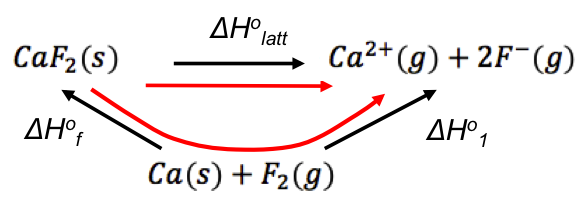
Born-Haber cycles are best represented in the form of energy diagrams. For example, if we want to calculate the standard enthalpy change of lattice energy of calcium fluoride ΔHlatto[CaF2(s)], we start by writing the equations for ΔHlatto[CaF2(s)] and the standard enthalpy change of the formation of calcium fluoride ΔHfo[CaF2(s)] :

CaF_2(s)\rightarrow Ca^{2+}(g)+2F^-(g)\; \; \; \; \; \; \; \; \Delta H_{latt}^{\: o}\; \; \; \; \; \; \; \; 7

Ca(s)+F_2(g)\rightarrow CaF_2(s)\; \; \; \; \; \; \; \; \Delta H_{f}^{\: o}

Applying Hess’ law, we can combine the two equations into a cycle:

ΔH1o is composed of a few standard enthalpy changes. If we rewrite the cycle to include every standard enthalpy change (starting with the reactants of ΔHfo), we have the Born-Haber cycle for CaF2(s):
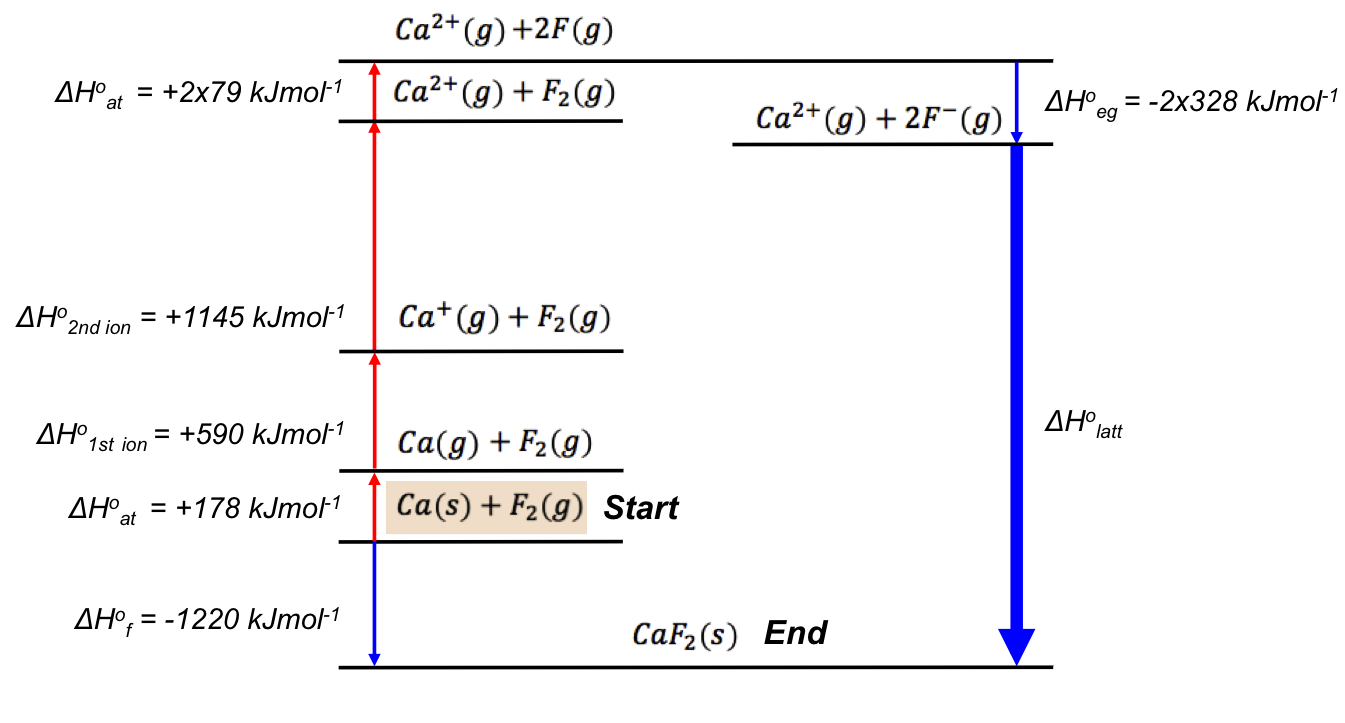
The Born-Haber cycle (also known as the Born-Haber energy diagram) reveals that ΔH1o is composed of:

    1. the standard enthalpy change of atomisation of CaHoat),
    2. the standard enthalpy change of the first ionisation of Ca Ho1st ion),
    3. the standard enthalpy change of the second ionisation of CaHo2nd ion),
    4. the standard enthalpy change of atomisation of F2 (ΔHoat), and
    5. the standard enthalpy change of electron gain of F (ΔHoeg).

It is also evident that the sum of the magnitudes of each enthalpy on the left-hand side of the energy diagram is equal to that on the right-hand side, i.e.

\Sigma_i\left | \Delta H^o_i\left ( LHS \right ) \right |=\Sigma_j\left | \Delta H^o_j\left ( RHS \right ) \right |

The above computation shows that ΔHolatt for CaF2 can be +2635 kJmol-1 or -2635 kJmol-1, depending on its definition. Since we have defined the standard enthalpy change of lattice energy as an endothermic process (see eq7, where ΔHolatt is the change in enthalpy to break the bonds in one mole of a solid ionic compound and separate its gaseous ions to an infinite distance under standard conditions),  ΔHlatto = +2635 kJmol-1.

In summary, the steps involved in generating the Born-Haber cycle are:

    1. Write the equations for the standard enthalpy change of lattice energy and the standard enthalpy change of formation of the ionic compound.
    2. Combine the two equations into a cycle using Hess’ law.
    3. Expand the cycle in a stepwise manner to include every standard enthalpy change.
    4. Draw the Born-Haber cycle energy diagram starting with the reactants of the standard enthalpy change of formation of the compound and ending with the ionic compound. There is no strict rule regarding what must be on the left or right side of the cycle, provided that the steps are shown sequentially and the arrow directions correctly reflect the signs of the enthalpy changes.
    5. Sum the magnitude of enthalpies on each side of the cycle and equate them to find ΔHlatto.

Question

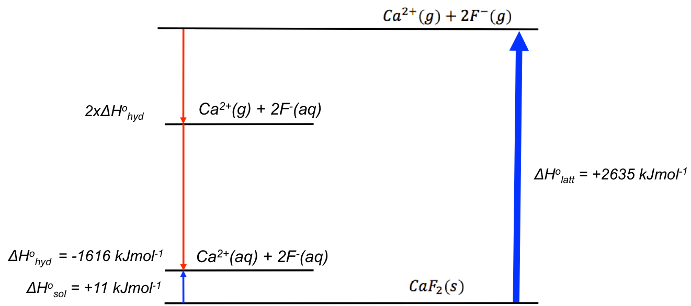
Calculate the standard change in enthalpy of hydration ΔHohyd for F given that ΔHolatt [CaF2 ] = +2635 kJmol-1, the standard enthalpy change of solution of CaF2 ( ΔHosol [CaF2 ]) is +11 kJmol-1 and ΔHohyd [Ca2+] = -1616 kJmol-1.

Answer

With reference to the Born-Haber cycle below,

\Sigma_i\left | \Delta H^o_i\left ( LHS \right ) \right |=\Sigma_j\left | \Delta H^o_j\left ( RHS \right ) \right |


Previous article: Hess’s law
Content page of intermediate chemical energetics
Content page of intermediate chemistry
Main content page

Cell notation

Cell notation is a shorthand representation of an electrochemical cell.

For example, the electrochemical cell depicted in the diagram above has a cell notation of

Pt\mid H_2\mid H^+ \parallel Cu^{2+}\mid Cu

A vertical line represents a phase boundary, while a double vertical line signifies a phase boundary with negligible junction potential, such as a salt bridge. The anode half-cell is denoted on the left and the cathode half-cell on the right, with the electrodes (Pt and Cu) positioned at both ends of the notation.

A gas is always written adjacent to the electrode. Furthermore, spectator ions are usually omitted and state symbols and concentrations may be included for emphasis, e.g.

Pt(s)\mid H_2(g)\mid H^+(aq,1\, M) \parallel Cu^{2+}(aq,1\, M)\mid Cu(s)

If the standard hydrogen electrode is undergoing reduction, its cell notation is:

Zn\mid Zn^{2+}\parallel H^+ \mid H_2\mid Pt


Question

What are the cell notations for a calomel reference electrode undergoing oxidation and a AgCl electrode undergoing reduction?

Answer

The calomel electrode cell notation can be written as

Hg\mid Hg_2Cl_2(sat'd),KCl(sat'd)\mid KCl(sat'd)\parallel

or

Hg\mid Hg_2Cl_2(sat'd),KCl(sat'd)\parallel

The comma separating Hg2Cl2 and KCl means that the two compounds are in the same phase. The double vertical line represents the porous frit, which has negligible junction potential.

The AgCl electrode cell notation is:

\parallel KCl(sat'd),AgCl(sat'd)\mid AgCl\mid Ag

or simply

\parallel KCl(sat'd),AgCl(sat'd)\mid Ag


Next article: Effects of concentration on Eo and the Nernst equation
Previous ARTICLE: Analysing reactions using standard electrode potentials
Content page of intermediate electrochemistry
Content page of intermediate chemistry
Main content page

Other standard electrodes (calomel, AgCl)

Other than the standard hydrogen electrode (SHE), two other standard or reference electrodes are widely used: the calomel electrode and the silver chloride electrode. Each of these electrodes, like the SHE, provides a constant potential that is insensitive to the electrolyte.

Silver chloride electrode

The silver chloride reference electrode consists of a AgCl coated silver wire dipped in a saturated KCl solution (also saturated with AgCl). The porous frit, which allows for the slow passage of ions, forms a liquid junction with the test solution. The electrode potential of 0.199 V versus SHE at rtp is given by the following half-cell reaction:

AgCl(s)+e^-\rightleftharpoons Ag(s)+Cl^-(sat'd)

Just as the constant bubbling of H2 in a H+ (1 M) electrolyte of the SHE half-cell provides the electrode with a constant potential,  the Ag wire and the equilibrium between AgCl coated on the wire and the saturated AgCl internal solution ensure that the AgCl electrode maintains a constant potential. Some literature quotes the potential vs SHE as 0.22 V at rtp. This value corresponds to a KCl concentration of 1.0 M, whereas 0.199 V is measured when KCl is saturated.

The calomel electrode

The calomel reference electrode consists of mercury in contact with a saturated solution of Hg2Cl2 (calomel), which is in turn in contact with saturated KCl. The electrode potential of 0.244 V versus SHE at rtp is given by the following half-cell reaction:

Hg_2Cl_2(s)+2e^-\rightleftharpoons 2Hg(l)+2Cl^-(sat'd)

Both AgCl and calomel reference electrodes are used for a wide range of electrochemical measurements. However, the toxicity of mercury in the calomel electrode poses health and environmental issues.

next article: standard electrode potentials
Previous article: standard hydrogen electrode
Content page of intermediate electrochemistry
Content page of intermediate chemistry
Main content page

Standard electrode potentials

Standard electrode potentials are crucial measurements that indicate the tendency of a chemical species to gain or lose electrons, providing a fundamental basis for predicting the direction of redox reactions in electrochemistry.

The electrochemical series described in a basic level article is, in fact, a tabulation of the half-cell standard electrode potentials, Eo, of various chemical species. Just as the metal reactivity series compares the reactivity of metals, the electrochemical series lists the reactivity of metals and ions in an electrochemical cell. A summary of the electrochemical series is as follows:-

The more positive the potential of a half-cell is, the more spontaneous its reaction is from left to right. Hence, when we connect two half-cells,

the overall cell potential is:

E_{cell}=E_{right}-E_{left}=E_{red,cathode}-E_{red,anode}

For example, the combined redox reaction of Zn2+/Zn and Cu2+/Cu is

E_{right}\; or\; E_{red,cathode}:H_2(g)+Cu^{2+}(aq)\rightleftharpoons 2H^+(aq)+Cu(s)

E_{left}\; or\; E_{red,anode}:Zn(s)+2H^+(aq)\rightleftharpoons Zn^{2+}(aq)+H_2(g)

Adding the two cell reactions, we have the Ecell reaction equation, whose Ecell value is Eright Eleft:

Zn(s)+Cu^{2+}(aq)\rightleftharpoons Zn^{2+}(aq)+Cu(s)

E_{cell}=0.34\; V-(-0.76\; V)=+1.10\; V

The above diagram can be simplified by omitting the standard hydrogen electrodes to give:


Question

What If we place the Cu2+/Cu half-cell on the left and the Zn2+/Zn half-cell on the right?

Answer

We will have

E_{cell}=-0.76\; V-0.34\; V=-1.10\; V

This implies that the overall electrochemical cell reaction is not spontaneous, which is not true.


next article: Analysing reactions using standard electrode potentials
Previous article: Other standard electrodes
Content page of intermediate electrochemistry
Content page of intermediate chemistry
Main content page

Effects of concentration on \(E^o\) (Nernst equation)

What is the effect of concentration on \(E^o\) ?

Consider the following standard electrochemical cell potential:

Cu(s)+2Ag^+(aq)\rightleftharpoons Cu^{2+}(aq)+2Ag(s)\; \; \; \; \; \; E^o=+0.46\; V

where [Cu2+] = [Ag+] = 1 M.

If [Ag+] > 1 M, the equilibrium will shift to the right according to Le Chatelier’s principle. This implies that the reaction has become more spontaneous from left to right, resulting in a more positive Eo. Conversely, if [Ag+] < 1 M, the equilibrium will shift to the left, giving a less positive Eo. In general, the effects of concentration of chemical species on the electrochemical cell potential is given by the Nernst equation:

E=E^o-\frac{RT}{nF}lnQ

where

    • E is the potential of the cell under non-standard conditions, e.g., when T is not 298 K, or concentrations of species are not at 1 M and 1 atm.
    • Eo is the overall standard electrode potential of the cell.
    • R is the gas constant
    • T is temperature
    • n is the number of moles of electrons transferred
    • F is the Faraday constant
    • Q is the reaction quotient, which for the above reaction is:

Q=\frac{[Cu^{2+}]}{[Ag^+]^2}

For example, if [Cu2+] = 1.8 M and [Ag+] = 0.02 M at rtp,

E=+0.46-\frac{(8.31)(298)}{(2)(96485)}ln\frac{1.8}{(0.02)^2}=+0.35\; V

It is important to note that the Nernst equation applies to situations where no current flows, i.e., it allows the potential of a cell to be calculated under open circuit situations. This means that the calculated value, E, for the above example, is the predicted potential of the cell (containing[ Cu2+] = 1.8 M and [Ag+] = 0.02 M at rtp), which is connected to an external emf that exactly balances this calculated potential.


Question

What If we want to calculate the potential of a cell where a current flows, such as an electrolytic cell ?

Answer

We will have to account for changes in electrode potentials due to a phenomenon called polarisation. Please see this article in the advanced section for details.


next article: Calculating the equilibrium constant
Previous article: Cell notation
Content page of intermediate electrochemistry
Content page of intermediate chemistry
Main content page

Analysing reactions using standard electrode potentials

Standard electrode potentials are used to analyse and predict reactions.

Under standard conditions, a reaction is thermodynamically feasible or spontaneous if the standard electrode potential of the electrochemical cell, Ecell, is positive. Let’s look at the following example:

Cr_2O_7^{\: 2-}(aq)+14H^+(aq)+6e^-\rightleftharpoons 2Cr^{3+}(aq)+7H_2O(l)\; \; \; \; \; E^o=+1.33\; V

Sn^{4+}(aq)+2e^-\rightleftharpoons Sn^{2+}(aq)\; \; \; \; \; E^o=+0.15\; V

The more positive the potential of a half-cell is, the more spontaneous its reaction from left to right. Hence, the first half-cell equation occurs at the cathode and the second one at the anode. Multiplying the second equation by a factor of three and combining it with the first,

Cr_2O_7^{\: 2-}(aq)+14H^+(aq)+3Sn^{2+}(aq)\rightleftharpoons 2Cr^{3+}(aq)+3Sn^{4+}(aq)+7H_2O(l)

E_{cell}=E_{red,cathode}-E_{red,anode}=+1.33\; V-(+0.15\; V)=+1.18\; V

Note that the \(E^o\) value of the second half-cell equation is unchanged when the equation is multiplied by a factor of three. This is because the unit of standard electrode potential is joules per coulomb. When we multiply the equation by three, we triple the number of moles of electrons (coulomb) as well as the amount of energy (joules) conveyed by the electrons. Thus, we say that the value of \(E^o\) is intensive (i.e. doesn’t depend on the amount of matter or the size of the system).

In general, a reaction with a positive Ecell value is thermodynamically feasible. There are, however, exceptions. One such example is

Cr_2O_7^{\: 2-}(aq)+14H^+(aq)+6e^-\rightleftharpoons 2Cr^{3+}(aq)+7H_2O(l)\; \; \; \; \; E^o=+1.33\; V

O_2(g)+4H^+(aq)+4e^-\rightleftharpoons 2H_2O(l)\; \; \; \; \; E^o=+1.23\; V

The combined reaction has a positive value of +0.10 V but it does not proceed. This is because the combined reaction, even though thermodynamically feasible, is not kinetically viable, which implies that the activation energy for the reaction is high.


next article: Cell notation
Previous article: Standard electrode potentials
Content page of intermediate electrochemistry
Content page of intermediate chemistry
Main content page

Calculating the equilibrium constant

What is the relationship between the Nernst equation and the equilibrium constant?

When an electrochemical cell discharges, its electrolyte’s concentration changes. The concentrations of the reaction species stop changing when the overall reaction reaches equilibrium. When this happens, no electrons flow in the circuit and E = 0. The Nernst equation becomes,

0=E^o-\frac{RT}{nF}lnK 

where K is the equilibrium constant or the reaction quotient at equilibrium.

Therefore,

K=e^{\frac{nFE^o}{RT}}

For example, the equilibrium constant for the reaction

Cu(s)+2Ag^+(aq)\rightleftharpoons Cu^{2+}(aq)+2Ag(s)\; \; \; \; \; \; E^o=+0.46\; V

is

K=e^\frac{2\times 96485\times 0.46}{8.31\times 298}=3.69\times 10^{15}


next article: Lithium-ion battery
Previous article: Effects of concentration on Eo (Nernst equation)
Content page of intermediate electrochemistry
Content page of intermediate chemistry
Main content page

Lithium-ion battery

The lithium ion battery is a rechargeable battery that is used in many portable electronic devices. The anode is made of graphite while the cathode is a lithium metal oxide, e.g. lithium cobalt oxide or lithium manganese oxide. The electrolyte consists of lithium salt complexes (e.g. LiBF4) in a mixture of organic carbonates (e.g. ethylene carbonate).


Discharging process

Lithium is oxidised at the anode as follows:

LiC_6\rightleftharpoons Li^++C_6+e^-

Electrons move to the copper collector and flow out to power an electronic device like a laptop, while lithium ions migrate across the electrolyte to the cathode. On their return, the electrons move from the aluminium collector to the cathode where they participate in the following reduction reaction:

CoO_2+Li^++e^-\rightleftharpoons LiCoO_2

When fully discharged, most of the lithium ions are stored at the cathode in the form of lithium cobalt oxide.


Charging process

During charging, an external alternating current power source connected to the circuit is converted to a direct current with a voltage that is higher than that produced by the lithium ion battery, i.e. an over-voltage. Electrons are therefore forced to flow to the anode where the reverse reaction takes place:

Li^++C_6+e^-\rightleftharpoons LiC_6

As lithium ions are reduced at the graphite electrode which is now the cathode, lithium cobalt oxide at the other electrode undergoes oxidation:

LiCoO_2\rightleftharpoons CoO_2+Li^++e^-

with the free electrons flowing via the aluminium collector out to the circuit and lithium ions migrating back across the electrolyte to the graphite electrode. When fully charged, most of the lithium ions are stored in the form of LiC6.

The separator is a thin membrane that plays an important role of keeping the two electrodes apart. If it is damaged (punctured, torn or degraded), the electrodes can come into contact with each other, causing a short circuit, which can then lead to thermal runaway, fires or explosions.


next article: Why lithium-ion batteries sometimes catch fire
Previous article: Calculating the equilibrium constant
Content page of intermediate electrochemistry
Content page of intermediate chemistry
Main content page

The electrolysis of water

The electrolysis of water uses electricity to dissociate water into hydrogen gas and oxygen gas. In this article, we are concerned with the following cases:

    1. Electrolysis of pure water
    2. Electrolysis of water with a salt
    3. Electrolysis of acidified water
    4. Electrolysis of alkaline water

1) Electrolysis of pure water

Water is a poor conductor of electricity, as it has a very small auto-ionisation constant (Kw = 10-14), i.e. water exists predominantly in its molecular form H2O instead of H+ and OH ions. Therefore, the electrochemical reaction at the anode involves molecular H2O rather than OH, and the reaction at the cathode involves H2O instead of H+.

At the anode:       2H2O (l) → O2 (g) + 4H+ (aq) + 4e         Eo = -1.23 V

At the cathode:   2e + 2H2O (l) → H2 (g) + 2OH (aq)       Eo = -0.83 V

Overall reaction: 2H2O (l) → O2 (g) + 2H2 (g)                       Eo = -2.06 V

In the bulk solution, H+ and OH from the autodissociation of water migrate to the cathode and anode respectively, neutralising the OH and H+ produced at the respective electrodes. However, due to the very small amounts of H+ and OH from the autodissociation of water, H+ (from the anodic reaction) and OH (from the cathodic reaction) accumulate at the anode and cathode respectively over time. This produces a counter potential that retards and eventually stops the electrolytic processes at both electrodes.

2) Electrolysis of water with a salt

As described above, the electrolysis of pure water cannot proceed after a while, rendering the process useless. This is why we add compounds to water to allow its electrolysis to proceed unhindered. If we add NaCl to water, the electrode half-cell equations remain the same. However, substantial amounts of Na+ and Cl are able to migrate to the cathode and anode respectively to compensate the negatively charged OH and positively charged H+, allowing the electrolysis to continue. The larger the amount of NaCl added, the longer the electrolysis of water proceeds. If NaCl becomes too concentrated, chlorine will be produced at the anode instead of O2, as Cl will be oxidised preferentially.

3) Electrolysis of acidified water

If we add an acid, e.g. H2SO4, then instead of NaCl to water, we have

At the anode:       2H2O (l) → O2 (g) + 4H+ (aq) + 4e        Eo = -1.23 V

At the cathode:   2e + 2H+ (aq) → H2 (g)                              Eo = 0.00 V

Overall reaction: 2H2O (l) → O2 (g) + 2H2 (g)                      Eo = -1.23 V

4) Electrolysis of alkaline water

If we add a base, e.g. NaOH, to water, we have

At the anode:       4OH (aq) → O2 (g) + 2H2O (l) + 4e       Eo = -0.40 V

At the cathode:   2e + 2H2O (l) → H2 (g) + 2OH (aq)       Eo = -0.83 V

Overall reaction: 2H2O (l) → O2 (g) + 2H2 (g)                        Eo = -1.23 V

Note that the overall standard electrode potential for the electrolysis of acidified water is the same as that for the electrolysis of alkaline water. Since most water electrolysis experiments involve either the addition of an acid or a base to water, the typical overall standard electrode potential quoted is Eo = -1.23 V instead of Eo = -2.06 V.


Previous article: Why lithium-ion batteries sometimes catch fire
Content page of intermediate electrochemistry
Content page of intermediate chemistry
Main content page
Mono Quiz