Standard enthalpy change of vaporisation

The standard enthalpy change of vaporisation, ΔHvap o, is the change in enthalpy when one mole of a substance in the gaseous state is formed from the same substance in its liquid state under standard conditions.

Vaporisation reactions are always endothermic, e.g.

H_2O(l)\rightarrow H_2O(g)\; \; \; \; \; \; \; \Delta H_{vap}^{\; o}=44\: kJmol^{-1}

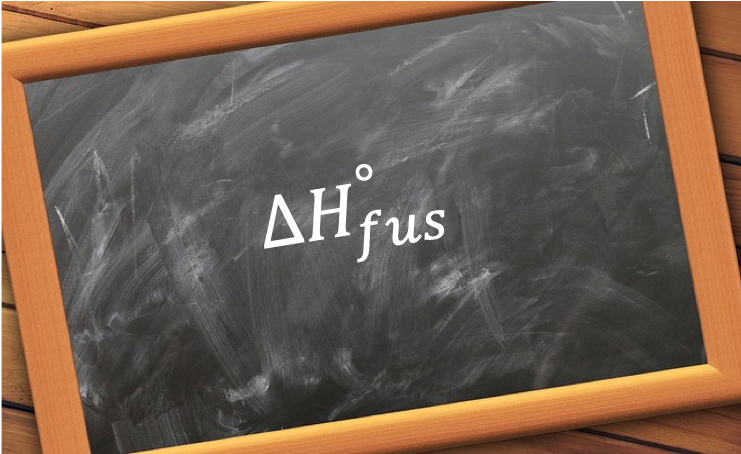
Even though ΔHvap o = 44.0 kJmol-1 is the standard enthalpy change of vaporisation of water at 298.15 K, many data sets of the standard enthalpy change of vaporisation of substances are quoted at the boiling points of those substances. In general, the standard enthalpy change of vaporisation of a substance is higher than the standard enthalpy change of fusion of that substance since molecules are separated further apart from one another from the liquid state to the gaseous state (more energy required) compared to the separation from the solid state to the liquid state. The standard enthalpy change of condensation of a substance, ΔHcon o, is the negative value of the standard enthalpy change of vaporisation of that substance.


Next article: Standard enthalpy change of fusion
Previous article: Standard enthalpy change of formation
Content page of intermediate chemical energetics
Content page of intermediate chemistry
Main content page

Standard enthalpy change of combustion

The standard enthalpy change of combustion ΔHc o is the change in enthalpy when one mole of a substance, in its most stable form, is burnt in excess oxygen under standard conditions.

Combustion reactions are always exothermic, e.g.

CH_4(g)+2O_2(g)\rightarrow CO_2(g)+2H_2O(l)\; \; \; \; \; \; \; \; \Delta H_c^{\: o}-890.4\: kJmol^{-1}

2Fe(s)+\frac{3}{2}O_2(g)\rightarrow Fe_2O_3(s)\; \; \; \; \; \; \; \; \Delta H_c^{\: o}-824.0\: kJmol^{-1}

The standard enthalpy change of combustion of iron is also the standard enthalpy change of formation of iron (III) oxide and the standard enthalpy change of reaction between iron and oxygen to give iron (III) oxide.

Next article: Standard enthalpy change of neutralisation
Previous article: Standard enthalpy change of sublimation
Content page of intermediate chemical energetics
Content page of intermediate chemistry
Main content page

Standard enthalpy change of atomisation

The standard enthalpy change of atomisation, ΔHat o, is the change in enthalpy when one mole of atoms in the gaseous state is formed from the most stable form of its element under standard conditions.

The atomisation process is always endothermic. Some examples are:

C(graphite)\rightarrow C(g)\; \; \; \; \; \; \; \Delta H_{at}^{\: o}=717\: kJmol^{-1}

\frac{1}{2}O_2(g)\rightarrow O(g)\; \; \; \; \; \; \; \Delta H_{at}^{\: o}=249\: kJmol^{-1}

The standard enthalpy of atomisation of an atom is the same as the standard enthalpy of formation of that atom and the standard enthalpy of the reaction to form that atom. The standard enthalpy of atomisation of a species that exist as a homonuclear diatomic molecule under standard conditions, e.g. O2, is also the bond enthalpy of that species. So,

\Delta H_{at}^{\: o}[O]=\Delta H_{be}[O=O]=249\: kJmol^{-1}


Next article: Standard enthalpy change of ionisation
Previous article: Standard enthalpy change of neutralisation
Content page of intermediate chemical energetics
Content page of intermediate chemistry
Main content page

Standard enthalpy change of ionisation

The standard enthalpy change of ionisation, ΔHiono, is the change in enthalpy for removing one mole of electrons from one mole of atoms or ions in the gaseous state under standard conditions.

When one mole of electrons is removed from atoms to form one mole of monovalent cations, the change in enthalpy is called the first ionisation enthalpy, e.g.

Na(g)\rightarrow Na^+(g)+e^-\; \; \; \; \; \; \; \Delta H_{ion}^{\: o}=502.2\: kJmol^{-1}

When one mole of electrons is removed from monovalent cations to form one mole of divalent cations, the change in enthalpy is called the second ionisation enthalpy, e.g.

Mg^+(g)\rightarrow Mg^{2+}(g)+e^-\; \; \; \; \; \; \; \Delta H_{ion}^{\: o}=1457.2\: kJmol^{-1}

The standard enthalpy change of ionisation of a substance is calculated from the substance’s ionisation energy (the two are not the same, as ionisation energy is defined at absolute zero). Ionisation energies are determined experimentally using photoelectron spectroscopy (PES), where the known energy of an incident photon on an atom equals to the atom’s first ionisation energy plus the measured kinetic energy of the ionised electron. These ionisation energies are then converted to ionisation energies at absolute zero before converting to standard enthalpies of ionisation, with both conversions using Kirchhoff’s law.


Question

Does the standard enthalpy of ionisation apply to anions?

Answer

Yes, e.g.

Cl^-(g)\rightarrow Cl(g)+e^-\; \; \; \; \; \; \; \Delta H_{ion}^{\: o}=355.2\: kJmol^{-1}\; \; \; \; \; \; 3


Next article: Standard enthalpy change of electron gain
Previous article: Standard enthalpy change of atomisation
Content page of intermediate chemical energetics
Content page of intermediate chemistry
Main content page

Standard enthalpy change of electron gain

The standard enthalpy change of electron gain, ΔHego, is the change in enthalpy when one mole of electrons is attached to atoms or anions in the gaseous state to form one mole of anions under standard conditions.
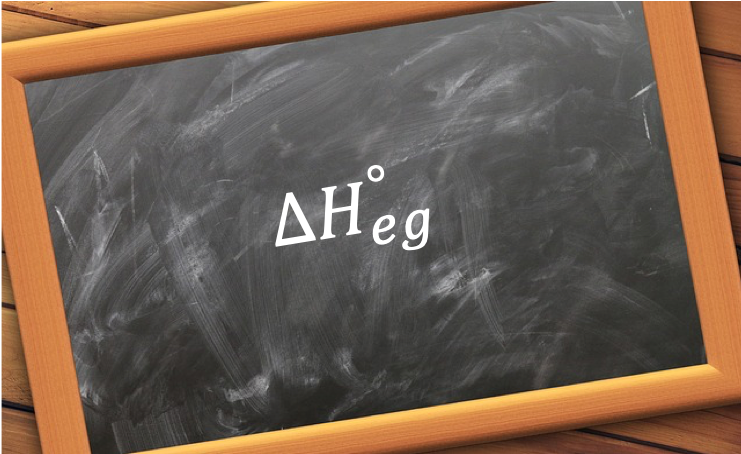
When one mole of electrons is attached to atoms to form one mole of monovalent anions, the change in enthalpy is called the first electron gain enthalpy, e.g.

Cl(g)+e^-\rightarrow Cl^-(g)\; \; \; \; \; \; \; \Delta H_{eg}^{\: o}=-355.2\: kJmol^{-1}

When one mole of electrons is attached to monovalent anions to form one mole of divalent anions, the change in enthalpy is called the second electron gain enthalpy, e.g.

O^-(g)+e^-\rightarrow O^{2-}(g)\; \; \; \; \; \; \; \Delta H_{eg}^{\: o}=837.8\: kJmol^{-1}

The standard enthalpy change of electron gain of a substance is calculated from the substance’s electron affinity (the two are not the same, as electron affinity is defined at absolute zero) using Kirchhoff’s law, or from the relationship:

\Delta H_{eg}^{\: o}\left [ X^n \right ]=-\Delta H_{ion}^{\: o}\left [ X^{n-1} \right ]\; \; \; \; \; \; 4

which states that the standard enthalpy change of electron gain of a species is the negative of the standard enthalpy change of ionisation of that species with an additional electron attached, e.g.

\Delta H_{eg}^{\: o}\left [ Cl(g) \right ]=-\Delta H_{ion}^{\: o}\left [Cl^-(g) \right ]\; \; \; \; \; \; 5

Substituting eq3 from the previous section in eq5,

\Delta H_{eg}^{\: o}\left [ Cl(g) \right ]=-355.2\: kJmol^{-1}

Electron affinities are determined experimentally using photoelectron spectroscopy (PES) where the known energy of an incident photon on an anion equals to the atom’s electron affinity plus the measured kinetic energy of the ionised electron. These electron affinities are then converted to electron affinities at absolute zero, which are then converted to standard enthalpies of electron gain, with both conversions using Kirchhoff’s law. It is easier to measure ionisation energies than electron affinities and therefore standard enthalpies of electron gain of substances are usually calculated using eq4.
 

Next article: Standard enthalpy change of hydration
Previous article: Standard enthalpy change of ionisation
Content page of intermediate chemical energetics
Content page of intermediate chemistry
Main content page

Standard enthalpy change of hydration

The standard enthalpy change of hydration, ΔHhydo, is the change in enthalpy when one mole of an ion (or molecule) in the gaseous state dissolves in water to form an infinitely dilute solution under standard conditions. This means that we need to dissolve the solute in excess water until there is no change in the energy absorbed or released by the system.

Some examples are:

Zn^{2+}(g)\rightarrow Zn^{2+}(aq)\; \; \; \; \; \; \; \Delta H_{hyd}^{\: o}=-2046\: kJmol^{-1}

ClO_4^-(g)\rightarrow ClO_4^-(aq)\; \; \; \; \; \; \; \Delta H_{hyd}^{\: o}=-238\: kJmol^{-1}

The standard enthalpy of hydration is usually exothermic (negative) and becomes more negative for ions with with higher charge-to-radius ratios and for molecules with greater polarity.


Next article: Standard enthalpy change of solution
Previous article: Standard enthalpy change of electron gain
Content page of intermediate chemical energetics
Content page of intermediate chemistry
Main content page

Standard enthalpy change of solution

The standard enthalpy change of solution, ΔHsolo, is the change in enthalpy when one mole of a solute dissolves in a solvent to form an infinitely dilute solution under standard conditions. This means that we need to dissolve the solute in excess solvent until there is no change in the energy absorbed or released by the system.

Some examples are:

KOH(s)\rightarrow KOH(aq)\; \; \; \; \; \; \; \Delta H_{sol}^{\: o}=-57.6\: kJmol^{-1}

HCl(g)\rightarrow HCl(aq)\; \; \; \; \; \; \; \Delta H_{sol}^{\: o}=-74.8\: kJmol^{-1}

Since KOH(aq) and HCl(aq) are fully dissociated in water, we can also write the above equation as:

KOH(s)\rightarrow K^+(aq)+OH^-(aq)\; \; \; \; \; \; \; \Delta H_{sol}^{\: o}=-57.6\: kJmol^{-1}

HCl(g)\rightarrow H^+(aq)+Cl^-(aq)\; \; \; \; \; \; \; \Delta H_{sol}^{\: o}=-74.8\: kJmol^{-1}

ΔHsolo can be positive or negative. Compounds with large positive ΔHsolo are relatively insoluble.

Question

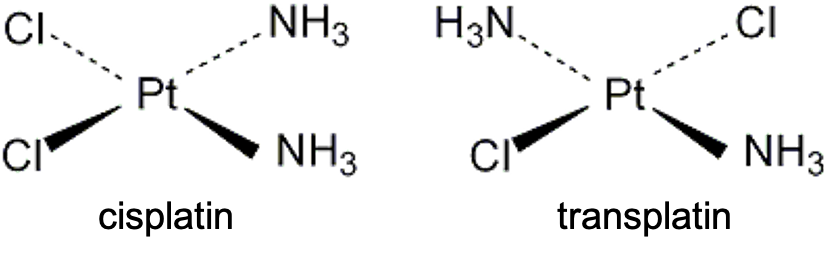
With reference to the diagram above showing the molecular structures of cisplatin (a chemotherapy drug) and transplatin, deduce which has a less positive standard enthalpy change of solution (in water), and hence, is more soluble in water.

Answer

According to Hess’s law,

where and are the standard enthalpy changes of sublimation and hydration respectively.

Both cisplatin and transplatin have square-planar molecule geometry. In the cis configuration, the two chloride ligands are adjacent to each other, and the two ammonia ligands occupy the remaining adjacent positions. Because Cl and NH3 have different electronegativities, their bond dipole moments do not cancel. This creates a polar molecule with a significant net electric dipole moment. In the trans configuration, identical ligands are positioned 180° apart. The bond dipoles of the two Pt–Cl bonds cancel each other, as do those of the two Pt–NH₃ bonds, resulting in a non-polar molecule with a net electric dipole moment of zero. Since water is a polar solvent, it interacts much more favourably with polar molecules. The stronger dipole–dipole interactions between water and gaseous cisplatin result in a more exothermic (more negative) standard enthalpy change of hydration than for transplatin.

In the solid phase, transplatin molecules are more symmetrical and can pack more efficiently into the crystal lattice. This more efficient packing increases intermolecular attractions in the solid, so the standard enthalpy change of sublimation of transplatin is expected to be more positive than that of cisplatin.

Combining the two terms, cisplatin has a more negative and a less positive . Therefore, its standard enthalpy change of solution is less positive than that of transplatin, consistent with cisplatin being more soluble in water.


Next article: Standard enthalpy change of lattice energy
Previous article: Standard enthalpy change of hydration
Content page of intermediate chemical energetics
Content page of intermediate chemistry
Main content page

Standard enthalpy change of neutralisation

The standard enthalpy change of neutralisation, ΔHn o, is the change in enthalpy when one mole of water is formed from an acid reacting with an alkali, both in their most stable forms, under standard conditions.

For example,

\frac{1}{2}H_2SO_4(aq)+NaOH(aq)\rightarrow \frac{1}{2}Na_2SO_4(aq)+H_2O(l)\; \; \; \Delta H_n^{\: o}=-57.1\: kJmol^{-1}

or in the ionic form,

H^+(aq)+OH^-(aq)\rightarrow H_2O(l)\; \; \; \; \; \; \Delta H_n^{\: o}=-57.1\: kJmol^{-1}

Since acids and alkalis, by definition, are in the aqueous state, their most stable form is the aqueous form. The standard enthalpy change of neutralisation in the above example is also the standard enthalpy change of reaction between sulphuric acid and sodium hydroxide to give sodium sulphate and water, i.e., ΔHn o =ΔHr o.


Question

Is the standard enthalpy change of neutralisation, H+(aq) + OH(aq)  H2O(l), the same as the standard enthalpy change of formation of water?

Answer

No. The definition of the standard enthalpy change of formation of water requires the reactants to be in their standard states, i.e., H2(g) and O2(g).


Next article: Standard enthalpy change of atomisation
Previous article: Standard enthalpy change of combustion
Content page of intermediate chemical energetics
Content page of intermediate chemistry
Main content page

Standard enthalpy change of lattice energy

The standard enthalpy change of lattice energy, ΔHlatto, is the change in enthalpy for breaking the bonds in one mole of a solid ionic compound and separating its gaseous ions to an infinite distance under standard conditions.

Since a large amount of energy is required to carry out the process, the standard enthalpy change of lattice energy of a compound is always positive (endothermic), e.g.

KCl(s)\rightarrow K^+(g)+Cl^-(g)\; \; \; \; \; \; \; \Delta H_{latt}^{\: o}=717\: kJmol^{-1}

However, it may be defined as the change in enthalpy when one mole of an ionic solid is formed from its gaseous ions that are initially infinitely apart under standard conditions. If so, it will always be a negative value (exothermic).

The magnitude of the standard enthalpy change of lattice energy increases for ions with higher charge densities, leading to stronger electrostatic forces of attraction between them in the ionic lattice. Hence,

The standard enthalpy change of lattice energy of an ionic compound is determined theoretically using a Born-Haber cycle, as it is very hard to measure it precisely through experiments.


Next article: Other Standard enthalpy changes
Previous article: Standard enthalpy change of solution
Content page of intermediate chemical energetics
Content page of intermediate chemistry
Main content page

Other standard enthalpy changes

There are possibly as many standard enthalpy changes as there are types of reactions. Some common ones other than those mentioned in previous articles include:

    1. Standard enthalpy of hydrating an anhydrous salt (not to be confused with standard enthalpy of hydration), e.g.

CuSO_4(s)+5H_2O(l)\rightarrow CuSO_4\cdot 5H_2O(s)\; \; \; \; \; \; \; \Delta H_{hydt}^{\: o}=-78.2\: kJmol^{-1}

    1. Standard enthalpy of precipitation, e.g.

AgNO_3(aq)+NaCl(aq)\rightarrow AgCl(s)+NaNO_3(aq)\; \; \; \; \; \Delta H_{ppt}^{\: o}=-65.8\; kJmol^{-1}

Question

Calculate the enthalpy of precipitation of PbBr2 when 150.0 mL of 0.500 M Pb(NO3)2 is added to 80.0 mL of 1.000 M NaBr in a calorimeter with the temperature rising from 298.15 K to 299.28 K (assuming that the solution’s specific heat capacity is 4.200 Jg-1K-1 and its density is 1.0 g/ml).

Answer

0.0800 moles of NaBr precipitates 0.0400 moles of PbBr2. Using eq5 from a basic level article,

\Delta H_{ppt}=-(4.200)(150.0+80.0)(299.28-298.15)=-1092\: J

\Delta H_{ppt}=\frac{-1092}{0.0400}=-27.3\: kJmol^{-1}


Next article: Hess’s law
Previous article: Standard enthalpy change of lattice energy
Content page of intermediate chemical energetics
Content page of intermediate chemistry
Main content page
Mono Quiz