Larmor precession is the change in orientation of the axis of the magnetic moment of a particle with respect to the axis of an external magnetic field.
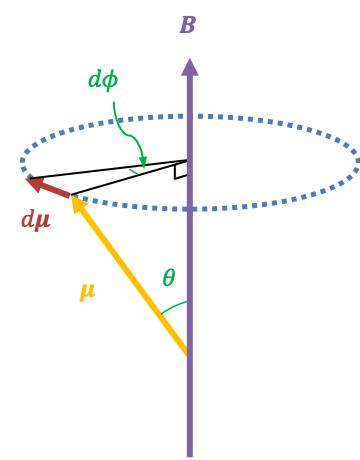
Consider an electron at rest with intrinsic spin angular momentum of in a uniform magnetic field
directed along the
-axis. The electron’s spin gives rise to a magnetic dipole moment
, which is antiparallel to
. As a result, the magnetic field interacts with the electron’s magnetic moment and generates a torque
(see diagram below).
Eq61 becomes , where
is the gyromagnetic ratio of the electron. Taking the derivative on both sides of this equation with respect to
,
From eq64 and eq71, we have , whose spin analogue is
. So,

Question
Explain in detail why precesses around
.
Answer
Since , the torque arises from the interaction between the magnetic dipole moment and the external magnetic field causes the spin angular momentum to change in time. Because this torque is perpendicular to the magnetic field direction (taken as the
-axis), it has no component along that axis. Consequently, the projection
of the spin angular momentum onto the field direction remains constant. The only way for
to change in time while maintaining a constant projection along the
-axis is for it to precess about the direction of the magnetic field.
With reference to the above diagram, the change in arc length with respect to is
. Hence,
where is the period,
is the mass of an electron and
is the Larmor frequency, which is defined as a positive value.
Note that the Larmor frequency is sometimes defined as , which is then
.
Next article: Biot-Savart law
Previous article: the vector model of quantum angular momentum
Content page of quantum mechanics
Content page of advanced chemistry
Main content page