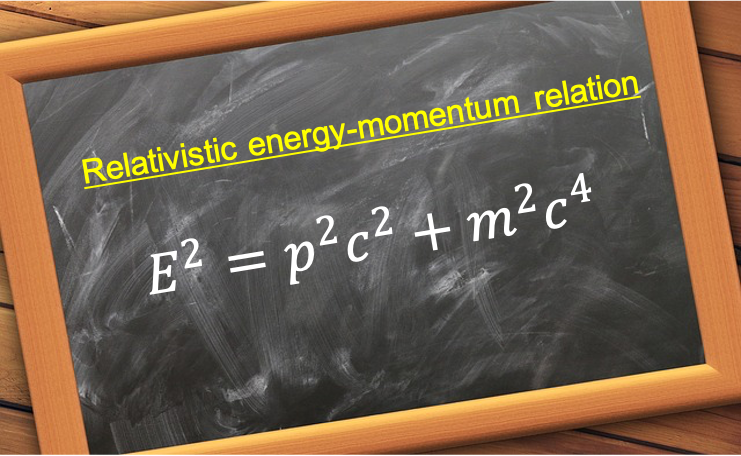
The relativistic energy–momentum relation describes how an object’s total energy is determined by both its momentum (motion through space) and its invariant mass (rest mass).
To derive the relation, consider the relativistic definition of momentum in terms of proper time,
where is the rest mass and
is the proper time measured by a clock moving with the object.
According to time dilation, , where
. Since the object’s velocity in the observer’s frame is
, we have
. Therefore,
From the definition of work, , or equivalently,
, since
and
. Differentiating eq254a throughout yields

Question
Show that and
.
Answer
Therefore, . Also,
Substituting and
into
results in
, or its integrated form
where is a constant.
To satisfy Einstein’s mass-energy equivalence relation , where
is the rest mass, eq254b must give
when
. Since
at
, this requires
. Thus, eq254b becomes
From eq254a, . Substracting this from the square of eq254c gives
Since ,
Therefore,
This is the relativistic energy–momentum relation.
Interestngly, has two solutions. The negative-energy solution seems problematic because ordinary particles are expected to have positive energy. However, it cannot consistently be discarded. This eventually led Paul Dirac to interpret the negative solution as corresponding to antiparticles.
Question
Explain why a particle with non-zero rest mass cannot reach or exceed the speed of light.
Answer
From , we have
as
. Since kinetic energy
is defined as the energy the particle has in excess of its rest energy,
It follows that the kinetic energy required to accelerate a particle with non-zero rest mass to the speed of light becomes infinite. Therefore, a particle with even an arbitrarily small but non-zero rest mass cannot reach or exceed the speed of light.
A photon, however, has zero rest mass, so this argument does not apply to it; in special relativity, a massless particle must travel at the invariant speed .