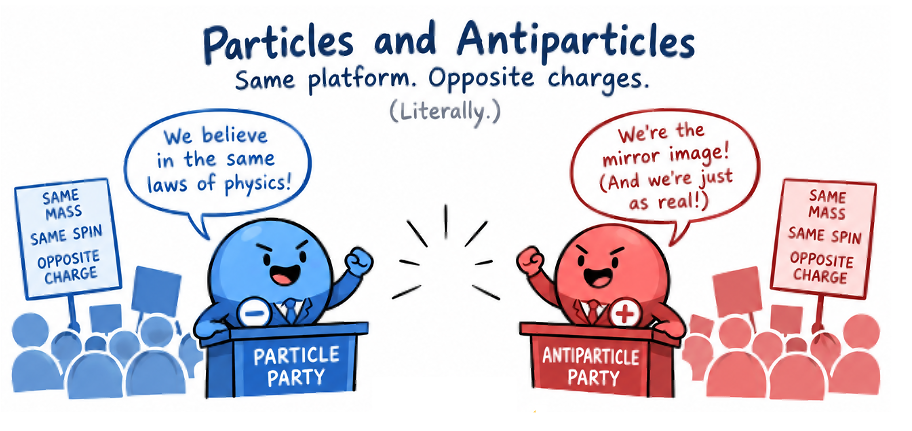
Particles are constituents of matter and energy, while antiparticles are their corresponding counterparts with the same mass and spin but opposite values of certain physical properties, such as electric charge.
The concept of antiparticles emerged from the development of relativistic quantum mechanics. In special relativity, the energy–momentum relation for a particle of mass is
, which gives two possible solutions:
For an ordinary particle, the positive-energy solution is physically intuitive: transitions to higher positive-energy states require the particle, such as an electron, to absorb energy from an external source. The negative-energy solution, however, posed a serious conceptual problem. Transitions to lower negative-energy states would instead be energetically favourable and could occur spontaneously, with the excess energy emitted as radiation. Moreover, the electron could continue transitioning to increasingly negative-energy states, releasing ever greater amounts of energy at each step. Since there would be no ground state for the electron to occupy, this process could, in principle, lead to an infinite and catastrophic release of radiation, making ordinary matter fundamentally unstable.
In 1930, the British physicist Paul Dirac sought to solve this problem by proposing that a vacuum is not truly empty. He imagined that all available negative-energy states in the vacuum were already occupied by electrons, forming what became known as the Dirac sea, while the positive-energy states were completely empty (see diagram below). Just as deep-sea fish experience the crushing, uniform and isotropic pressure of the surrounding water as their baseline environment, Dirac proposed that the sea of negative-energy electrons was similarly uniform, to the extent that we could regard it as the zero-energy state, . Hence, any electron added to the vaccum could not simply fall into a negative-energy state because of the Pauli exclusion principle. It would instead occupy a positive-energy state, consistent with ordinary observations.
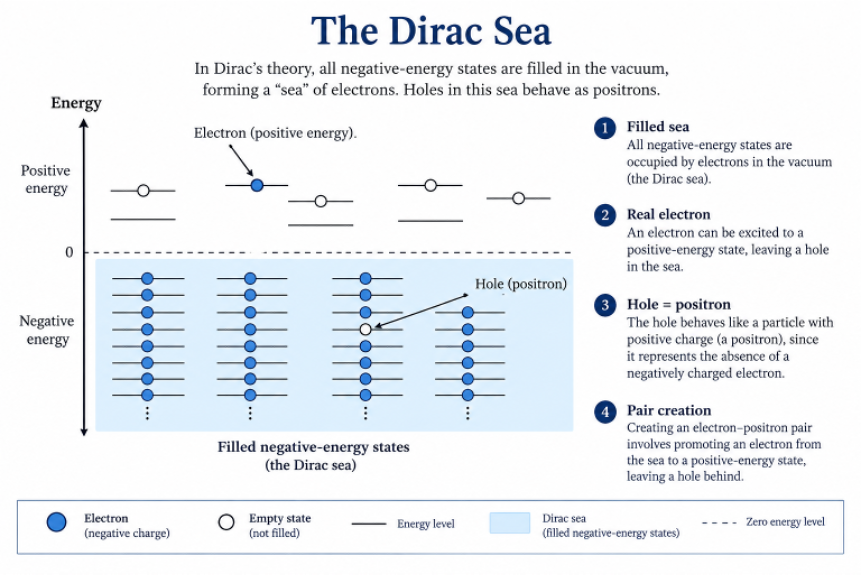
Furthermore, if one of the electrons in this sea, with energy , where
, were removed, the resulting hole would carry the opposite charge of the missing electron and have positive energy relative to the filled Dirac sea:
. Such a hole would behave as a particle with the same mass and spin as an electron but with the opposite electric charge. Dirac therefore interpreted the hole as a positively charged counterpart of the electron: the anti-electron, or positron. This gives the negative-energy solutions of the relativistic energy–momentum relation a physical interpretation.

Question
If the baseline energy of the Dirac sea is defined as zero, shouldn’t all electrons in the sea have zero energy?
Answer
Although the sea as a whole is defined to have zero-energy, each electron in the sea does not lose its identity; that is, each sea electron still occupies a specific negative-energy state.
Imagine that your bank account has exactly negative one million dollars. You decide to redefine your financial baseline starting right now. You reset your mental accounting app so that this exact state is treated as your “zero point” (baseline = 0). Even though you call your current state “zero,” the actual debt making up that balance has not disappeared. If you remove a single one-dollar debt () from that pile, your total debt decreases. Relative to your newly defined baseline, your account balance shifts towards the positive side:
.
The hypothesis also suggested a mechanism for producing particle–antiparticle pairs. If sufficient energy were supplied to the vacuum, an electron could be promoted from a negative-energy state into a positive-energy state, leaving a hole behind in the Dirac sea and, hence, generating an electron and a positron simultaneously.
However, Dirac’s conjecture had a flaw: it implied an infinite amount of energy in the vacuum. The Dirac sea concept was eventually superseded by quantum field theory, in which the vacuum is permeated by quantum fields. According to the Heisenberg Uncertainty Principle, a quantum field in a vacuum cannot simultaneously have both an exactly zero field value and an exactly zero conjugate momentum. As a result, a vacuum field unavoidably exhibits tiny quantum fluctuations. These fluctuations are sometimes described heuristically as particles appearing and disappearing randomly for extremely short periods of time. However, real particles require stable excitations of a field and therefore a definite enery source to be produced. Their formation is triggered by physical processes that supply energy to the field, such as particle collisions in accelerators or the decay of an unstable nucleus.
Nevertheless, Dirac’s prediction was particularly significant because no such particle had been observed at the time. The existence of a positively charged particle with the same mass as the electron was confirmed in 1932 by the American physicist Carl Anderson. In his experiments, he exposed a cloud chamber, filled with supersaturated water vapour, to naturally occurring high-energy radiation from deep space, known as cosmic rays (see diagram below). As charged cosmic-ray particles passed through the chamber, they ionised the gas along their paths, leaving visible particle tracks that curved under the influence of a magnetic field.
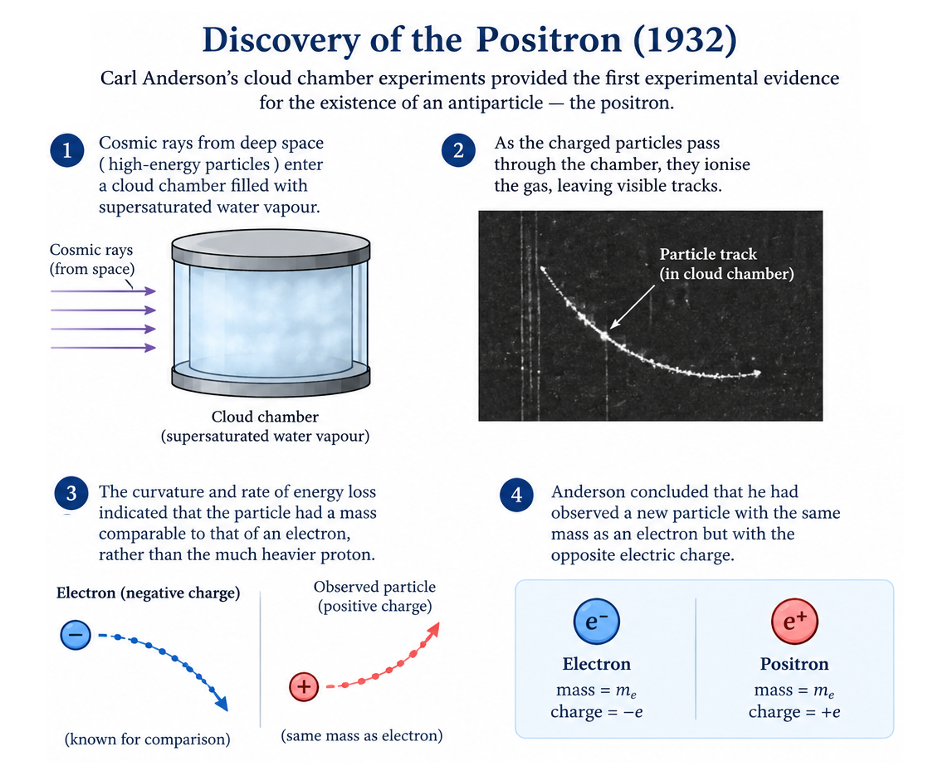
Anderson observed tracks that curved in the direction expected for positively charged particles. However, their curvature and rate of energy loss indicated that these particles had a mass comparable to that of an electron, rather than that of the much heavier proton. He therefore concluded that he had observed a new particle with the same mass as an electron but with the opposite electric charge. This particle was subsequently identified as the positron, providing the first experimental evidence for antiparticles and confirming one of the most remarkable predictions arising from Dirac’s theory.
The electron is not the only particle with an antiparticle. Many particles have corresponding antiparticles with the same mass and spin but opposite additive quantum numbers. For example, the antiparticle of a quark is an antiquark, while the proton and neutron have corresponding antiparticles known as the antiproton and antineutron. Some particles, such as the photon, are their own antiparticles because they have no relevant distinguishing additive quantum numbers.
Particles and antiparticles interact in a distinctive process known as annihilation. When a particle encounters its corresponding antiparticle, they can be converted into other particles while conserving quantities such as energy, momentum and electric charge. For example, an electron and a positron can annihilate to produce photons. This process illustrates the equivalence of mass and energy described by Einstein’s relation.
The reverse process, known as pair production, can also occur as predicted by Dirac. Under suitable conditions, sufficient energy can be converted into a particle and its corresponding antiparticle. Pair production and annihilation demonstrate the close relationship between matter and energy and are important processes in high-energy particle physics.
Together, particles and antiparticles form an essential part of the modern description of the physical universe. The prediction and subsequent discovery of the positron demonstrated that antimatter could arise naturally from the laws of relativistic quantum mechanics. Since then, the study of antiparticles has become an important part of particle physics, providing insight into the fundamental structure of matter and the interactions that govern the universe.