A Lie group is a group that has the structure of a smooth manifold, meaning its elements vary continuously and smoothly, allowing calculus to be performed them.
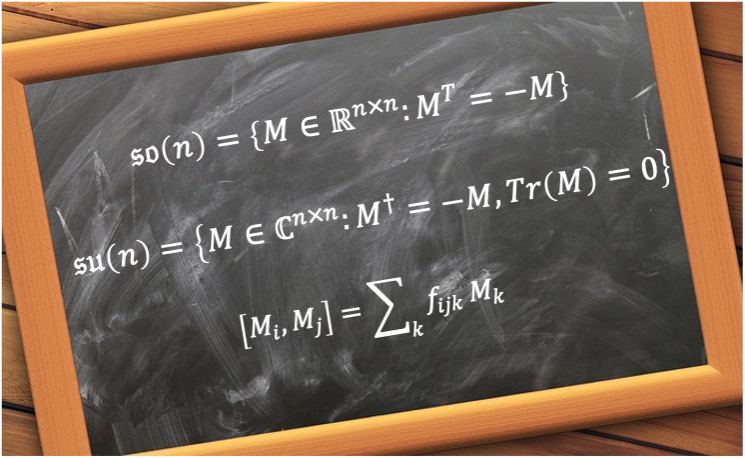
It is named after the Norwegian mathematician Sophus Lie, who developed the theory in the late 19th century. All SO(n) and SU(n) groups are Lie groups.
But what exactly is a manifold? It is a set of points describing a topological space that locally resembles Euclidean space . For example, a line is a one-dimensional manifold because every sufficiently small neighbourhood is indistinguishable from an interval in
(see diagram below). Similarly, a circle is a collection of coordinates that satisfy the rule in which it closes back on itself globally, while every sufficiently small arc is locally indistinguishable from a straight line.
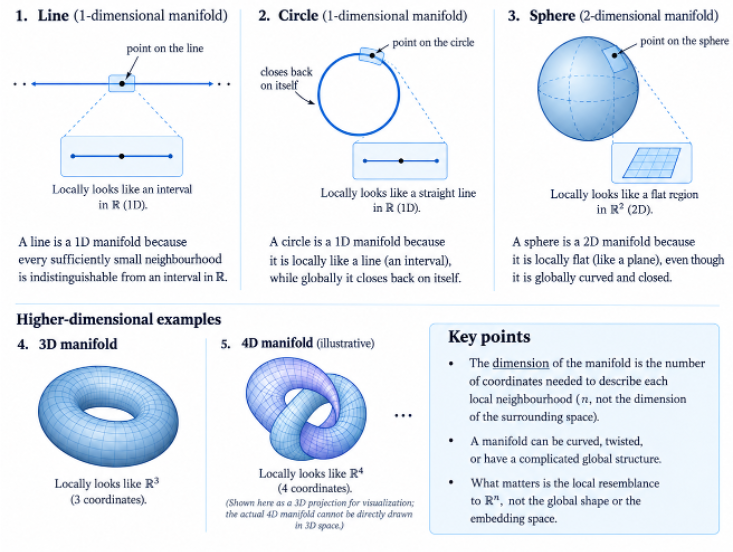
A hollow sphere provides a two-dimensional example. Although the surface of a sphere is globally curved and closed, a sufficiently small patch of its surface looks flat, like a region of . This is exactly how we experience the Earth: because our perspective is limited to a small patch, the ground behaves locally like a two-dimensional flat plane, even though the planet is embedded in three-dimensional space.
This idea extends naturally to higher dimensions. A three-dimensional manifold is a space in which every point has a neighbourhood that resembles ; a four-dimensional manifold locally resembles
, and so on. In general, an
-dimensional manifold can be curved, twisted, or have a complicated global structure, while still appearing locally like ordinary
-dimensional Euclidean space. What matters is not the dimension of the surrounding space, but the number of coordinates needed to describe each local neighbourhood.

Question
Why is every sufficiently small neighbourhood of the sphere and the torus (donut-shaped object) a region of and
respectively? Why is the small neighbourhood of the twisted object labelled “4D manifold” not a region of
, but of
?
Answer
The hollow sphere in the diagram is an inifinitesimally thin surface, while every small neighbourhood of the solid torus is a three-dimensional volume. The 4D object in the diagram is just a visual projection, as it cannot be depicted in a 3D space.
SO(n)
SO(n) is the special orthogonal group of degree , consisting of all orthogonal matrices with determinant 1. An example is SO(2), which consists of all
proper rotation matrices. A finite rotation by an angle
about the origin is represented by
, where
, corresponds to a set of matrices that forms the defining representation of SO(2). Each rotation matrix can be viewed as a point in the SO(2) space, with all the points continuously parameterised by a single angle
. As
varies, the set of rotation matrices forms a space with the topology of a circle. Since every sufficiently small neighbourhood on this circle is locally indistinguishable from an interval in
, SO(2), which is characterised by these set of points, is a one-dimensional manifold.
Calculus can be performed on because its matrix elements
and
are smooth functions of
. For example,
can be differentiated with respect to
:
Furthermore, composing two rotations corresponds to matrix multiplication, , showing that the group operation is also smooth. A smooth group operation means that if the rotation angles are changed by small amounts
, the resulting rotation also changes smoothly by the corresponding amount
. These properties make SO(2) a Lie group.
One important consequence of a Lie group’s continuous structure is that finite transformations can be constructed by exponentiating infinitesimal generators , e.g.
, where
. To elaborate on this, consider an infinitesimal rotation
about the origin described by:
Applying the first-order Taylor expansions and
yields
Substituting and
into the above equation, where
is a large positive integer, gives
A rotation by an angle applied sequentially
times is equivalent to a single rotation by an angle
. Therefore,
Taking the limit as ,
This limit defines the matrix exponential function (see this article for details). So,
To see explicitly how truly generates the matrix representation
, consider the Taylor series of the matrix exponential:
Noting that , with
and
,
In other words, , as part of the exponential function, generates the representation
.
If we multiply by a scalar
, so that
, the same Taylor series argument results in
, where
. Therefore,
is the general form of the infinitesimal generator of the matrix representation
.
Expressing as a function of time, with
, gives
where is the angular velocity.
As mentioned earlier, the SO(2) group is a one-dimensional manifold with the shape of a circle. A point on this manifold can represented by . As
varies,
traces out a curve on the manifold. The derivative of this curve with respect to time gives a tangent vector to the manifold at each point.
If we regard as a curve in the vector space of
matrices, then the identity matrix corresponds to the point on the curve at
because
. Therefore, the derivative of
with respect to time at the identity is
It follows that this derivative, which is the general form of the infinitesimal generator, is a tangent vector to SO(2) at the identity. Since can take any real value, the set of all possible tangent vectors at the identity is
. Importantly, this set forms a vector space. For example, its elements are closed under addition:
and scalar multiplication:
The significance of this is that although SO(2) is a nonlinear, curved manifold, its tangent space at the identity is a flat vector space that can be studied using linear algebra. This provides a linear approximation to the Lie group near the identity. We say that the tangent space, denoted by , is the Lie algebra associated with SO(2).
Regarding the SO(n) group in general, if we assume that represents any smooth curve through the identity, where
, then
is a tangent vector to SO(n) at the identity. Since the elements of SO(n) are orthogonal matrices,
. Differentiating
with respect to time gives
Substituting and
into the above equation yields the definition of a skew-symmetric matrix:
It follows that every tangent vector at the identity of SO(n) is a skew-symmetric matrix. Therefore, the tangent space at the identity, which is the Lie algebra , is given by
Let’s define , which satisfies
. Then,
and
. Since every skew-symmetric matrix has zero trace,
, where we have used the identity
(see property 15 of this article for the proof). Thus,
.
Now, SO(n-1) is a subgroup of SO(n) such that if the matrices and the identity
are elements of SO(n-1), then an element of SO(n) can be expressed generally as
. So, if
where
, then an element of SO(n) is given by
where (see this article for details) is skew-symmetric because each
is skew-symmetric.
Rewriting using the SO(2) infinitesimal generator
, where
and
, gives
, and hence,
Since we have already established that ,
Hence, is an infinitesimal generator of SO(n). For example, the infinitesimal generator
generates the SO(3) element
which describes rotations in the -plane.
SU(n)
In the case of the special unitary group SU(n) of degree, the elements are unitary matrices satisfying
and
. It follows that
, where
is a Hermitian matrix. By convention,
is defined as an infinitesimal generator of SU(n).
Differentiating with respect to time gives
Evaluating at using
and
, where
, yields the definition of a skew-Hermitian matrix:
Thus, every tangent vector at the identity of SU(n) is skew-Hermitian. Using the identity (see property 15 of this article for the proof),
Since every SU(n) matrix must satisfy , we require
for all
, which implies that
, or equivalently,
. Therefore, the tangent space at the identity, which is the Lie algebra
, is
As consists of vectors in the inner product space
, we can use the Gram-Schmidt process to orthogonalise the collection of matrices such that:
where is a scaling constant.
Question
Show that the commutator is an element of
.
Answer
For to be an element of
, it must satisfy
and
. In terms of the skew-Hermitian property,
where we have used the identities and
(see property 13 of this article for the proof).
Since , we have
. Using the identity
(see property 14 of this article for the proof),
Therefore, is an element of
.
Since , which is also known as a Lie bracket, is an element of
, we can express it as a linear combination of
:
where the coefficients are known as the structure constants.
Substituting into the commutator gives
Multiplying both sides by and taking the trace yields
Substituting and
into
results in
. Thus,
Multiplying both sides by and replacing the indices
with
gives
Swapping the first two indices results in
Swapping the last two indices yields
Using the cyclic identity (see property 14 of this article for the proof) gives
Since , it is totally antisymmetric under the permutation of any pair of its indices. If any two indices of the structure constant are equal, such as
, swapping the two a’s gives
, which is only possible if
. Therefore,
becomes
We shall now explain how the structure constant is related to the Levi-Civita symbol , where
Consider the Taylor series (see this article for derivation)
If we regard as a moving particle on the curved manifold of the Lie group, its velocity vector at any time
is found by taking the derivative. At
, the first-order approximation gives
Since ,
represents the tangent vector, or instantaneous direction of motion, of the path as it leaves the identity. For example,
may represent one tangent direction in the SU(n) manifold, while
represents another. Because the number of independent variables in
describes the particle’s degrees of freedom on the manifold, the number of independent
, and hence the number of independent
, must correspond to the number of independent variables in
.
In the case of SU(2), an element can be written as: . Although
initially contains four real variables because
and
, the condition
gives
, or equivalently,
It follows that the number of independent variables in is given by
for SU(n). For SU(2), the constraint leaves three independent variables (or three degrees of freedom), corresponding to three independent
. Therefore, the indices in
can only take the values in the set
. Because
is totally antisymmetric, its value is determined by a single ordered triplet with all indices distinct, such as
. Any other permutation of these indices will either gives
, changes its sign, or yields a vanishing structure constant. Therefore,
To evaluate , consider an SU(2) rotation by an angle
described by the operator
, where
, and
are the Pauli matrices:
If and
, we have
. Using
, setting
and comparing
with
gives
. Since
and
, then
. Hence, the matrices
, which are Hermitian and traceless, are infinitesimal generators of SU(2).
Substituting and
into eq125 yields
Since , the scaling constant is
, giving
Substituting back into eq126 results in
. Now,
So, . Substituting this back into
gives
From eq128, . Therefore,
and eq127 becomes
. Finally substituting this back into eq126a yields
This is the defining condition of the infinitesimal generators of SU(2) and is also the iconic commutation relation for angular momentum and spin operators in quantum mechanics.
For SU(3), the number of independent variables in increases to
. Consequently, the indices
now range from 1 to 8. While the structure constants
remain totally antisymmetric, they can no longer be represented by a single Levi-Civita symbol. To analyse these structure constants, we refer to the set of SU(3) generators
, where
are the Gell-Mann matrices (see this article for details):
Since the Gell-Mann matrices are chosen to satisfy ,
Therefore, the scaling constant remains , and so
. The first three Gell-Mann matrices
contain Pauli matrices embedded in the their upper-left block. Evaluating the commutator for these matrices yields
. Substituting this and
into eq128a gives
Repeating the analysis for other permutations results in
Any permutation of the indices of the above structure constants changes the sign according to the parity of the permutation, such as and
. All other combinations of indices that cannot be permutated into the sets above, and do not have distinct elements across these families, automatically vanish. Using eq125a, the general commutation relation defining the SU(3) generators is: