Dirac bra-ket notation

The Dirac bra-ket notation is a concise way to represent objects in a complex vector space \mathbb{C}^{n}.

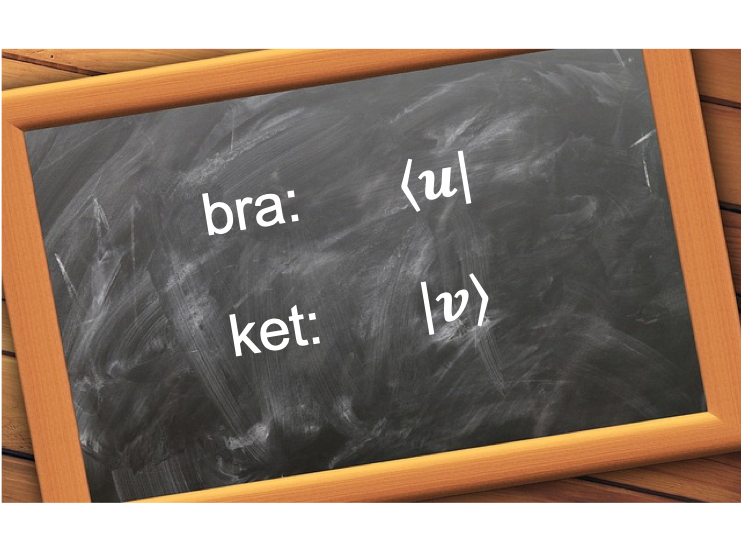
A ket, denoted by \vert \textbf{v} \rangle, is a vector \textbf{v}. Since a linear operator \hat{O} maps a vector to another vector, we have \hat{O}\vert \boldsymbol{v_{1}}\rangle=\vert \boldsymbol{v_{2}} \rangle.

A bra, denoted by \langle\boldsymbol{u}\vert , is often associated with a ket in the form of an inner product, denoted by \langle\boldsymbol{u}\vert\boldsymbol{v}\rangle. If a ket is expressed as a column vector, the corresponding bra is the conjugate transpose of its ket, i.e. \langle\boldsymbol{u}\vert=\vert\boldsymbol{u}\rangle^{\dagger}. The inner product can therefore be written as the following matrix multiplication:

or in the case of functions:

\langle\boldsymbol{u}\vert\boldsymbol{v}\rangle=\int_{-\infty}^{\infty}f_{u}^{*}(x)f_{v}(x)dx

Since a linear operator acting on a ket is another ket, we can express an inner product as:

\langle\phi_{i}\vert\phi_{k}\rangle=\langle\phi_{i}\vert\hat{O}\vert\phi_{j}\rangle=\int \phi_{i}^{*}\hat{O}\phi_{j}d\tau

where \hat{O}\vert\phi_{j}\rangle=\vert\phi_{k}\rangle.

If i=j, then \langle\phi\vert\hat{O}\vert\phi\rangle is the expectation value (or average value) of the operator \hat{O}.

As mentioned above, bras and kets can be represented by matrices. Therefore, the multiplication of a bra and a ket that involves a linear operator is associative, e.g.:

\langle\boldsymbol{u}\vert(\hat{O}\vert\boldsymbol{v}\rangle)=(\langle\boldsymbol{u}\vert\hat{O})\vert\boldsymbol{v}\rangle\equiv\langle\boldsymbol{u}\vert\hat{O}\vert\boldsymbol{v}\rangle

(\vert\boldsymbol{u}\rangle\langle\boldsymbol{v}\vert)\vert\boldsymbol{w}\rangle=\vert\boldsymbol{u}\rangle(\langle\boldsymbol{v}\vert\boldsymbol{w}\rangle)

(\hat{O}\vert\boldsymbol{u}\rangle)\langle\boldsymbol{v}\vert=\hat{O}(\vert\boldsymbol{u}\rangle\langle\boldsymbol{v}\vert)\equiv\hat{O}\vert\boldsymbol{u}\rangle\langle\boldsymbol{v}\vert

You can verify the above examples using a 2×2 matrix with complex elements to represent the operator acting on a vector in \mathbb{C}^{2}. The three examples reveal that:

    1. \hat{O}\vert\boldsymbol{v}\rangle produces another ket.
    2. \langle\boldsymbol{u}\vert\hat{O} results in another bra. This is because (\langle\boldsymbol{u}\vert\hat{O})\vert\boldsymbol{v}\rangle=\langle\boldsymbol{u}\vert(\hat{O}\vert\boldsymbol{v}\rangle)=\langle\boldsymbol{u}\vert\boldsymbol{v'}\rangle=c, where c is a scalar; and if (\langle\boldsymbol{u}\vert\hat{O})\vert\boldsymbol{v}\rangle=c, the only possible identity of (\langle\boldsymbol{u}\vert\hat{O}) is a bra.
    3. \vert\boldsymbol{u}\rangle\langle\boldsymbol{v}\vert , which is called an outer product, is an operator because (\vert\boldsymbol{u}\rangle\langle\boldsymbol{v}\vert)\vert\boldsymbol{w}\rangle=\vert\boldsymbol{u}\rangle(\langle\boldsymbol{v}\vert\boldsymbol{w}\rangle)=c\vert\boldsymbol{u}\rangle, i.e. \vert\boldsymbol{u}\rangle\langle\boldsymbol{v}\vert maps the ket \vert\boldsymbol{w}\rangle to another ket c\vert\boldsymbol{u}\rangle. In other words, the operator \vert\boldsymbol{u}\rangle\langle\boldsymbol{v}\vert transforms the vector \vert\boldsymbol{w}\rangle in the direction of the vector \vert\boldsymbol{u}\rangle, i.e. \vert\boldsymbol{u}\rangle\langle\boldsymbol{v}\vert projects \vert\boldsymbol{w}\rangle onto \vert\boldsymbol{u}\rangle.
    4. The product of two linear operators is another linear operator: \hat{O}\hat{O'}=\hat{O}(\vert\boldsymbol{u}\rangle\langle\boldsymbol{v}\vert)=(\hat{O}\vert\boldsymbol{u}\rangle)\langle\boldsymbol{v}\vert=\vert\boldsymbol{u'}\rangle\langle\boldsymbol{v}\vert=\hat{O''}.

Next article: vector space
Previous article: stationary state
Content page of quantum mechanics
Content page of advanced chemistry
Main content page

Leave a Reply

Your email address will not be published. Required fields are marked *

Mono Quiz