Effect of concentration on equilibrium

What is the effect of concentration on equilibrium?

As mention in an earlier article, the equilibrium constant K of a reaction is:

K=e^{-\frac{\Delta_rG^o}{RT}}\; \; \; \; \; \; \; \; 17

Eq17 shows that the value of K for a particular reaction only varies with temperature and is independent of the concentration of reaction species. With that in mind, how does concentration affect the position of chemical equilibrium of a reaction? Consider the hydrolysis of ethyl ethanoate,

CH_3COOC_2H_5(l)+H_2O(l)\rightleftharpoons CH_3COOH(l)+C_2H_5OH(l)

The equilibrium constant for the reaction is

K=\frac{[CH_3COOH][C_2H_5OH]}{[CH_3COOC_2H_5][H_2O]}

When the reaction reaches dynamic equilibrium at a particular temperature, the ratio of the products and the reactants is a constant. If we increase the concentration of ethyl ethanoate at this stage, the excess ethyl ethanoate reacts with water to give more products to maintain the constant value of K, thereby reducing the concentration of ethyl ethanoate and shifting the position of the equilibrium to the right to attain a new dynamic equilibrium. This is consistent with Le Chatelier’s principle.

If we now increase the concentration of ethanoic acid or decrease the concentration of ethyl ethanoate, the position of the equilibrium will shift to the left to minimise the change, maintaining the same value of K.

We can also explain the above observation using chemical kinetics. At equilibrium, the rate of the forward reaction is equal to the rate of the reverse reaction. If we increase the concentration of ethyl ethanoate, the greater number of ethyl ethanoate molecules leads to a higher frequency of collisions between ethyl ethanoate and water molecules, which increases the rate of the forward reaction relative to the reverse reaction. As a result, the position of equilibrium shifts to the right to maintain the value of K.


Next article: Effect of pressure on equilibrium
Previous article: Le Chatelier’s principle
Content page of chemical equilibrium
Content page of intermediate chemistry
Main content page


Acid/base dissociation constant

An acid/base dissociation constant is a measure of the strength of an aqueous acid/base.

A weak acid dissociates partially in an aqueous solution to give the hydroxonium ion and a conjugate base.

HA(aq)+H_2O(l)\rightleftharpoons H_3O^+(aq)+A^-(aq)

Since water is the solvent, its activity approximately equals to one, and the equilibrium constant is given by:

K_a=\frac{\left [ H_3O^+ \right ][A^-]}{[HA]}\; \; \; \; \; \; \; \; 12

Ka is called the acid dissociation constant. The higher the value of Ka of an acid, the greater the extent of dissociation of the acid (i.e., the stronger the acid). It is difficult to determine accurately the Ka of an acid that completely ionises in water (a strong acid), since [HA] → 0. Hence, Ka is a useful measure only for weak acids.

A weak base dissociates partially in an aqueous solution to give a conjugate acid and the hydroxide ion.

B(aq)+H_2O(l)\rightleftharpoons BH^+(aq)+OH^-(aq)

Since water is the solvent, its activity approximately equals to one, and the equilibrium constant is given by:

K_b=\frac{[BH^+][OH^-]}{[B]}\; \; \; \; \; \; \; \; 13

Kb is called the base dissociation constant. The higher the value of Kb of a base, the greater the extent of dissociation of the base (i.e., the stronger the base). Similar to acids, it is difficult to determine accurately the Kb of a base that completely ionises in water (a strong base), since [B] → 0. Hence, Kb is a useful measure only for weak bases.

Note that BH+ is an acid with the following dissociation equilibrium:

BH^+(aq)+H_2O(l)\rightleftharpoons B(aq)+H_3O^+(aq)

K_a=\frac{[B][H_3O^+]}{[BH^+]}\; \; \; \; \; \; \; \; 14

Multiplying eq14 with eq13,

K_aK_b=[H_3O^+][OH^-]\; \; \; \; \; \; \; \; 15

Substituting eq11 from the previous article in eq15

K_aK_b=K_w\; \; \; \; \; \; \; \; 16

Eq16 expresses the relationship for all conjugate acid-base pairs.


Question

Given that Ka for HCN is 6.2×10⁻¹⁰ at 25oC, calculate the equilibrium constant for

CN^-(aq)+H_2O(l)\rightleftharpoons HCN(aq)+OH^-(aq)

Answer

K_b=\frac{K_w}{K_a}=\frac{10^{-14}}{6.2\times 10^{-10}}=1.6\times 10^{-5}


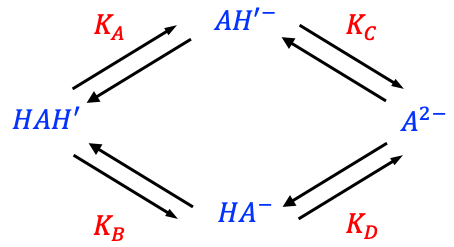
Consider a diprotic acid with the ionisation pathways shown in the diagram above, where

The equilibrium constant for the overall process is , which is the product of the microscopic equilibrium constants along either pathway.

The equilibrium constant for the 1st ionisation of the acid is:

Similarly, the equilibrium constant for the 2nd ionisation of the acid is:

Since ,

In general, because the diprotic acid becomes negatively charged after the first ionisation, which electrostatically inhibits the second ionisation. Eq16 indicates that the pH at the first titration inflection point depends on both  and . Similarly, eq17 shows that the pH at the second inflection point depends on both and . If , then


Question

Why is if ?

Answer

Since , we have . If , then .


Similarly, if , then

Under these conditions, the pH at each inflection point is effectively determined by a single acid dissociation constant, with both constants belonging to the same pathway.


Next article: Solubility product
Previous article: Ion-product constant for water
Content page of chemical equilibrium
Content page of intermediate chemistry
Main content page

Effect of pressure on equilibrium

What is the effect of pressure on equilibrium?

Similar to concentration, a change in pressure does not change the value of the equilibrium constant K. So how does pressure affect the position of chemical equilibrium of a reaction? Consider the following reaction:

2NO_2(g)\rightleftharpoons 2NO(g)+O_2(g)

The equilibrium constant for the reaction is

K=\frac{p_{NO}^{\; \; \; \; \; \; 2}p_{O_2}}{p_{NO_2}^{\; \; \; \; \; \; \; 2}}

where pi is the partial pressure of gas i.

We can also write the above equation as:

K=\frac{\left ( x_{NO}p \right )^2\left ( x_{O_2}p \right )}{\left ( x_{NO_2}p \right )^2}=\frac{x_{NO}^{\; \; \; \; \; \; 2}\, x_{O_2}\, p}{x_{NO_2}^{\; \; \; \; \; \; \; 2}}=\frac{\left (\frac{n_{NO}}{n} \right )^2\left ( \frac{n_{O_2}}{n} \right )p}{\left ( \frac{n_{NO_2}}{n}\right )^2} =\left ( \frac{n_{NO}^{\; \; \; \; \; \; 2}\, n_{O_2}}{n_{NO_2}^{\; \; \; \; \;\; \;\, 2}} \right )\frac{p}{n}\; \; \; \; \; \; \; \; 18

where xi is the mole fraction of gas i, p is the total pressure of the system, ni  is the number of moles of gas i, and n is the total number of moles of the gas mixture.

For ideal gases, we can substitute pV = nRT in eq18 to give:

K=\left ( \frac{n_{NO}^{\; \; \; \; \; \; 2}\, n_{O_2}}{n_{NO_2}^{\; \; \; \; \;\; \;\, 2}} \right )\frac{RT}{V}\; \; \; \; \; \; \; \; 19

If we increase the total pressure by decreasing the volume of the system at constant temperature, the denominator of the term in brackets in eq19 must increase to maintain the value of K (or the numerator of the term in brackets must decrease). The position of the equilibrium of the reaction therefore shifts left to increase the amount of nitrogen dioxide. This is consistent with Le Chatelier’s principle, where an increase in pressure shifts the position of the equilibrium from right (3 moles of gases) to left (2 moles of gases) to minimise the change in pressure.

It is important to note that changes in pressure only affects the position of an equilibrium where species are gases, as solids and liquids are relatively incompressible.


Question

Consider a fixed-volume reaction vessel with the following reaction at a state of equilibrium at constant temperature:

2NO_2(g)\rightleftharpoons 2NO(g)+O_2(g)

If we increase the pressure in the vessel by adding an inert gas (assuming that all gases in the vessel are ideal gases), will the composition of the gases change?

Answer

No, because the partial pressures of the gases remain the same even though the total pressure of the system has increased.

p_i=x_ip=\frac{n_i}{n}p=\frac{n_iRT}{V}

Since the factor of RT/V is a constant, pi does not change if ni remains the same.


Next article: Effect of temperature on equilibrium
Previous article: Effect of concentration on equilibrium
Content page of chemical equilibrium
Content page of intermediate chemistry
Main content page


Effect of temperature on equilibrium

What is the effect of temperature on equilibrium?

The change in temperature of a chemical reaction at equilibrium results in a shift in position of the equilibrium that opposes the temperature change. For example, the increase in temperature of an endothermic reaction encourages the reaction to occur because the increased energy is absorbed to facilitate the reaction, thereby lowering the temperature.

Quantitatively, the effect of temperature on a chemical reaction system is best explained using the van’t Hoff equation (see below for derivation):

\frac{dlnK}{d\frac{1}{T}}=-\frac{\Delta_rH^o}{R}\; \; \; \; \; \; \; \; 20

where ΔrHo is the enthalpy of a reaction at standard conditions, K is the equilibrium constant, T is the temperature of the system and R is the universal gas constant.

Eq20 can be rewritten as:

ln\left ( \frac{K_f}{K_i} \right )=-\frac{\Delta_rH^o }{R}\left ( \frac{1}{T_f}-\frac{1}{T_i} \right )\: \: \: \: \: \: \: \:\: 20a

where the subscripts f and i represent ‘final’ and ‘initial’ respectively.

Let’s consider an increase in T of an endothermic reaction (ΔrHo > 0). The RHS of eq20a under such conditions is positive, which means that Kf > Ki, i.e. the equilibrium constant increases with an increase in T for an endothermic reaction. Therefore, unlike concentration and pressure, temperature affects the value of K. Nevertheless, Le Chatelier’s principle still applies, as illustrated by the following example:

N_2(g)+O_x(g)\rightleftharpoons 2NO(g)\; \; \; \; \; \; \; \Delta_rH^o=+180\: kJmol^{-1}

K=\frac{p_{NO}^{\; \; \; \; \; \; 2}}{p_{N_2}\, p_{O_2}}\; \; \; \; \; \; \; \; 21

If K increases as a result of an increase in T, the numerator of eq21 must increase relative to the denominator. This means that the position of the equilibrium shifts to the right, which is consistent with the definition of Le Chatelier’s principle.

Using the same logic and eq20a, we can describe the effect of temperature on the position of an exothermic reaction’s equilibrium.

In summary,

T

K

Equilibrium position

Endothermic

  ↓

Exothermic

  ↓


Question

Derive the van’t Hoff equation.

Answer

Substituting the definition of the standard Gibbs energy of reaction ΔrGo = ΔrHorSo in the Gibbs energy equilibrium constant relation ΔrGo = –RTlnK, we have

lnK=-\frac{\Delta_r H^o}{RT}+\frac{\Delta_rS^o}{R}

If we assume that ΔrHo and ΔrSo are constant for a reaction over a range of temperature, the change of lnK with respect to the change in temperature is:

\frac{dlnK}{dT}=\frac{\Delta_r H^o}{RT^2}

This is the called the van’t Hoff equation, which can also be written as:

\frac{dlnK}{d\frac{1}{T}}=-\frac{\Delta_r H^o}{R}


Next article: Effect of catalysts on equilibra
Previous article: Effect of pressure on equilibrium
Content page of chemical equilibrium
Content page of intermediate chemistry
Main content page

Effect of catalysts on equilibria

Catalysts have no effect on either the equilibrium constant or the position of equilibrium of a reaction. A catalyst offers a separate pathway for a reaction to proceed with lower activation energy, Ea, and does not affect the energy levels of the reactants and products. As a result, a catalyst increases the rates of both the forward and reverse reactions by the same factor and allows a reaction to reach its dynamic equilibrium faster without affecting either the equilibrium constant or the position of equilibrium of the reaction.

Mathematically, let’s consider the following reversible reaction

A\; \begin{matrix} k_f\\\rightleftharpoons \\ k_r \end{matrix}\: B

where kf is the rate constant of the forward reaction and kr is that for the reverse reaction. In chemical kinetics, the rates of formation of B and A are:

rate_f=k_f[A]\; \; \; and\; \; \;rate_r=k_r[B]

At equilibrium, ratef = rater

k_f[A]=k_r[B]\; \; \; \; \; \; \; \; 22

Substituting the equilibrium constant, K = [B]/[A], in eq22 gives

K=\frac{k_f}{k_r}\; \; \; \; \; \; \; \; 23

Substituting the Arrhenius equation, where k=Ae^{-\frac{E_a}{RT}}, in eq23 yields

For a catalysed reaction in which the activation energy decreases by an amount, \left | \Delta E \right | ,

Assuming the ratio of the forward pre-exponential factor and the reverse pre-exponential factor for the uncatalysed reaction (Af/Ar) is the same as that for the catalysed one (Af,cat/Ar,cat), the equilibrium constant for an uncatalysed reaction, eq24, is the same as that for a catalysed one, eq25. This means that the catalytic pathway does not affect the value of the equilibrium constant. Furthermore, both the numerator and denominator of eq24 are unchanged despite a change in the activation energy in the catalysed reaction, which means that the position of equilibrium remains the same. Lastly, the forward rate of reaction, kf[A], and reverse rate of reaction, kr[B], increase by the same factor of e^{\frac{\left | \Delta E \right |}{RT}} for the catalysed reaction, allowing the reaction to achieve equilibrium faster.


Question

If a catalyst increases the rates of both the forward and reverse reactions of a reversible reaction, does it mean that we will not achieve a greater amount of products than an uncatalysed reaction (assuming we begin both the catalysed and uncatalysed reactions consisting of only the same amount of reactants under the same temperature and pressure, and that kf > kr for the uncatalysed reaction)?

Answer

Since a catalysed reaction does not alter either the equilibrium constant or the position of the equilibrium of the reaction, we will obtain the same amount of product as the uncatalysed reaction, but at a faster rate.


Next article: Clausius-Clapeyron Equation
Previous article: Effect of temperature on equilibrium
Content page of chemical equilibrium
Content page of intermediate chemistry
Main content page

Standard conditions (chemical energetics)

Standard conditions in chemical energetics provide a consistent reference framework that enables reliable comparison of thermodynamic properties and reaction feasibility across different chemical systems.

The value of the change in enthalpy of a reaction, ΔHr, depends on the following physical properties of reactants and products:

    1. Temperature
    2. Pressure or concentration
    3. State of matter

In other words, ΔHr for a reaction carried out, for example, at 298.15 K, is different from that at 373.15K.

To avoid confusion, thermodynamic calculations are often made using data derived under a specific set of conditions known as standard conditions, which are defined as:

    1. Temperature: 298.15K (data are sometimes derived at other temperatures)
    2. Pressure: 100 kPa or 1 bar
    3. Concentration: 1 M
    4. State of matter: Each substance is in its normal state (s, l or g) at 100 kPa and 298.15K. For example, the normal state of molecular oxygen at 100 kPa and 298.15K is O2 (g).

Thermodynamic properties, e.g. ΔHr, that are calculated using standard conditions data are given an additional symbol “oas a superscript to their current symbols, i.e. ΔHo. ΔHo is therefore the standard enthalpy change of reaction. If ΔHo is observed at a temperature other than 298.15K, the symbol ΔHo(T) will be used, where T is the temperature at which ΔHo is observed.


Question

The standard enthalpy change of the manufacture of ammonia via the Haber process, \frac{1}{2}N_2(g)+\frac{3}{2}H_2(g)\rightleftharpoons NH_3(g), is ΔHo = -46.1 kJmol-1. However, the process is too slow at 298.15 K and 1 bar. Instead, it takes place at around 720 K and 200 bar. How then is ΔHo obtained?

Answer

The enthalpy change of the reaction, ΔH, is first measured at the optimum conditions of 720 K and 200 bar and subsequently converted to ΔHo at 298.15 K and 1 bar using Kirchhoff’s law (the understanding of this law requires the knowledge of chemical thermodynamics at the advanced level).


The value of the standard enthalpy change of a reaction is quoted to match the stoichiometric coefficients of the written reaction equation. For example, if the equation for the Haber process is written as 2NH_3(g)\rightleftharpoons N_2(g)+3H_2(g), the quoted standard enthalpy change of reaction is:

2NH_3(g)\rightleftharpoons N_2(g)+3H_2(g)\; \; \; \; \; \; \; \; \Delta H=+92.2\: kJmol^{-1}


Question

Why is water always in the liquid state in combustion equations like CH_4(g)+2O_2(g)\rightarrow CO_2(g)+2H_2O(l) when it should be in vapour form considering the temperature of combustion?

Answer

Equations like the combustion of methane are usually written under standard conditions, i.e. with all reactants and products in their normal states at 100 kPa and 298.15K. Although it is not wrong to write the equation as CH_4(g)+2O_2(g)\rightarrow CO_2(g)+2H_2O(g), calculations are often carried out using thermodynamic properties that are quoted in standard conditions, which makes CH_4(g)+2O_2(g)\rightarrow CO_2(g)+2H_2O(l) more relevant.


Next article: Types of enthalpy changes
Content page of intermediate chemical energetics
Content page of intermediate chemistry
Main content page

Types of enthalpy changes (chemical energetics)

Types of enthalpy changes, including enthalpy of formation, enthalpy of combustion and enthalpy of reaction, play a vital role in thermodynamics by quantifying the heat absorbed or released during chemical processes.

ΔHo is a thermodynamic property that describes the standard enthalpy change of any reaction.

As reactions are classified into different categories (e.g. combustion, neutralisation and hydration), standard enthalpy changes are similarly categorised as:

    1. Standard enthalpy change of formation, ΔHf o
    2. Standard enthalpy change of vaporisation, ΔHvap o
    3. Standard enthalpy change of fusion, ΔHfus o
    4. Standard enthalpy change of sublimation, ΔHsub o
    5. Standard enthalpy change of combustion, ΔHco
    6. Standard enthalpy change of neutralisation, ΔHn o
    7. Standard enthalpy change of atomisation, ΔHat o
    8. Standard enthalpy change of ionisation, ΔHion o
    9. Standard enthalpy change of electron gain, ΔHeg o
    10. Standard enthalpy change of hydration, ΔHhyd o
    11. Standard enthalpy change of solution, ΔHsol o
    12. Standard enthalpy change of lattice energy, ΔHlatt o
    13. Other standard enthalpy changes


Next article: Standard enthalpy change of formation
Previous article: Standard conditions
Content page of intermediate chemical energetics
Content page of intermediate chemistry
Main content page

Standard enthalpy change of formation

The standard enthalpy change of formation, ΔHf o, is the change in enthalpy when one mole of a substance is formed from its elements in their reference states, which are the most stable forms of the respective elements at 100 kPa and 298.15K.

For example:

Element

Most stable form

Notes

Oxygen

O2 (g)

The oxygen radical, O, is unstable

Carbon

Graphite

Graphite is thermodynamically more stable than diamond since it has delocalised electrons

Mercury

Liquid mercury

Phosphorous

White phosphorous

Although not the most thermodynamically stable form, it is easier to isolate in its pure form than red and black phosphorous. This is the only exception.

Examples of standard enthalpy changes of formation are:

2C(graphite)+3H_2(g)+\frac{1}{2}O_2(g)\rightarrow C_2H_5OH(l)\; \; \; \; \; \; \Delta H_f^{\: o}=-1367\; kJmol^{-1}

Mg(s)+\frac{1}{2}O_2(g)\rightarrow MgO(s)\; \; \; \; \; \; \Delta H_f^{\: o}=-602\; kJmol^{-1}


Question

What is the standard enthalpy change of formation of O2?

Answer

The standard enthalpy change of formation of O2 is written as:

O_2(g)\rightarrow O_2(g)

since the standard enthalpy change of formation of a substance is defined as the enthalpy change when 1 mol of the substance is formed from the most stable form of its elements in their standard states. Therefore, the standard enthalpy change of formation of O2 is zero, because there is no change involved when O2(g) is formed from itself. Similarly, \Delta H_f^{\: o}\left [ C(graphite) \right ]=0, \Delta H_f^{\: o}\left [ H_2(g) \right ]=0 and \Delta H_f^{\: o}\left [ Mg(s) \right ]=0.


We can also say that the standard enthalpy change of formation of a substance ΔHf o is the standard enthalpy change of the reaction ΔHo that forms the substance. For example,

Mg(s)+\frac{1}{2}O_2(g)\rightarrow MgO(s)\; \; \; \; \; \; \Delta H_f^{\: o}=\Delta H_r^{\: o}=-602\: kJmol^{-1}


Question

For the reaction MgCO_3(s)\rightarrow MgO(s)+CO_2(g), show that

\Delta H_r^{\: o}=\sum \Delta H_f^{\: o}<div class="woocommerce columns-4 "><ul class="products columns-4">
<li class="product type-product post-9170 status-publish first instock product_cat-ebook has-post-thumbnail downloadable virtual taxable purchasable product-type-simple">
	<a href="https://monomole.com/product/science-around-the-house-discovering-the-hidden-science-in-daily-life/" class="woocommerce-LoopProduct-link woocommerce-loop-product__link"></a></li>
<li class="product type-product post-8651 status-publish instock product_cat-ebook has-post-thumbnail downloadable virtual taxable purchasable product-type-simple">
	<a href="https://monomole.com/product/the-mole-theories-behind-the-experiments-that-define-the-avogadro-constant/" class="woocommerce-LoopProduct-link woocommerce-loop-product__link"></a></li>
</ul>
</div>-\sum \Delta H_f^{\: o}[reactants]

Answer

As we know,

Mg(s)+\frac{1}{2}O_2(g)\rightarrow MgO(s)\; \; \; \; \; \; \Delta H_f^{\: o}[MgO]\; \; \; \; \; \; 1a

C(graphite)+O_2(g)\rightarrow CO_2(g)\; \; \; \; \; \; \Delta H_f^{\: o}[CO_2]\; \; \; \; \; \; 1b

Mg(s)+C(graphite)+\frac{3}{2}O_2(g)\rightarrow MgCO_3(s)\; \; \; \; \; \; \Delta H_f^{\: o}[MgCO_3]\; \; \; \; \; \; 1c

Reversing eq1c,

MgCO_3(s) \rightarrow Mg(s)+C(graphite)+\frac{3}{2}O_2(g)\; \; \; \; \; \; -\Delta H_f^{\: o}[MgCO_3]\; \; \; \; \; \; 1d

Taking the sum of eq1a, eq1b and eq1d, and simplifying,

Equation:\; MgCO_3(s)\rightarrow MgO(s)+CO_2(g)

Change\: in\: enthalpy:\:\Delta H_r^{\: o}=\Delta H_f^{\: o}[MgO]+\Delta H_f^{\: o}[CO_2]-\Delta H_f^{\: o}[MgCO_3]

Since \Delta H_f^{\: o}[MgO]+\Delta H_f^{\: o}[CO_2]=\sum \Delta H_f^{\: o}<div class="woocommerce columns-4 "><ul class="products columns-4">
<li class="product type-product post-9170 status-publish first instock product_cat-ebook has-post-thumbnail downloadable virtual taxable purchasable product-type-simple">
	<a href="https://monomole.com/product/science-around-the-house-discovering-the-hidden-science-in-daily-life/" class="woocommerce-LoopProduct-link woocommerce-loop-product__link"></a></li>
<li class="product type-product post-8651 status-publish instock product_cat-ebook has-post-thumbnail downloadable virtual taxable purchasable product-type-simple">
	<a href="https://monomole.com/product/the-mole-theories-behind-the-experiments-that-define-the-avogadro-constant/" class="woocommerce-LoopProduct-link woocommerce-loop-product__link"></a></li>
</ul>
</div> and \Delta H_f^{\: o}[MgCO_3]= \sum \Delta H_f^{\: o}[reactants],

\Delta H_r^{\: o}=\sum \Delta H_f^{\: o}<div class="woocommerce columns-4 "><ul class="products columns-4">
<li class="product type-product post-9170 status-publish first instock product_cat-ebook has-post-thumbnail downloadable virtual taxable purchasable product-type-simple">
	<a href="https://monomole.com/product/science-around-the-house-discovering-the-hidden-science-in-daily-life/" class="woocommerce-LoopProduct-link woocommerce-loop-product__link"></a></li>
<li class="product type-product post-8651 status-publish instock product_cat-ebook has-post-thumbnail downloadable virtual taxable purchasable product-type-simple">
	<a href="https://monomole.com/product/the-mole-theories-behind-the-experiments-that-define-the-avogadro-constant/" class="woocommerce-LoopProduct-link woocommerce-loop-product__link"></a></li>
</ul>
</div> -\sum \Delta H_f^{\: o}[reactants]\; \; \; \; \; \; \; 1e


Eq1e is a very useful formula and is a consequence of Hess’ law. In general, for a reaction involving multiple products and multiple reactants, the relationship between ΔHr o, ΔHf o[product] and ΔHf o[reactants] is given by eq6 from the article on Hess’ law:

\Delta H_r^{\: o}=\sum _Pv_P\left (\Delta H_f^{\: o}\right )_P-\sum _Rv_R\left (\Delta H_f^{\: o}\right )_R

where P denotes the number of products and R denotes the number of reactants. vP and vR are the stoichiometric coefficients of the products of the respective standard enthalpy of formation reactions.

An issue arises when we want to determine the standard enthalpy change of formation of aqueous ions, which are always formed as pairs of cations and anions, e.g.

KOH(s)\; \begin{matrix} H_2O\\\rightarrow \end{matrix}\; K^+(aq)+OH^-(aq)

This implies that it is impossible to have a solution consisting of pure cations or anions. The problem is circumvented by defining the standard enthalpy change of formation of the aqueous hydrogen ion as zero:

\Delta H_f^{\: o}\left [ H^+(aq) \right ]=0\; \; \; \; \; \; \; \; 2a

The consequence of this can be illustrated by considering the ion pair of H+(aq) and Br(aq) where:

\frac{1}{2}H_2(g)+\frac{1}{2}Br_2(g)\rightarrow HBr(g)\; \; \; \; \; \; \Delta H_f^{\: o}=-36\: kJmol^{-1}\; \; \; \; \; 2b

HBr(g)\rightarrow HBr(aq)\; \; \; \; \; \; \Delta H_r^{\: o}=-85\: kJmol^{-1}\; \; \; \; \; 2c

ΔHr o for the above reaction is also known as ΔHsol o, the standard enthalpy change of solution of HBr(g). Since HBr(aq) is fully dissociated to H+(aq) and Br(aq), we can also write eq2c as:

HBr(g)\rightarrow H^+(aq)+Br^-(aq)\; \; \; \; \; \; \Delta H_r^{\: o}=-85\: kJmol^{-1}\; \; \; \; \; 2d

Using eq1e on eq2d,

\Delta H_r^{\: o}=\Delta H_f^{\: o}\left [ H^+(aq) \right ]+\Delta H_f^{\: o}\left [ Br^-(aq) \right ]-\Delta H_f^{\: o}\left [ HBr(g) \right ]

-85=\Delta H_f^{\: o}\left [ H^+(aq) \right ]+\Delta H_f^{\: o}\left [ Br^-(aq) \right ]-(-36 )

Since \Delta H_f^{\: o}\left [ H^+(aq) \right ]=0

\Delta H_f^{\: o}\left [ Br^-(aq) \right ]=-121\: kJmol^{-1}

The standard enthalpy change in formation of other aqueous ions, e.g. Cl(aq), can be determined using the same approach. This results in all standard enthalpy changes in formation of aqueous ions being adjusted by the real value of \Delta H_f^{\: o}\left [ H^+(aq) \right ].


Next article: Standard enthalpy change of vaporisation
Previous article: Types of enthalpy changes
Content page of intermediate chemical energetics
Content page of intermediate chemistry
Main content page

Standard enthalpy change of fusion

The standard enthalpy change of fusion, ΔHfus o, is the change in enthalpy when one mole of a substance in the liquid state is formed from the same substance in its solid state under standard conditions.

The process of melting is always endothermic, e.g.

CH_4(s)\rightarrow CH_4(l)\; \; \; \; \; \; \; \Delta H_{fus}^{\: o}[91.1K]=943.8\: kJmol^{-1}

Most data for the standard enthalpy change of fusion of substances are quoted at the melting points of those substances instead of at 298.15 K. The standard enthalpy change of solidification of a substance, ΔHsolid o, is the negative value of the standard enthalpy change of fusion of that substance.


Next article: Standard enthalpy change of sublimation
Previous article: Standard enthalpy change of vaporisation
Content page of intermediate chemical energetics
Content page of intermediate chemistry
Main content page

Standard enthalpy change of sublimation

The standard enthalpy change of sublimation, ΔHsub o, is the change in enthalpy when one mole of a substance in the gaseous state is formed from the same substance in its solid state, without going through the liquid state, under standard conditions.

The process of sublimation is always endothermic, e.g.

CO_2(s)\rightarrow CO_2(g)\; \; \; \; \; \; \; \Delta H_{sub}^{\: o}=26.1\: kJmol^{-1}

The standard enthalpy change of sublimation is greater than that of vaporisation and hence greater than that of fusion. The standard enthalpy change of deposition of a substance, ΔHdep o, is the negative value of the standard enthalpy change of sublimation of that substance.


Next article: Standard enthalpy change of combustion
Previous article: Standard enthalpy change of fusion
Content page of intermediate chemical energetics
Content page of intermediate chemistry
Main content page
Mono Quiz